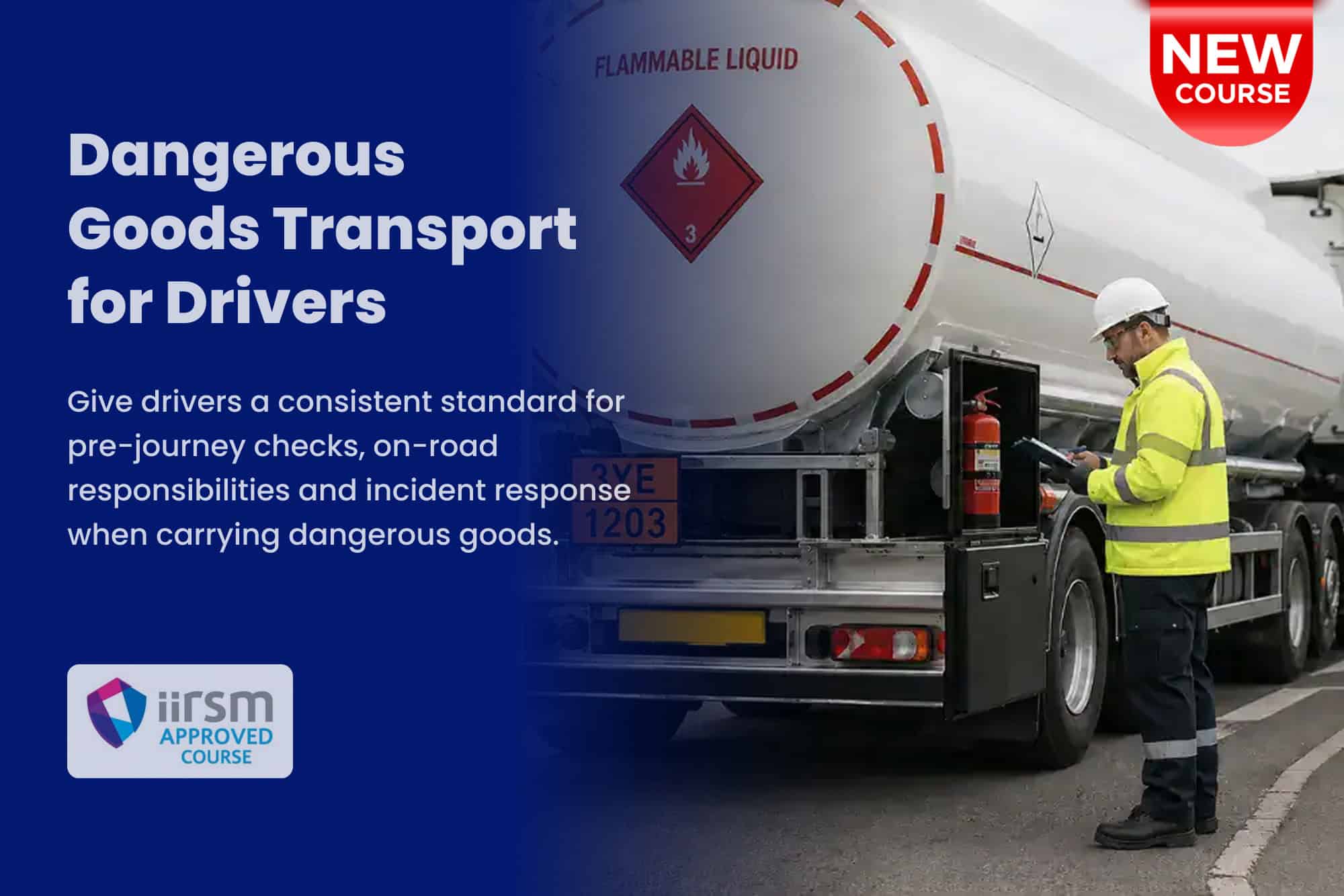
We are pleased to introduce our fully online course: Dangerous Goods Transport for Drivers.
This IIRSM-approved course is designed specifically for drivers carrying dangerous goods under small-load, limited-quantity or excepted-quantity conditions who do not require a full ADR vocational training certificate (VTC).
Current to ADR 2025, the course follows the driver’s work before, during and at the end of a journey. It covers dangerous goods identification, labels and markings, pre-journey checks, route planning, on-road responsibilities, security awareness, incident response and end-of-journey handover and reporting.
The training takes 50 minutes or more to complete and is fully online and self-paced. Learners complete an online assessment and receive a digital certificate on successful completion.
This course provides ADR Chapter 1.3 awareness and function-specific knowledge for the scenarios it covers. It does not replace a full ADR VTC where one is required, or the supervised practical experience and employer authorisation needed to carry out the role competently.
Not requiring a full ADR vocational certificate does not mean that all dangerous goods training duties disappear.
ADR Chapter 1.3 requires role-appropriate training before relevant duties are carried out. For drivers operating under the small-load, limited-quantity or excepted-quantity conditions covered by this course, that means understanding the requirements that still apply to their work and knowing when a different level of training or certification is needed.
The driver’s responsibilities begin before the vehicle moves. Checks can include the condition of the load, transport documentation, vehicle markings, required equipment and PPE. Drivers also need to recognise when damaged packages, missing information or incompatible goods require escalation before a journey begins.
During the journey, responsibilities can involve load monitoring, parking, route and tunnel restrictions and security awareness. ADR 1.10 also places requirements around security awareness.
Drivers must also know what to do if something goes wrong. The course covers the awareness-level response to incidents such as leaks, fires or collisions, including when to stop, keep away from the load, follow the relevant Instructions in Writing, contact the emergency services and report the incident afterwards.
This training helps organisations:
- Provide a consistent, driver-specific ADR 1.3 awareness and function-specific training baseline for the scenarios covered
- Reinforce pre-journey checks covering the load, documentation, equipment and vehicle markings
- Set clear expectations around on-road duties, including load monitoring, parking, route restrictions and security awareness
- Give drivers a structured approach to incident response and end-of-journey handover and reporting
- Keep ADR 2025 requirements, including current Written Instructions, visible within driver training arrangements
This course is for drivers carrying dangerous goods under small-load, limited-quantity or excepted-quantity conditions who do not require a full ADR VTC. Relevant roles include:
- Van and LGV drivers carrying dangerous goods
- Owner-drivers transporting dangerous goods
- Multi-drop and delivery drivers
- Trade-counter and field-service drivers
- Construction, waste, utilities and maintenance drivers
- Drivers requiring ADR Chapter 1.3 awareness and function-specific training
The course is not a substitute for the full ADR vocational certificate where one is required for the vehicle and load.
By completing this training, drivers will understand:
- What ADR is, its legal basis in the UK and the duties it places on drivers
- How to identify the nine hazard classes and recognise dangerous goods labels, placards and markings
- The checks required before a journey, including load condition, documentation and vehicle markings
- How tunnel restrictions and other route considerations can affect journey planning
- Their duties while driving, including load monitoring, parking and security awareness
- How to respond safely to an incident or emergency, including following the Instructions in Writing and contacting the emergency services
- How to complete end-of-journey handover and reporting correctly
- When to raise or refuse an unsafe or non-compliant load and seek guidance from a manager or Dangerous Goods Safety Adviser
Are drivers carrying dangerous goods under the small-load, limited-quantity or excepted-quantity conditions covered by this course receiving training that reflects their actual duties?
Enrol your drivers in the Dangerous Goods Transport for Drivers course to provide a consistent route through pre-journey checks, on-road responsibilities, incident response and end-of-journey reporting as part of your ADR Chapter 1.3 training arrangements.
Enrol Now
For more details about this course, please contact us.