Drivers carrying dangerous goods below the ADR threshold still have clear legal duties, even without a full ADR vocational certificate. This IIRSM-approved Dangerous Goods Transport for Drivers gives them the knowledge to understand the dangerous goods they carry, complete the checks required before a journey, follow their duties on the road and respond correctly if something goes wrong.
The fully self-paced online programme is built specifically for drivers working under small-load, limited-quantity or excepted-quantity conditions. Its driver-specific operational walk-through follows the work before, during and at the end of the journey, helping organisations provide a consistent approach to ADR 1.3 function-specific training.
This course is for drivers carrying dangerous goods under small-load, limited-quantity or excepted-quantity conditions who do not require a full ADR vocational certificate (VTC). It is suitable across logistics, transport and distribution; construction and civil engineering; waste management; utilities and facilities management; manufacturing; trade supply and builders’ merchants, including:
Van and LGV drivers carrying dangerous goods
Owner-drivers transporting dangerous goods
Multi-drop and delivery drivers
Trade-counter and field-service drivers
Construction, waste, utilities and maintenance drivers
Drivers requiring ADR Chapter 1.3 awareness and function-specific training
This is awareness under ADR 1.3 and is not a substitute for the full ADR vocational certificate when required.
Course Content
The Dangerous Goods Transport for Drivers course includes the following sections:
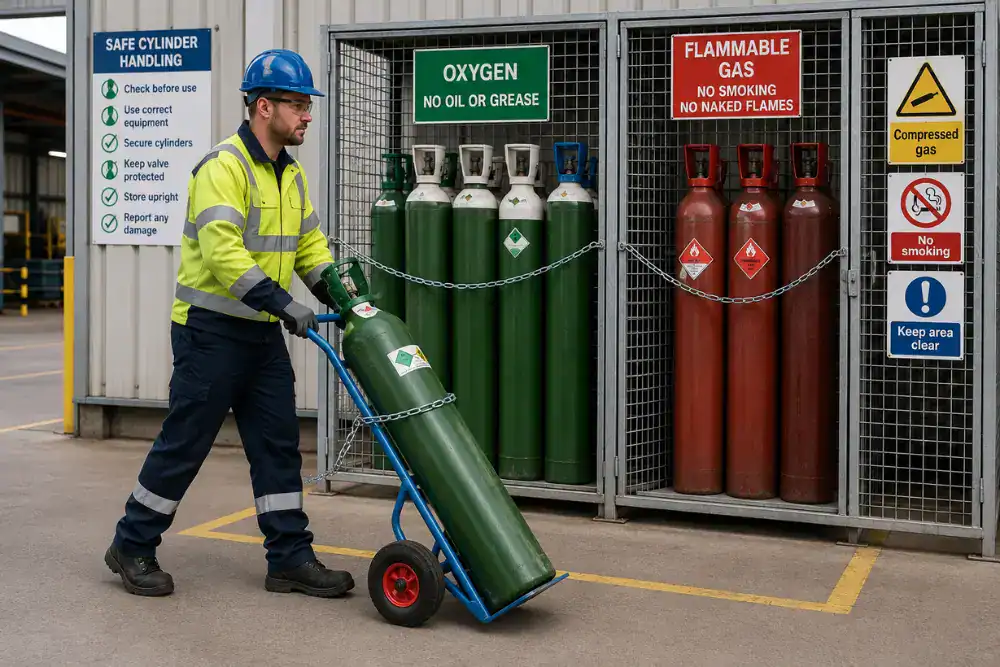
Recognise everyday products that can be dangerous goods, including fuels, gases, paints, batteries, cleaning chemicals and some medical or biological materials. Understand how transport, handling and changing conditions can affect the risks they present.
Understand what ADR is, how UK ADR requirements are implemented through the Carriage of Dangerous Goods and Use of Transportable Pressure Equipment Regulations (CDG), and the specific legal duties placed on drivers. Understand where a full ADR VTC is a separate requirement and when to involve a manager or DGSA.
Recognise the nine ADR hazard classes and the different types of risk they communicate, from explosives and gases to corrosive and miscellaneous dangerous goods.
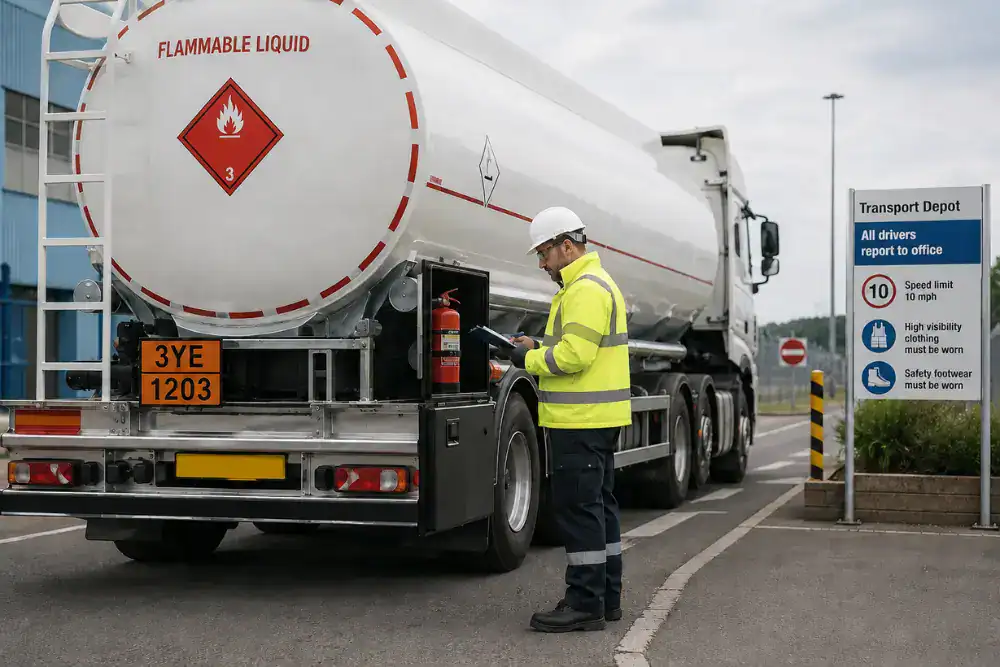
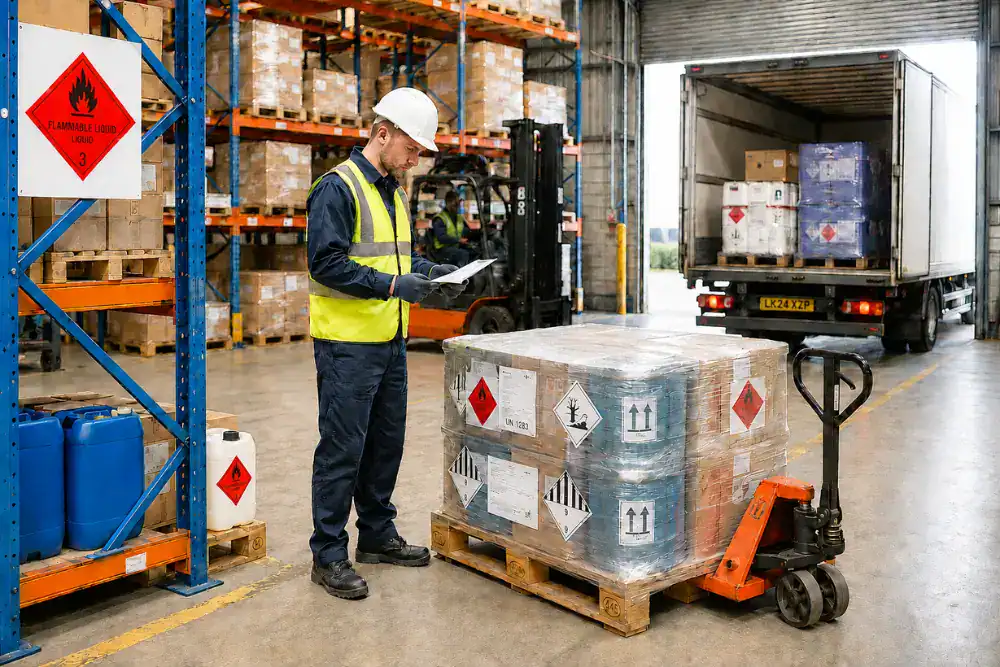
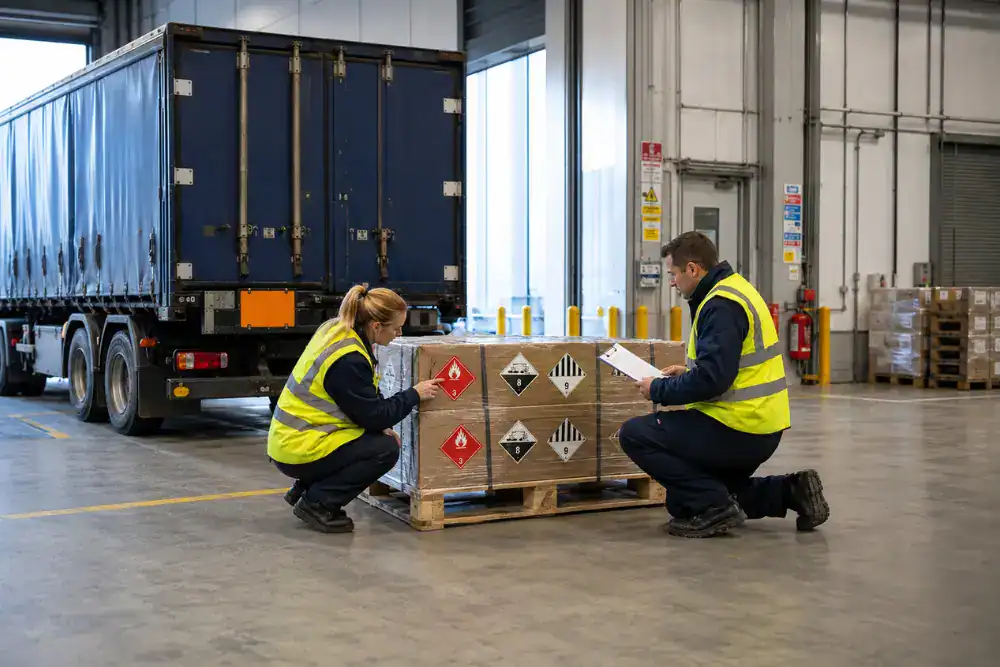
Identify the labels, placards and markings used in dangerous goods transport, including orange plates, limited-quantity marks and excepted-quantity marks. Understand what UN numbers, Hazard Identification Numbers and tunnel restriction codes communicate where they apply.
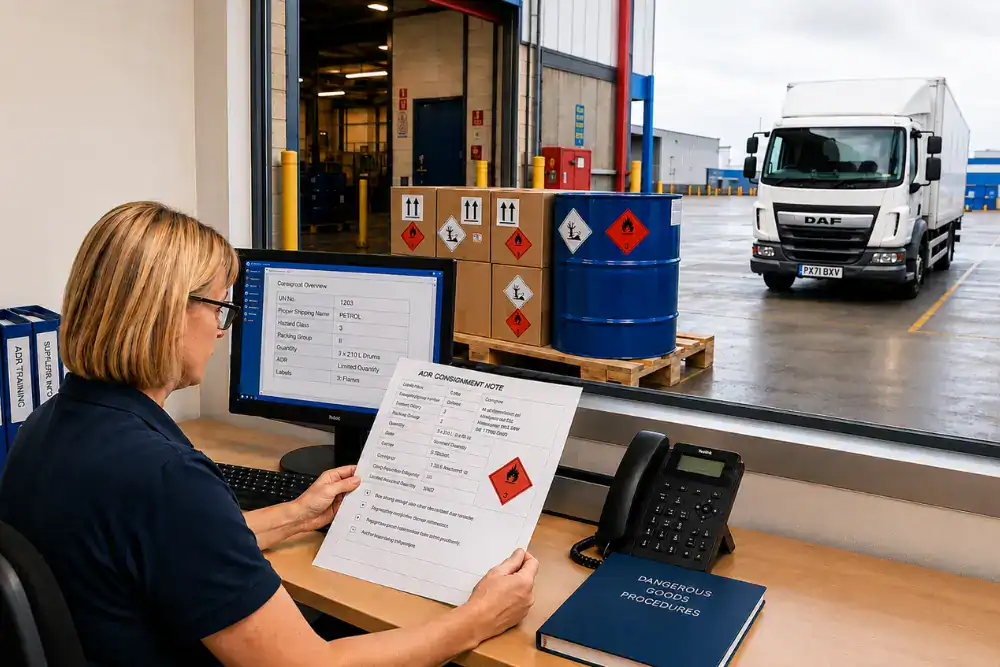
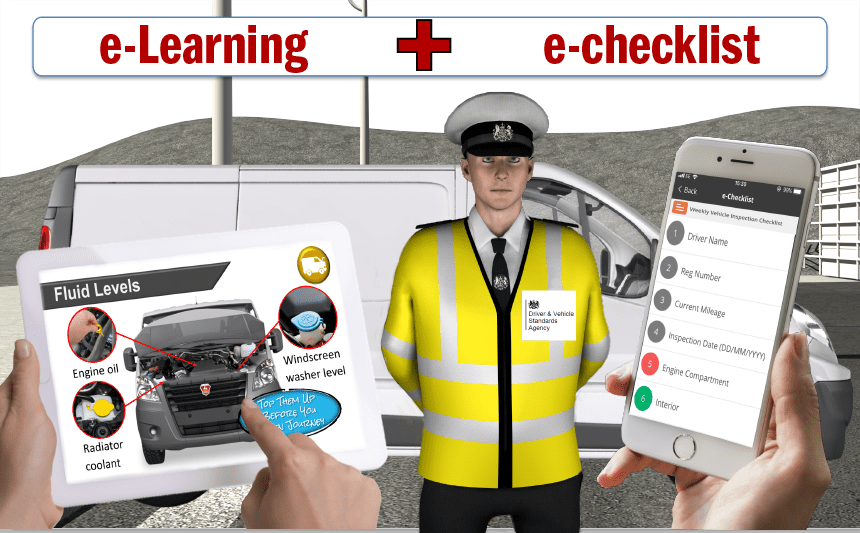
Complete the checks required before every journey, including load condition, documentation, vehicle markings, equipment and PPE. Check the transport document, delivery paperwork and Instructions in Writing where required, and know when damaged packages, missing information or incompatible goods must be escalated before setting off.
Check tunnel restriction codes and other route controls where they apply. Consider bridge, weight, width and local restrictions, environmentally sensitive areas and suitable stopping places before setting off.
Understand how driving, parking and route changes can affect the load. Reinforce the checks required at stops and delivery points, load monitoring, secure stopping and the security procedures relevant to the journey.
Follow an on-road leak scenario through the immediate response. Learn when to stop, switch off the engine, keep away from the load, assess from a safe distance and contact the emergency services. Understand what information to provide, what not to attempt and what must be reported afterwards.
Reinforce delivery, unloading, handover and reporting checks. Understand when markings should be removed, how to identify new damage or leakage and what information should be recorded at the end of the journey.
Understand which ADR requirements apply to your role based on what you are carrying, in what quantities and under what conditions. Know when to raise or refuse a non-compliant or unsafe load, report unsafe practices and speak to a manager or DGSA if you are unsure.
Disclaimer: This course provides guidance and knowledge of dangerous goods transport duties for drivers. Completing it does not by itself make a learner competent or qualified for any task or role — under UK law, competence combines training, knowledge, skills and experience, and confirming it is the employer’s responsibility. It provides underpinning knowledge only; competence to carry out driver duties under ADR also requires supervised practical experience and employer authorisation.
What Your Staff Will Learn
By completing this training, drivers will be able to:
Understand what ADR is, its legal basis in the UK, and the specific duties it places on drivers.
Identify the nine hazard classes and recognise the labels, placards and markings used in dangerous goods transport.
Complete the checks required before every journey — load condition, documentation and vehicle markings.
Understand duties while driving, including load monitoring, parking, tunnel restrictions and security awareness.
Recognise how to respond safely to an incident or emergency, including following the Instructions in Writing and contacting the emergency services.
Complete end-of-journey handover and reporting correctly.
Available in 20+ Languages
Course subtitles are available in multiple languages, including:
This course is approved by IIRSM – the International Institute of Risk & Safety Management.
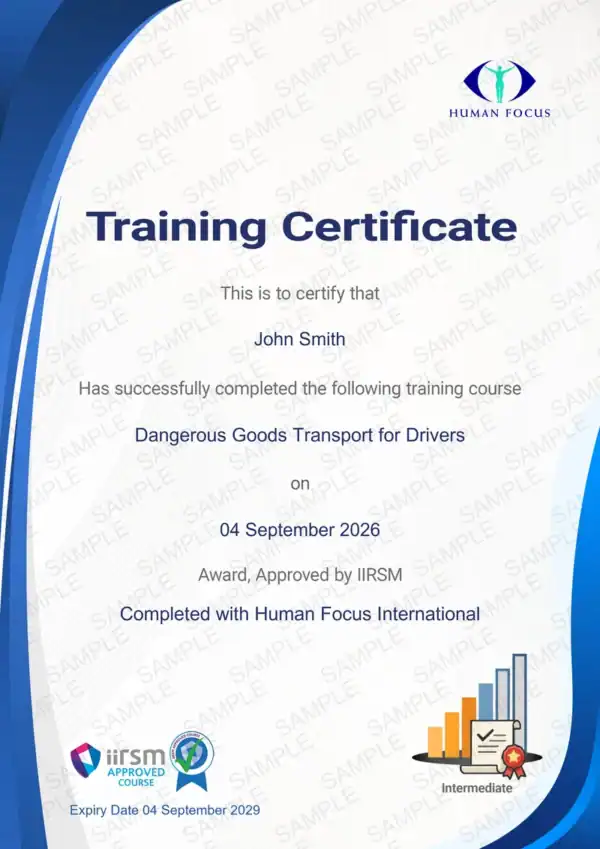
The course certificate includes:
User name
Company name
Course name
Completion date
Expiry date
Approval body
An IIRSM-approved course certificate will be available for download and printing instantly upon course completion.
Users must complete a final theory test before earning their certificate.
The end-of-course test is:
Fully online
Multiple choice
A score of 80% is required to pass.
Course attempts
Each licence includes one attempt at the final knowledge assessment.
If a trainee does not pass and wishes to try again, an additional licence is required. For their second attempt, the trainee can retake the assessment without repeating the course content.
Customer Feedback
Why Is Dangerous Goods Transport for Drivers Training Important?
Drivers and employers often wrongly assume sub-threshold loads carry no legal duty. The course addresses that gap by separating ADR 1.3 awareness and function-specific training from the full ADR vocational certificate and by reinforcing the duties that still apply to the small-load, limited-quantity and excepted-quantity scenarios it covers.
ADR 1.3 requires role-appropriate training before duties are carried out. This course meets that requirement for the small-load, limited-quantity and excepted-quantity scenarios it covers, but does not replace the full ADR vocational certificate where one is required. Security awareness is mandatory under ADR 1.10.
ADR is updated on a two-year cycle. This course is current to ADR 2025 and covers Written Instructions, sometimes still called TREM cards. ADR 2025 revised the format and content of Written Instructions, so older TREM cards should be checked.
The course also addresses practical areas that commonly create uncertainty for drivers, including tunnel restriction codes, secure parking, load monitoring, incident response and end-of-journey handover and reporting.
How This Training Helps Your Organisation
This dangerous goods driver awareness training enables organisations to:
Provide a consistent, driver-specific ADR 1.3 awareness and function-specific training baseline for the small-load, limited-quantity and excepted-quantity scenarios covered
Reinforce pre-journey load, documentation, equipment and vehicle-marking checks before the vehicle moves
Set clear expectations for on-road duties, including load monitoring, parking, tunnel restrictions, route changes and ADR 1.10 security awareness
Use a driver incident scenario to reinforce what to do, and what not to do, if a spill, leak, fire or collision occurs, followed by end-of-journey handover and reporting
Keep ADR 2025 Written Instructions and older TREM-card checks visible within the driver training journey
Assess learning through section tests and an MCQ end test, with an instant certificate, while making clear that the course does not replace a full ADR VTC, supervised practical experience or employer authorisation
Start Your Dangerous Goods Transport for Drivers Training Today
Train drivers carrying dangerous goods under small-load, limited-quantity or excepted-quantity conditions who do not require a full ADR VTC. Give them a driver-specific route through pre-journey checks, on-road duties, incident response and end-of-journey handover, with online assessment and an instant certificate to support your ADR 1.3 training records.