Contractor Interfaces: Preventing Struck-by Incidents When Multiple Teams Share the Same Work Area

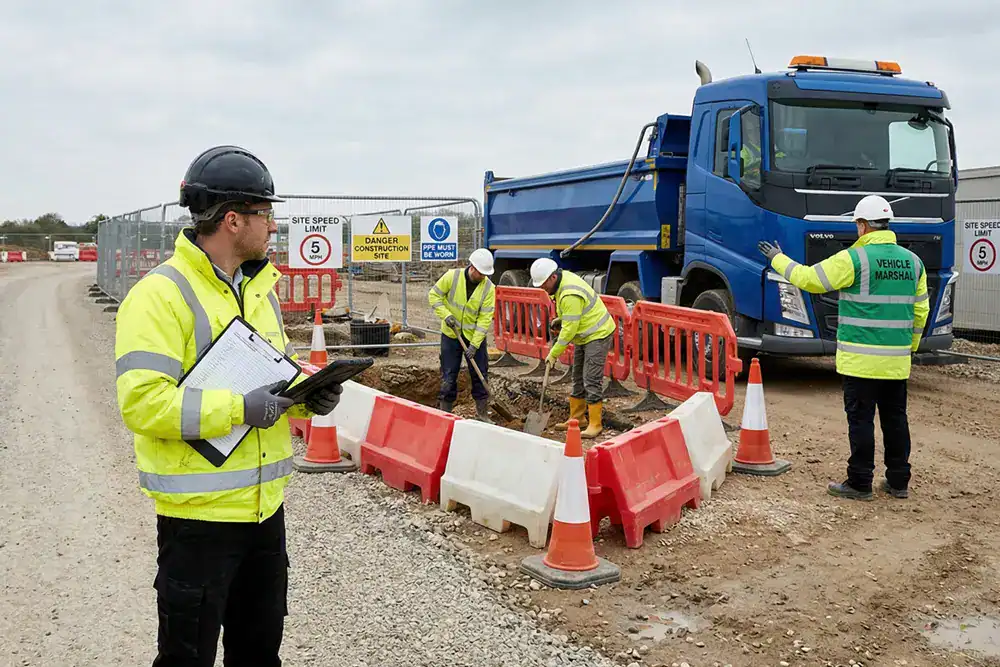
Contractor Interfaces blog image

Struck-by incidents on multi-team sites rarely begin with missing paperwork. They begin when coordination is treated as complete at pre-start, even though the work itself keeps changing. On paper, the controls are in place. In practice, the conditions those controls were built around have already shifted.

That is why this failure persists. Most coordination systems are strongest at set-up and weakest at the point of change. Inductions are completed. RAMS are reviewed. Supervisors are briefed. But as workfaces move, routes alter and plant activity changes, many sites have no equally disciplined system for identifying what has changed. Exposure changes first. The coordination response often comes later, if it comes at all.

In many struck-by events, the teams were competent and the documentation was intact. The gap was not usually a lack of rules or effort. It was the absence of a coordination system that remained operational as site conditions changed and contractor interfaces tightened.

This article explains why that gap keeps recurring, what UK law requires, and what effective coordination looks like when it is treated as a live control rather than a completed pre-start exercise.


Key Takeaways

  • Many struck-by incidents on multi-team sites are not caused by missing paperwork, but by coordination systems that no longer reflect how the site is actually operating.
  • Inductions, RAMS reviews and logistics plans may describe the site at the start of work, but they do not, on their own, control what happens as work fronts, routes and trade interfaces change.
  • HSE’s provisional 2024/25 figures show that being struck by a moving object and being struck by a moving vehicle remain among the leading causes of fatal worker injury.
  • Serious risk can still develop even where teams are competent, inductions have been completed and documentation remains intact, because those controls do not automatically manage the space between contractors.
  • Under UK law, coordination is not just a pre-start exercise. It is an active duty that must keep pace with changing site conditions throughout the construction phase.

Why Are Interface Hazards a Different Category of Risk?

The instinct after a struck-by incident is to look for the individual failure. A driver who did not check mirrors. A worker who stepped into a vehicle route. A foreman who missed something at the morning briefing. That account is sometimes accurate. It is more often incomplete.

Multi-team environments produce interface hazards: risks that arise from how two or more teams interact in shared physical space. Neither team individually created these risks, and neither team individually controls them.

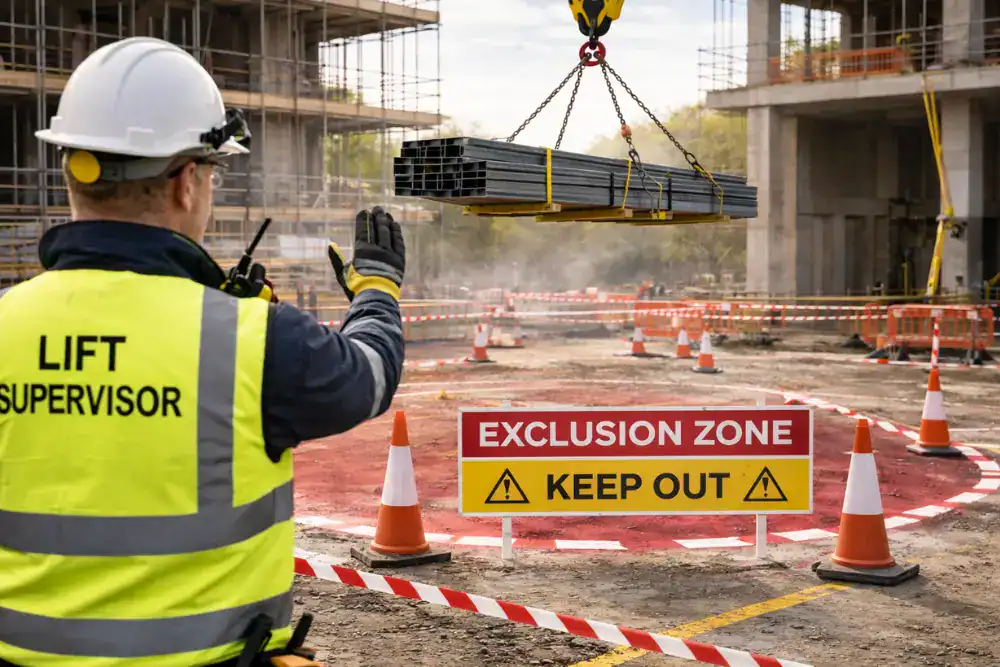
A principal contractor’s delivery schedule runs through a subcontractor’s new work front. A crane movement notified to one foreman was never communicated to the crew working below. An exclusion zone plotted last Tuesday has not been updated to reflect where the second trade moved this morning.

The construction safety research confirms what incident investigations repeatedly show. Research on multiteam construction systems suggests that coordination between teams is a significant contributor to construction safety risk (Li and Wang, 2023). Interface points between trades can become high-risk when coordination breaks down.

A site where every team is individually competent and properly briefed can still produce fatal conditions. That happens when the system governing the shared space is not actively managed. Competence matters for each team’s own operations. It does not govern what happens at the interface between them.

What Does CDM 2015 Require Beyond Pre-Start Documentation?

UK legislation places the coordination obligation clearly. The management challenge is understanding how demanding that obligation actually is.

Under the Management of Health and Safety at Work Regulations 1999, Regulation 11, employers sharing a workplace are required to co-operate and co-ordinate to manage shared health and safety risks (UK Parliament, 1999). The duty is mutual and ongoing. It is not discharged by issuing site rules at induction.

CDM 2015, Regulation 13 goes further (UK Parliament, 2015). Where more than one contractor is involved, the principal contractor must plan, manage, monitor and coordinate the construction phase.

The duty is to ensure work is carried out, so far as reasonably practicable, without risks to health or safety. In practice, that coordination duty requires the principal contractor to actively manage what happens between contractors, not just ensure each one is competent within their own scope.

The principal contractor cannot issue a logistics plan and expect subcontractors to self-manage within it. Interface management is an active, ongoing duty that continues as the site evolves, not one fulfilled at pre-start.

The Health and Safety at Work etc. Act 1974, Section 2 places a duty on employers to ensure health and safety so far as reasonably practicable (UK Parliament, 1974). That duty includes maintaining safe systems of work and providing adequate information, instruction, training and supervision.

Applied to a multi-team environment, it supports the principle that a safe system of work cannot mean each team’s own system operating independently — it must account for what happens between teams, not just within them.

Where many sites fall short is in treating these as pre-start duties. The pre-construction meeting is held, the logistics plan is circulated, RAMS are reviewed. The coordination duty is treated as discharged. On a live programme where conditions change daily, it has not been.

If Segregation Is the Primary Control, Why Do Secondary Controls Dominate?

HSE’s workplace transport guidance is clear: the most effective control for vehicle/pedestrian struck-by incidents is segregation by design (HSE, n.d.-a).

Defined, physically separated routes for pedestrians and vehicles, with controlled crossings only where separation is unavoidable, represent the highest-order practical control available in many site environments.

HSE guidance supports designing traffic routes to reduce or eliminate reversing through one-way systems and adequate turning areas, which should be considered before appointing a signaller (HSE, n.d.-b). A banksman is a secondary control and does not replace higher-order design controls.

In programme-driven environments, segregation by design costs money and may require changes to the logistics plan or site layout. That conversation is one many site managers avoid when lower-order controls are immediately available.

High-visibility clothing and banksmen are deployed instead, not because they are adequate substitutes, but because their cost is immediate and visible. The risk does not feel concentrated. There is no specific scenario anyone can point to and say: this movement, on this day, will cause an incident. That ambiguity makes it easier to accept controls that are visible but not effective.

The consequence is that secondary controls carry more weight than the hierarchy intends. When the site sequence changes and a new work front opens adjacent to a vehicle route, a banksman provides visible assurance.

It does not confirm that the revised conditions were risk-assessed, that the banksman understands the changed exposure, or that the pedestrian route was updated. The control is present. It is not doing the work the hierarchy assigned to it.

In multi-team environments this problem compounds. Each team may operate its own banksman protocol for its own operations. But when those operations share a route or zone, there is no single protocol covering the overlap. Nobody has been given that responsibility.

What Do Inductions and RAMS Actually Govern?

HSE’s INDG368 guidance on contractor management sets out the essentials: identify risks, share information, manage and supervise the work, and co-operate with contractors (HSE, n.d.-c). These are necessary steps. They are not sufficient on their own to prevent interface incidents.

Three specific failure mechanisms explain why.

Inductions Address the Site at a Single Point in Time

Work fronts advance, sequences are revised, trades move. The logistics plan accurate on day one may be materially wrong by day ten. Nothing in the standard induction model updates it. The briefed conditions drift away from the actual conditions. Nobody is tracking the gap, because the induction model assigns no one that responsibility.

Inductions Address Each Team's Individual Operating Area

A groundworks crew briefed on their exclusion zone and a delivery driver briefed on the access route may each follow their own instructions. Their paths can still converge unexpectedly. Neither team has done anything wrong individually. The coordination system failed to identify the overlap before it became an incident.

Individual Competence Does Not Aggregate to Collective Safety.

NIOSH guidance is clear: design the site and the coordination system to reduce hazards, before relying on individuals to spot and avoid them (NIOSH, n.d.).

A site of CSCS-carded workers from multiple contractors, each following their own team’s rules, is not a coordinated system. It is a collection of individually compliant operations sharing a space that nobody is actively governing.

What Does Operational Coordination Actually Require?

Pre-task planning guidance supports the principle that hazards should be identified before work starts and that changing site conditions should trigger updated planning (CPWR, 2024). That principle suggests cross-contractor coordination needs to happen before the day’s work starts, especially where work fronts and traffic routes change.

he evidence on what specifically fails is instructive. Research into the PC-subcontractor interface found that where subcontractor supervisors do not have visibility of how adjacent trades are working, and where PC foremen lack current awareness of what subcontractor crews are doing, interface hazards can accumulate undetected.

The research points to visibility and information flow at the PC-subcontractor interface as significant contributors to risk (RMIT, 2018). Improving coordination at the interface calls for clearer information channels, more frequent updates, and explicit responsibility for sharing operational changes across teams.

Operational coordination in a shared area requires more than a daily check-in. It requires answers, each working day, to questions no induction document can carry:

  • What plant is moving today, where and when
  • What new work fronts have opened since yesterday
  • Which exclusion zones have changed
  • What one team’s activities will generate as a hazard for teams working nearby or below

Those answers need to be held by subcontractor supervisors directly, not filtered through the principal contractor’s representative alone.

A frequently absent element is authority. A named coordinator needs the authority to stop or re-sequence work when an overlap creates an exposure the current logistics arrangement does not control. Coordination without that authority is advisory.

A subcontractor crew on a fixed-price package loses money when work stops. When a PC foreman identifies an interface hazard, asking that crew to stop is asking them to accept a financial cost voluntarily.

That will sometimes work. It is not a system. Clear authority to stop or re-sequence work is what makes the coordination function reliable rather than dependent on good will. In practice, that coordination duty needs to be backed by clear authority to pause or re-sequence work when interface risks emerge.

Under CDM 2015, Regulation 13, the principal contractor holds the coordination role and is best placed to exercise that authority (UK Parliament, 2015). The practical challenge is ensuring it is exercised operationally, not merely stated contractually.

How Do You Know Whether Coordination Is Functioning?

Multi-contractor sites can be characterised by split accountability at team interfaces. Where the PC-sub interface is not actively managed, both parties may assume the other is monitoring the shared space.

The principal contractor assumes the subcontractor supervisor will flag any condition that creates exposure. The subcontractor supervisor assumes the PC’s logistics plan is up to date. Neither assumption is reliable. Neither party is explicitly wrong. The accountability gap sits in the space neither fully owns.

This is not an unusual failure of communication. Research into the PC-sub interface in construction identified it as a structural feature of sites where outcomes are poor (RMIT, 2018). When no coordinator is clearly nominated for the shared space, interface hazards can accumulate undetected. Not because anyone is negligent, but because no one is positioned to see them.

HSE’s guidance on CDM 2015 principal contractor responsibilities is explicit: the PC must ensure effective coordination among all contractors on site (HSE, n.d.-d).

The practical test is not whether coordination documents exist. It is whether the coordination function is operational. Are the people managing each contractor’s work talking to each other, in real time, about what has changed since yesterday? Is someone with the authority to act on that information present in that conversation?

Workplace transport safety training for drivers, vehicle marshals and workers in vehicle movement areas supports this system. It is designed to help individuals recognise hazards and respond correctly. It is most effective when the coordination structure it operates within reflects current site conditions. Training equips individuals to follow their team’s protocols. Without a maintained coordination system, those protocols do not govern the space between teams.

Supporting Workplace Transport Safety

Human Focus offers Workplace Transport Safety Training covering vehicle and pedestrian interaction, exclusion zones, and the responsibilities of drivers and workers in shared vehicle movement areas. For those with banksman or traffic marshal responsibilities, Human Focus also offers a separate Banksman and Traffic Marshal course covering reversing controls, signalling, and banksman duties. Both courses support a struck-by prevention programme and are most effective within a coordination structure that is actively maintained.

About the author(s)

Human Focus Editorial Staff comprises a dedicated collective of workplace safety specialists and content contributors. The team shares practical guidance on human factors, risk, and compliance to support safer, more effective workplaces.

Share with others
You might also like

Popular Courses

GDPR Awareness Training Course
GDPR Training
View Course Details
LOTOTO online training course
Safe Isolation – Lock Out, Tag Out, Try Out (LOTOTO) Training
View Course Details
IOSH Managing Safely
IOSH Approved Managing Safely e-Learning
View Course Details
spill kit training
Spill Kit Hazardous Substances Training
View Course Details
Legionella-Risk-Assessment-Training
Legionella Risk Management Principles for Responsible Persons
View Course Details

Recent Articles

legionella monitoring records
Legionella Monitoring Records Gaps Across Multi-Site Estates: Why Compliance Keeps Slipping Through the Cracks
Most In-Demand Construction Safety Courses
Top 5 Most In-Demand Construction Safety Courses for UK Workplaces
security awareness training platform
Security Awareness Training Platform: How to Choose the Right Solution for Your Organisation
Course Announcement Manual Handling in Industry For Managers Training
Course Announcement: Manual Handling in Industry – For Managers Training
Course Announcement Back Care Management Offices Managers
Course Announcement: Back Care Management in Offices for Managers Training

Current Offers

CAT & Genny Training

Original price was: £150.00.Current price is: £125.00. +VAT

near miss reporting for effective learning
Managing Near Miss Reporting for Effective Learning

Original price was: £895.00.Current price is: £595.00. +VAT

Sustainability and Environmental Management Training
Sustainability & Environmental Management Training

Original price was: £895.00.Current price is: £595.00. +VAT

colour blind test
Colour Blind Test

Original price was: £25.00.Current price is: £15.00. +VAT

Icon-PNG
Home Working Bundle Pack (4 in 1)

Original price was: £100.00.Current price is: £49.00. +VAT