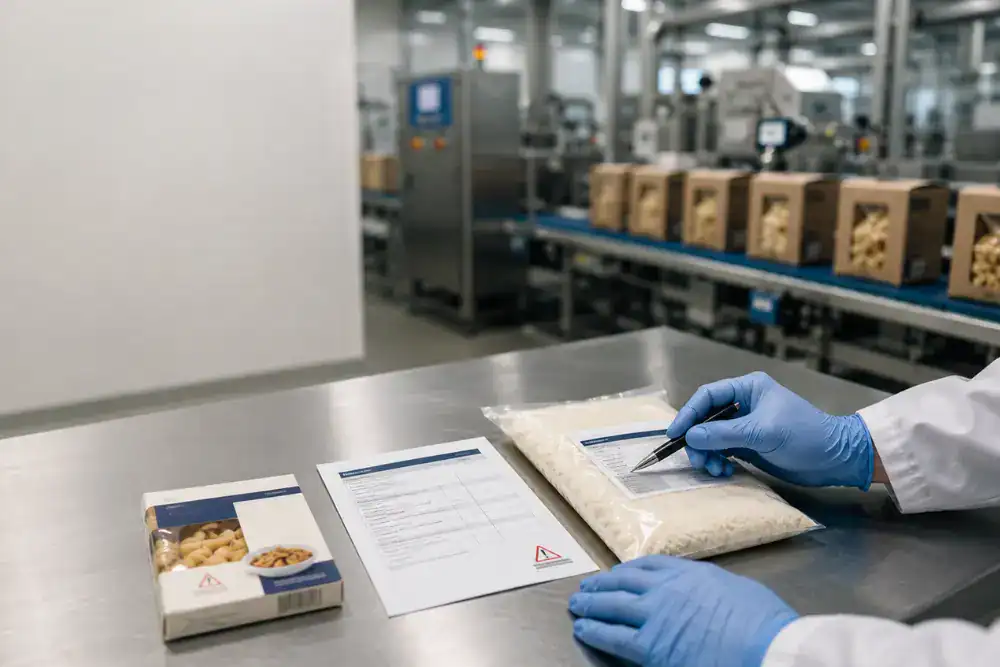
In short: Cleaning verification gaps during high-turnover changeovers are usually handover failures, not cleaning failures. When contractor turnover, agency cover, seasonal ramp-ups or compressed shift changeovers replace stable teams, verification can become a paperwork exercise rather than a meaningful check. The checklists still get signed, but the supervision, shared understanding and local knowledge that made the sign-off reliable have been weakened or removed.
Why Do Cleaning Verification Controls Fail During High-Turnover Changeovers?
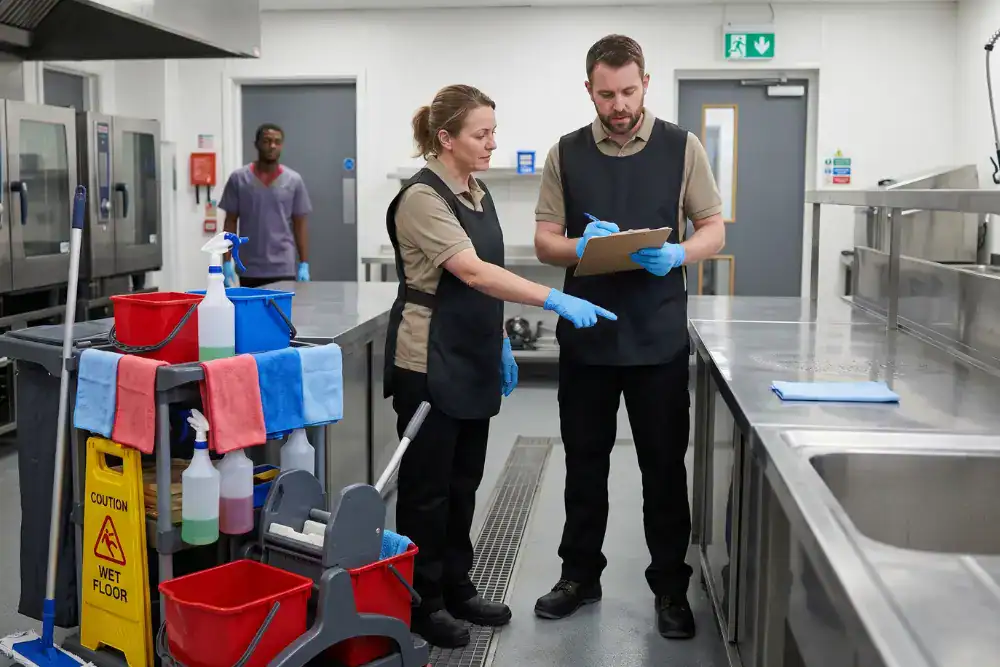
Most organisations believe their cleaning verification system is working. Look more closely during a contractor changeover, an agency-staffed shift or a compressed restart, and the weaknesses become visible. This article sets out why cleaning verification controls fail during high-turnover changeovers, where they break down in practice and what must be in place for the release decision to remain meaningful when supervision, time and continuity are reduced.
Cleaning verification in many organisations was designed for steady-state operation – stable teams, stable supervisors, stable expectations. High-turnover changeovers remove those conditions, often without triggering a reassessment of how the verification system itself should change.
The sections below set out what cleaning verification is actually doing during a changeover, why it can fail even when cleaning continues and which controls remain reliable when the system is stretched. Each recommended control is paired with the condition that determines whether it is likely to remain effective or weaken during periods of staff turnover.
Key Takeaways
- Cleaning verification failures during high-turnover changeovers are typically handover failures, not cleaning failures.
- High turnover exposes the tacit knowledge and supervision that stable teams quietly maintained.
- Verification becomes a paperwork exercise rather than a meaningful check when supervision and shared understanding are weakened.
- Visual checks confirm appearance, not method compliance, particularly on the hard-to-reach points where shortcuts happen first.
- Risk-based verification only protects high-consequence changeovers if scrutiny is maintained on the busiest days.
- Verification is more reliable when release authority, structured handover and visible supervision work together as part of the changeover process.
What Do Cleaning Verification Controls Actually Do During a Changeover?
During a changeover, cleaning verification is a release decision. The person signing off the area, line, room or equipment is asserting that the next team can safely rely on the claim that it is clean and ready for use.
In practice, that makes verification a safety-critical status transfer, not housekeeping confirmation – the same principle the Health and Safety Executive (HSE) addresses in its shift handover guidance, where responsibility and risk information must pass reliably between people under time constraints (HSE, n.d.).
COSHH Training
Our COSHH Training course provides basic awareness to trainees to help them identify the dangers and adopt safe working practices whilst working with hazardous substances, as well as, comply with the law.
The Three Questions Verification Must Answer
“Verification” covers three different questions, but many systems treat them as one.
The first is whether the outcome was acceptable: did the result meet the local cleanliness standard? In healthcare, this maps to what NHS England calls a technical audit – an outcome check against a defined standard.
The second is whether the process was delivered properly at the point of work, including awkward or hard-to-access areas under time pressure. This maps to an efficacy audit: not whether the area looks clean, but whether the correct method was followed where it mattered.
The third is whether there is independent assurance beyond the team doing the work. In high-consequence environments, self-sign-off under throughput pressure can produce a complete paper trail without a verified outcome.
What High Turnover Does to Verification
When turnover is high, these three distinctions begin to blur because the system looks for fast, low-effort ways to appear assured rather than to be so. Visual checks replace process evidence. Sign-off takes the place of shared understanding.
Familiar routines stand in for competence that has been demonstrated on this site, with these conditions. None of these substitutions are usually deliberate. The result is rarely dramatic failure.
More often, it is verification inconsistency: the same task is released to different standards depending on who is on shift, how much time is left and how much supervision is actually available.
Stable Teams Hide Weak Verification
In a steady-state operation, the substitution often goes unnoticed because experienced staff are present to catch what the checklist misses. When turnover is high, that informal correction layer disappears, and the substitution becomes the system.
Why Do Cleaning Verification Controls Fail During Changeovers Even When Cleaning Continues?
Cleaning verification controls fail during high-turnover changeovers not because cleaning stops, but because the conditions that give verification meaning are removed by the same pressures that caused the changeover:
- Embedded supervision
- Working knowledge of local quirks
- Adequate time to confirm the critical points
HSE’s HSG48 identifies competence, communication and supervision as predictable failure points during organisational change. Employers must ensure risk assessments remain suitable and sufficient under the Management of Health and Safety at Work Regulations 1999. Yet many organisations still treat cleaning verification as a procurement or service-delivery matter rather than a question of whether their controls are actually working.
Three patterns typically drive this failure.
Sign-Off Drifts Away from the Work
Checklists may be completed after the physical cleaning, or by someone who did not observe the critical steps. This is not fraud; it is a throughput adaptation. When changeover windows shrink, operators push paperwork to the edge of the job, and verification becomes a record that follows production reality rather than a control that constrains it.
Visual Checks Replace Process Evidence
Visual inspection is fast, available and easy to justify, but it tells the organisation very little about whether the right process was followed at the right moment, especially when access is constrained or surfaces are deceptive.
ARHAI Scotland’s 2023 review confirms that subjective visual assessment alone is a weak basis for determining cleanliness, and recommends complementing it with objective tools such as adenosine triphosphate (ATP) bioluminescence and fluorescent marker methods (ARHAI Scotland, 2023).
Split Responsibility Leaves Gaps at the Interfaces
Changeovers rarely belong to one role. Operators strip equipment, cleaners complete the formal clean, engineers remove guards or panels and facilities teams manage waste. In healthcare, nurses and domestic staff may share responsibility for patient equipment.
On paper, the division works. In practice, it creates gaps at every handover point: inside guards, behind panels, under fixtures, around removable parts and on touchpoints, where no one is responsible for confirming the whole area from start to finish.
Why Should "Clean and Ready" Be Treated as a Safety-Critical Handover Decision?
A “clean and ready” declaration during a high-turnover changeover should be treated as a safety-critical handover, because in practice that is exactly what it is. The next team will rely on the claim immediately, often without independent verification, and the consequence of an unsafe release falls on the team that did not produce it.
HSE’s shift handover guidance sets out the conditions for effective handover where safety depends on information transfer (HSE, n.d.), and those conditions apply directly to the release decision at a cleaning changeover. The five conditions HSE specifies are:
- Face-to-face, two-way communication – not passive sign-off through a form.
- Preparation by the outgoing party – status is clear before transfer, not constructed during it.
- Opportunity for questions and challenge – the incoming party can interrogate the release, not just receive it.
- Adequate time allocated – handover sits inside the schedule, not at the edge of it.
- Clear written support – the record reinforces the conversation; it does not replace it.
Under high turnover, structured handover degrades quickly. New starters may not know what to question. Agency or contractor staff often lack the confidence or authority to challenge a release they doubt, particularly when the outgoing operator is permanent. Supervisors stretched across parallel changeovers may not witness the transfer at all. The organisation still believes it has a release step because the form exists, but the risk information has not actually passed to the next team.
Where the control fails. Structured handover is fragile under three specific pressures. Restart deadlines compress the time available to confirm anything beyond the form. The difference in status between permanent and agency staff makes it difficult in practice for incoming workers to challenge a release they doubt. Stretched supervision removes the witness who would have caught a weak handover in a stable operation. In many cases, none of these pressures are visible in the audit trail because the form was completed correctly.
HSE’s point is not that communication should be better. It is that where safety depends on status transfer, the handover itself must be designed, resourced and treated as safety-critical. Cleaning verification during changeover falls squarely into that category.
Why Should Technical Outcome Be Separated from Process Efficacy in Verification?
A clean appearance is not evidence of a clean process. The only way to detect process drift before it produces visible failure is to test outcome and method separately. NHS England’s 2025 standards make this distinction explicit by separating technical audits, which ask whether the result meets the standard, from efficacy audits, which ask whether the correct method was delivered at the point of work.
The principle applies across sectors wherever access is constrained, throughput is compressed or shortcuts are most likely on the hardest-to-verify points – allergen changeovers in food production, aseptic preparation in pharma, high-acuity clinical environments and equipment cleaning behind guards in manufacturing.
Technical outcome audits detect visible failure. Efficacy audits detect process drift, including the shortcuts and omissions that are most likely during turnover-heavy changeovers. Neither audit type substitutes for the other.
Where the control fails. Even well-designed verification models drift in predictable ways. Audits can become performative, with attention shifting towards scores, dashboards and presentation rather than understanding where the cleaning process actually breaks under pressure. Efficacy checks may become routine rather than risk-led, scheduled around auditor availability instead of the high-risk changeovers where method compliance is most likely to slip. When gaps are found, many organisations default to individual blame – the cleaner missed a step – rather than examining the conditions that made the omission likely, such as restricted access, compressed time windows, missing tools, restart pressure or unclear ownership.
The structure may remain in place while its ability to detect and correct drift weakens. The warning sign is not always a failed audit. It may be the pattern of audit coverage: which changeovers are checked, which are missed, and whether the highest-risk checks still happen on the busiest days. That pattern is not usually visible in management reports.
How Should Cleaning Verification Be Made Risk-Based Without Drifting Under Pressure?
Cleaning verification should be made risk-based by concentrating effort where the consequence of failure is highest, and by protecting that effort on the days when throughput pressure is greatest. These are also the days when scrutiny is most likely to be reduced. NHS England’s functional risk approach links audit frequency and target compliance to risk category, ranging from weekly checks at the highest risk to annual checks at the lowest (NHS England, 2025). The principle is sound across sectors. Where it commonly fails is in the implementation.
Those differences in consequence matter. An allergen changeover, a high-acuity clinical environment, an aseptic preparation area, a precision manufacturing line and a vulnerable patient group each carry distinct risks if cleaning has been assumed rather than confirmed. A verification regime that applies the same level of scrutiny to all of them spreads effort too thinly. One that relies on static ratings can also miss a shift in the operating conditions that actually creates the risk.
Where the control fails. Risk-based verification models can fail in quiet, predictable ways:
- Risk ratings may become static even though product mix, staffing stability and changeover tempo shift week to week – so a setting that warrants close scrutiny under new conditions continues to be treated as low risk.
- Organisations may dilute effort by trying to verify everything equally, spreading supervision and audit capacity so thinly that high-consequence changeovers receive no meaningful additional scrutiny.
- Local workarounds emerge under pressure. On busy days, verification intensity may be quietly reduced to protect throughput – exactly when instability and time pressure make stronger verification most necessary.
A risk-based model only protects high-consequence changeovers if scrutiny is maintained on the busiest days, and if risk ratings are reviewed more frequently than the annual cycle allows. Without both, the framework can remain in place on paper while it gradually loses its protective value under day-to-day operational pressure.
How Should Objective Monitoring Tools Be Used Without Overclaiming What They Prove?
Objective monitoring tools should be used to identify problems and track process reliability within a wider verification regime, not as universal pass-or-fail tests. ATP bioluminescence, fluorescent markers and UV gel each detect specific conditions and each have documented limits that determine what they can reliably tell the organisation. Those limits are:
- Fluorescent markers indicate whether the marked substance was physically removed from a surface. They do not measure microbial load and do not confirm cleanliness in any wider sense (ARHAI Scotland, 2023).
- ATP bioluminescence detects ATP as a proxy for organic residue. Thresholds vary by device and by context, and the technique is not a sterility test (Nante et al., 2017).
- NHS England frames technologies such as UV gels, ATP and UV black light as tools to highlight what has not been cleaned effectively and to support training – not as evidence on their own that a process is safe (NHS England, 2025).
Used appropriately, objective tools create credible feedback loops, particularly with new starters and agency staff. They make the failure points of a process visible under real changeover conditions. The organisation can then use that information to redesign access, sequencing, supervision or staffing at the changeovers where failures concentrate.
Where the control fails. The management of exceptions weakens fastest when restart pressure is highest. Issues may be logged but left unresolved before release because throughput takes priority. When responsibility is unclear between operators, cleaners, engineers and facilities teams, gaps linger because no one has clear authority to ensure closure. Even when exceptions are recorded, they often remain local – noted in a shift log but not included in the formal changeover handover. The problem is not that issues are invisible; it is that they are not transferred with the risk status to the next team.
What Are the Key Conclusions on Cleaning Verification Failures During High-Turnover Changeovers?
Cleaning verification failures during high-turnover changeovers are, in most cases, handover failures and organisational design failures rather than cleaning failures. The verification regime was designed for stable conditions that no longer apply on the days it matters most. Staff turnover exposes the local knowledge, supervision and informal coordination the system was quietly relying on. Three conclusions follow directly.
Verification is a release decision, and the release decision must be designed with the same rigour as a safety-critical handover. Where it is treated as form-filling, it becomes unreliable during periods of staff turnover and produces a complete paper trail without a confirmed outcome.
Each control in the verification regime needs to be tested against the conditions that determine whether it will remain effective. Structured handover, separated technical and efficacy audits, risk-based intensity, objective monitoring, the design of roles and ownership and the management of exceptions each fail in distinct, predictable ways under throughput, supervision and staffing pressure. A control whose failure points have not been identified is not yet reliable.
Verification is most reliable when release authority, structured handover, visible supervision and feedback loops reinforce each other as part of the changeover process, not when they sit as separate items on a compliance register. The practical next step is operational rather than procedural: select one high-consequence changeover, redesign the release so it requires a two-way handover, explicit exception status and at least one process-focused check, then identify what breaks down under real operating conditions.
Supporting Cleaning Verification Competency During Changeovers
Cleaning verification depends on more than a signed checklist. Supervisors, cleaning leads and contractor managers need to understand how to manage release decisions, maintain cleaning standards during periods of staff changeover and check whether the correct method is being followed at the point of work.
Human Focus’ General Office Cleaning course supports this by helping cleaning staff understand how to prepare tasks safely, use tools and chemicals correctly, and follow structured cleaning methods across shifts and teams. For organisations managing higher-risk cleaning tasks, this can be paired with more specific courses on chemical safety, biohazard cleaning or spill response.