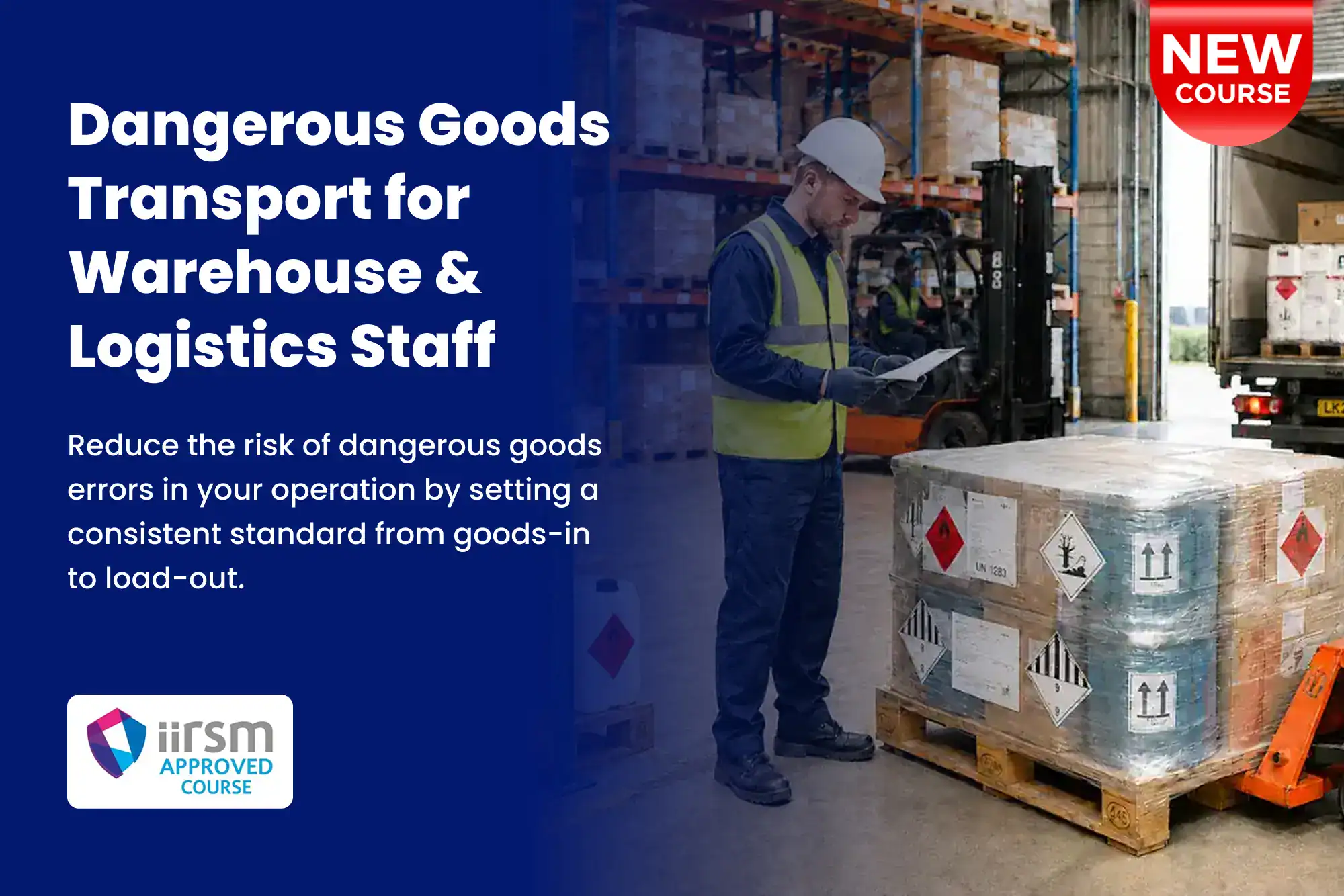
We are pleased to introduce our fully online course: Dangerous Goods Transport for Warehouse & Logistics Staff.
This IIRSM-approved course is designed for staff whose duties involve receiving, storing, picking, packing, loading or unloading dangerous goods. Written to ADR 2025, it gives warehouse and logistics teams a role-specific framework for the checks and decisions involved from goods-in through to load-out.
The course takes approximately one hour and covers dangerous goods classes, labels and markings, receiving checks, safe storage, packaging, loading and unloading, transport documentation, incident response and reporting. It also explains where ADR transport requirements interact with separate site controls, including DSEAR, COSHH, Safety Data Sheets and HSG71 storage guidance.
Successful completion provides a digital certificate and an LMS completion record to support employer training records. The course provides underpinning knowledge and should be used alongside relevant site, load and procedure-specific instruction, supervised practical experience and employer confirmation of competence.
ADR Chapter 1.3 requires people whose duties concern the carriage of dangerous goods to receive training appropriate to their responsibilities before carrying out those duties.
For warehouse and logistics operations, those responsibilities extend across several stages. Staff may receive a consignment, check its condition and markings, place it into storage, prepare it for despatch, load it onto a vehicle or unload it at the other end. A damaged package, incorrect UN number, missing marking, storage incompatibility or documentation discrepancy needs to be identified at the appropriate stage rather than passed further through the process.
ADR also places specific responsibilities on people performing different functions. For example, loaders have segregation duties under ADR 7.5.2, while unloading involves checking that goods correspond with the transport documentation and inspecting their condition as they come off the vehicle.
Warehouse operations must also take account of site-based controls that sit alongside transport requirements. Depending on the substances and activities involved, DSEAR controls, COSHH assessments, Safety Data Sheets and appropriate storage arrangements can all influence how dangerous goods are managed on site.
This training helps organisations:
- Establish a consistent, role-specific approach from goods-in checks through to storage, packing, loading and unloading
- Improve consistency in how dangerous goods consignments are checked before they enter or leave the warehouse process
- Reinforce relevant packing, segregation, loading and unloading responsibilities
- Give staff clear points at which to stop, quarantine, report or escalate a discrepancy within their training and authorisation
- Support ADR Chapter 1.3 training arrangements with a digital certificate and LMS completion record
This course is designed for sites where dangerous goods are received, stored and despatched. It is suitable for relevant staff working in logistics, warehousing and distribution, manufacturing and engineering, chemical storage, hazardous waste handling, construction supply and retail or wholesale distribution, including:
- Warehouse operatives who receive, store, pick, pack and despatch dangerous goods
- Forklift and mechanical-handling-equipment operators handling hazardous consignments
- Goods-in and goods-out staff
- Loading-bay staff
- Loaders responsible for segregation
- Warehouse supervisors and team leaders
- Staff requiring ADR 1.3 general awareness and function-specific knowledge rather than a driver vocational training certificate
By completing this training, staff will understand:
- What dangerous goods are, how they are classified and why they require careful management
- How to identify the correct labels, markings and packaging on incoming dangerous goods consignments
- The segregation requirements and storage conditions that apply to the work covered by the course
- The requirements for inner and outer packaging, overpacks and relevant quantity limits
- The checks involved when receiving dangerous goods and when a consignment should be quarantined, rejected or escalated
- Safe handling procedures and load segregation requirements during loading and unloading
- How to recognise transport documents and the information that should accompany a consignment
- When and how to raise a concern or report a non-conformance
Do the staff receiving, storing, packing, loading and unloading dangerous goods across your operation have training that reflects the responsibilities they actually perform?
Enrol your team in the Dangerous Goods Transport for Warehouse & Logistics Staff course to establish a consistent framework from goods-in to load-out. The training can form part of your ADR Chapter 1.3 arrangements alongside the practical instruction, site procedures and authorisation required for each role.
Enrol Now
For more details about this course, please contact us.