In short: In Great Britain, the Provision and Use of Work Equipment Regulations 1998 (PUWER) can apply to a safety harness as work equipment, but they do not provide the specific inspection duty for harnesses used as personal fall protection. PUWER Regulation 6(5)(f) excludes from Regulation 6 work equipment to which Regulation 12 of the Work at Height Regulations 2005 applies. For ordinary fall-arrest or work-restraint harnesses used for work at height, Regulation 12 of the Work at Height Regulations 2005 is therefore the relevant inspection provision. Regulation 7 of the Personal Protective Equipment at Work Regulations 1992, as amended, also requires employer-provided PPE to be maintained, including being replaced or cleaned as appropriate, in an efficient state, in efficient working order and in good repair. LOLER may additionally apply, but only where the relevant item is lifting equipment or a lifting accessory used to lift or lower a load, including a person.
Harness Inspection Requirements: Does PUWER Apply?
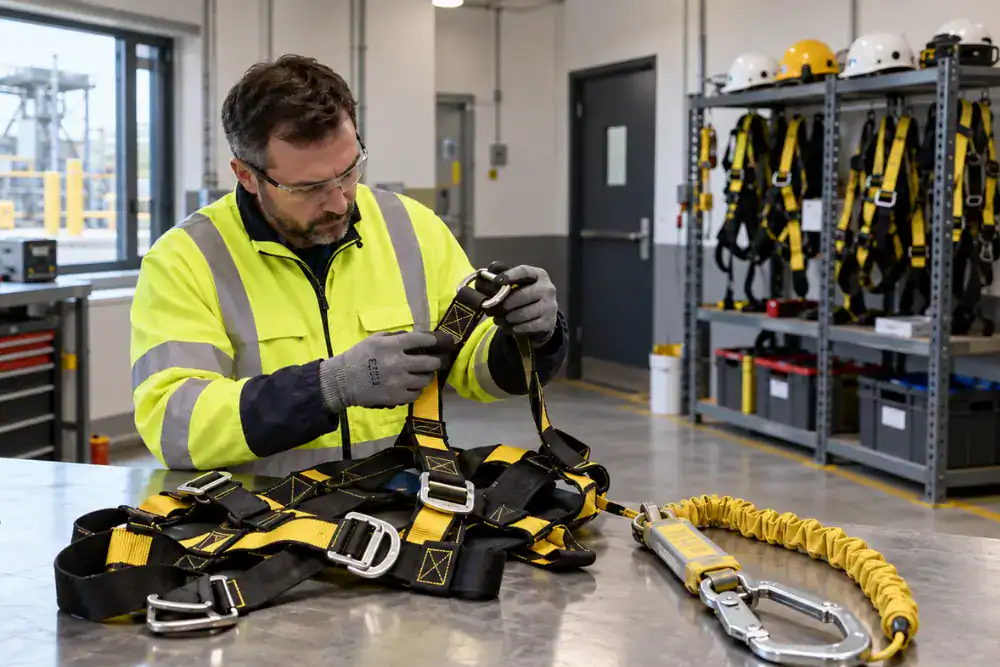
PUWER can apply to a safety harness as work equipment, but the harness inspection requirements that duty holders in Great Britain must actually meet sit in Regulation 12 of the Work at Height Regulations 2005 (Work at Height Regulations, 2005).
This article explains why those two things are not the same, and what follows from the distinction for inspection intervals, competence, records, inspection scope and withdrawal from use.
Which Regulations Apply to Harness Inspection in Great Britain?
The principal equipment-specific regulations that may be relevant to a harness used at work in Great Britain are the Work at Height Regulations 2005, PUWER 1998, the Personal Protective Equipment at Work Regulations 1992, as amended, and LOLER 1998 (Work at Height Regulations, 2005); (PUWER, 1998); (PPE at Work Regs, 1992); (LOLER, 1998). For ordinary fall protection, Regulation 12 of the Work at Height Regulations provides the specific inspection duty (Work at Height Regulations, 2005).
Keep two ideas apart: whether a set of regulations applies, and which provision creates the inspection duty.
Work at Height Regulations 2005: The Specific Inspection Duty
Regulation 12 of the Work at Height Regulations 2005 applies to work equipment exposed to conditions causing deterioration liable to result in dangerous situations, which includes a harness and its connecting components (Work at Height Regulations, 2005).
A competent person must inspect it at suitable intervals and each time exceptional circumstances liable to jeopardise safety have occurred, and Regulation 12(6) requires the result to be recorded and kept until the next inspection result is recorded (Work at Height Regulations, 2005).
PUWER 1998: General Duties, but Not the Inspection Duty
A harness can be work equipment, so wider PUWER duties such as suitability and maintenance can remain relevant (PUWER, 1998).
However, Regulation 6(5)(f) of the Provision and Use of Work Equipment Regulations 1998 expressly excludes equipment to which Work at Height Regulation 12 applies from PUWER’s inspection duty. So PUWER may apply to the harness, but its Regulation 6 inspection duty does not (PUWER, 1998).
PPE at Work Regulations 1992, as Amended: Maintenance
Regulation 7 of the Personal Protective Equipment at Work Regulations 1992 requires employers to ensure that personal protective equipment provided to workers is maintained — including being replaced or cleaned as appropriate — in an efficient state, in efficient working order and in good repair. That duty ties the regime to the manufacturer’s instructions on cleaning, storage and care, and to timely replacement (PPE at Work Regs, 1992).
LOLER 1998: Only Where an Item Is Lifting Equipment or a Lifting Accessory
The Lifting Operations and Lifting Equipment Regulations 1998 (LOLER) cover lifting equipment and lifting accessories used to lift or lower a load, including a person, and fall arrest or work restraint does not meet that test on its own. For rescue, man-riding, rope-based or davit and winch systems, classify each component by actual use: a winch that raises or lowers a person is lifting equipment, while the harness worn for fall protection may not be (LOLER, 1998).
Where LOLER applies, Regulation 9 may also require thorough examination before first use and after installation or reassembly. Equipment exposed to deterioration must be thoroughly examined at least every six months if it lifts people or is a lifting accessory, at least every 12 months if it is other lifting equipment, or in accordance with a written examination scheme — and after exceptional circumstances liable to jeopardise its safety (LOLER, 1998).
Key insight: Do not collapse ‘PUWER applies’ into ‘PUWER Regulation 6 creates the inspection duty’, and do not treat LOLER as engaged because a harness is worn. Incorrect classification obscures the type of inspection required, its timing and the evidence that must accompany it.
This article states the position for Great Britain. Northern Ireland has its own parallel regime, so duty holders there should check the equivalent provisions against current NI legislation and HSENI (Health and Safety Executive Northern Ireland) guidance on working at height.
How Often Must a Safety Harness Be Inspected?
There is no fixed statutory interval for harness inspection. Work at Height Regulation 12 sets two tests instead of a number: inspection at suitable intervals, and inspection each time exceptional circumstances liable to jeopardise safety have occurred. A suitable interval reflects the pattern of use, the working environment, deterioration history and the manufacturer’s instructions (Work at Height Regulations, 2005).
Depending on the equipment and how it is used, the inspection regime may include the following checks and examinations:
Pre-use check. The trained user carries out a tactile and visual check of the complete system before each use, following the manufacturer’s instructions. It is not normally formally recorded unless the manufacturer, the client or an internal control system requires a record.
Detailed inspection. A competent person carries out a formal, in-depth inspection at the minimum intervals set in the employer’s regime. HSE leaflet INDG367 recommends detailed inspection of lanyards at least every six months, increasing to at least every three months for frequently used lanyards, particularly in arduous conditions. HSE states that many of the leaflet’s principles can also be applied to safety harnesses, subject to the manufacturer’s instructions and the employer’s risk-based inspection regime (HSE, 2002).
Interim inspection. Also in-depth, and appropriate between detailed inspections where the risk assessment identifies a risk of significant deterioration — for example transient work involving paints, chemicals or grit blasting. These are recorded too.
Event-triggered inspection. After a fall, chemical exposure, heat damage or another abnormal event, the item is withdrawn first and assessed afterwards.
LOLER thorough examination. Applicable only to items that are lifting equipment or lifting accessories by function, at the intervals above (LOLER, 1998).
Standards support this picture without setting the legal test. BS EN 365:2004 remains current and refers to periodic examination at least twelve-monthly, but that reference is neither a statutory minimum nor the normal HSE recommendation, and INDG367 notes that manufacturers of textile products usually advise more frequent examination (BSI, 2004); (HSE, 2002). BS 8437:2022 is the current British code of practice for personal fall protection; because INDG367 predates it, attribute the six- and three-month figures to the HSE leaflet rather than to the standard (BSI, 2022); (HSE, 2002).
Service life is a separate decision. Observe any manufacturer-stated maximum service life or obsolescence date, while retiring equipment earlier where condition or history requires it. Where no limit is stated, a documented retirement policy informed by manufacturer advice and competent judgement is the defensible position.
Who Can Inspect a Safety Harness?
Detailed and interim inspections require a competent person: someone with sufficient knowledge, training and experience to identify defects, apply the manufacturer’s criteria for that specific product and decide whether continued use is safe. That person can be in-house — INDG367 is clear that an external company is not obligatory, although many manufacturers and suppliers offer inspection services and product-specific training. Completing a training course does not by itself establish competence (HSE, 2002).
Objectivity matters as much as knowledge. HSE guidance states that the person carrying out an inspection should be sufficiently independent and impartial to make objective decisions, with genuine authority to withdraw, quarantine or discard defective equipment. The trained user normally carries out the pre-use check, a different level of check with a different purpose (HSE, 2002).
What Must Be Recorded After a Harness Inspection?
Work at Height Regulation 12(6) requires the result of the inspection to be recorded and kept until the next inspection result is recorded. The regulation does not prescribe every field for a harness record, so treat these as defensible good practice rather than statutory particulars: unique equipment identification, equipment type, date, the name of the person who carried out the inspection, findings, the action taken or resulting status, and the next due date (Work at Height Regulations, 2005).
Regulation 12(5) adds a separate duty: where relevant work equipment leaves an employer’s undertaking, or is obtained from another undertaking and used, it must be accompanied by physical evidence that the last required inspection has been carried out (Work at Height Regulations, 2005).
A tag, label, inspection certificate or report clearly linked to the item can provide this evidence. Do not rely on a standalone or remote register entry unless the equipment is accompanied by evidence identifying the item and its last required inspection.
Clear status control makes the record usable: mark each item as in service, quarantined or withdrawn, so no item returns to use before a competent decision has been made and recorded.
What Must Be Checked During a Harness Inspection?
The inspection regime should cover every relevant component in the fall-protection system, although not necessarily within a single harness inspection.
Webbing and stitching
Check for cuts, fraying, surface and edge abrasion, broken or pulled stitching, chemical attack, heat or friction damage, degradation from ultraviolet light and contamination such as grit, which can abrade fibres internally. Small defects matter: INDG367 notes that a 1 mm cut at the edge of a webbing lanyard can reduce its strength by 5% to 40% (HSE, 2002).
Buckles, D-rings and metal components
Check for cracks, corrosion, distortion, sharp edges and wear, confirm that fastenings and adjusters operate correctly, and confirm that components are compatible and correctly assembled.
Labels, identity, history and service life
Confirm the item is uniquely identifiable, that markings such as EN 361 for full body harnesses remain legible, that its inspection history is traceable and that any manufacturer-stated service life or obsolescence limit has not expired (BSI, 2002).
Lanyards, energy absorbers, connectors and the complete system
Inspect each item covered by the harness inspection against its manufacturer’s criteria and any applicable standard, checking compatibility across the system, energy-absorber deployment indicators and connector and gate function.
Anchors, lifelines, retractable devices and other equipment may require separate product-specific inspections by someone competent for that equipment.
When Must a Harness Be Withdrawn From Use?
Withdraw it immediately; any decision about the item’s future should follow a product-specific assessment. After a fall or another exceptional circumstance:
- Withdraw every item involved from service immediately and quarantine it.
- Record the event, including the height, the load and the components in use.
- Follow the manufacturer’s post-fall instructions for each affected component.
- Obtain an assessment by a competent person or the manufacturer before deciding whether the item may return to use, must be sent to the manufacturer or an authorised repairer where repair is permitted, or must be destroyed.
Two points should not be softened. INDG367 states that a lanyard used to arrest a fall should never be reused, and should be destroyed or returned to the manufacturer. And no component returns to service simply because no damage is visible; absence of visible damage is not evidence of retained performance (HSE, 2002).
Doubt has the same first step: withdraw and quarantine the item, then have a competent person carry out a product-specific assessment. For lanyards, INDG367 gives further reasons for withdrawal and referral: no evidence of a competent-person inspection within the previous six months, missing identification, marking to BS 1397:1979, or doubt about safety after a pre-use or interim inspection. Where an item’s identity or history cannot be established, it should remain out of service (HSE, 2002); (BSI, 1979).
How Should a Duty Holder Build a Defensible Harness Inspection Regime?
Start with the correct legal duty. PUWER may apply to a harness in general terms, but its Regulation 6 inspection duty does not apply where Work at Height Regulation 12 applies. For ordinary fall-arrest and work-restraint equipment, Regulation 12 governs inspection and records (Work at Height Regulations, 2005); (PUWER, 1998).
Build the regime on that duty, on the maintenance duty in PPE at Work Regulation 7, on the manufacturer’s instructions and on risk — and apply LOLER only after analysing the actual lifting function of each relevant component (PPE at Work Regs, 1992); (LOLER, 1998).
Three conclusions follow for anyone auditing a regime:
- Inspection timing: Suitable intervals and exceptional circumstances are the statutory tests. The interval should reflect the employer’s risk assessment, the manufacturer’s instructions and the equipment’s condition and use. For lanyards, INDG367 provides the six- and three-month recommendations described above (Work at Height Regulations, 2005); (HSE, 2002).
- Records: Inspection records must satisfy Regulation 12(6), with physical evidence provided under Regulation 12(5) when equipment changes undertakings (Work at Height Regulations, 2005).
- Competence and withdrawal: Competent, impartial judgement and immediate withdrawal after a fall or whenever safety is uncertain are essential to a defensible regime.
If your regime depends on people who can apply manufacturer’s criteria and make objective withdrawal decisions, the Human Focus Harness and Lanyard Inspection Course covers the knowledge element of that competence, including inspection scope, defect recognition and how to handle inspection failures.
Course completion alone does not make a person competent, qualified or authorised to inspect; the duty holder still needs to assess product-specific capability, experience and authority.