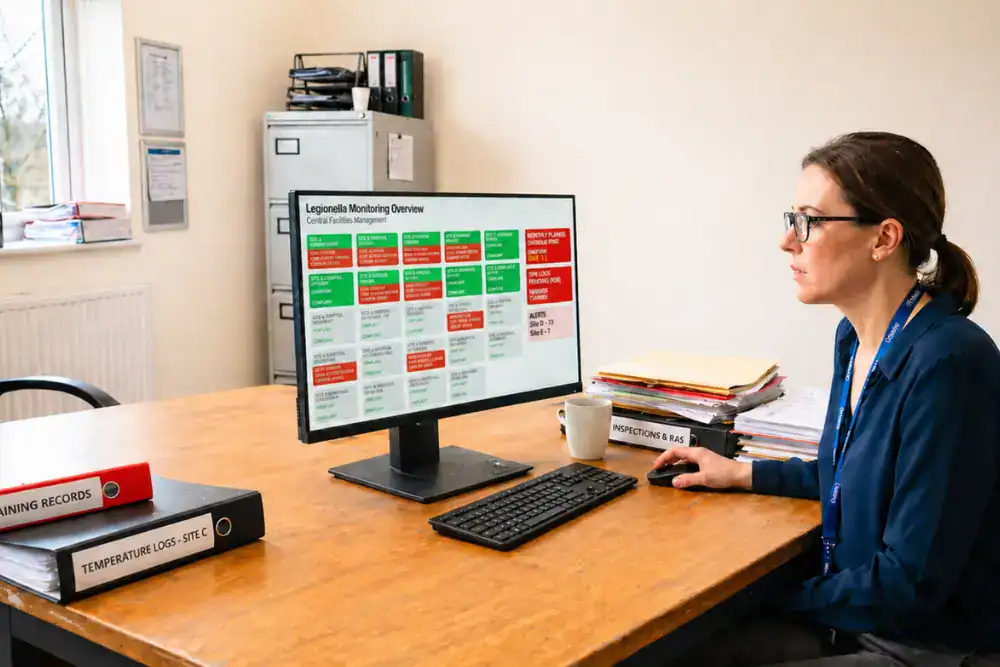
Most duty holders managing multi-site estates are not wilfully ignoring Legionella risks. The records gaps that emerge across their portfolios, such as missed temperature logs, undated inspections and training certificates that cannot be located, are rarely the product of negligence in the traditional sense. They are the predictable outcome of systems that were never designed to work at scale, combined with legal obligations that many organisations only fully interrogate when a safety inspector is already at the door.
That’s why organisations can look broadly on top of Legionella and still struggle to produce defensible evidence when it matters. Not because the legal framework is unclear, but because evidencing compliance across 40, 80 or 200 sites is a different operational problem – and most estates are still trying to solve it with local logbooks, intermittent contractor reporting and role-holders who carry critical knowledge in their heads.
This blog explains why Legionella monitoring records and training records fail in predictable ways across multi-site estates and what those failures tell you about the design and governance of your control scheme, rather than the motivation of the people filling in the forms.
The UK’s legal requirements are, on paper, reasonably clear. The Health and Safety at Work etc. Act 1974 places a duty on anyone controlling premises to protect people from health risks (UK Parliament, 1974). COSHH Regulations 2002 classify Legionella as a biological hazard requiring formal risk assessment and documented control measures (UK Parliament, 2002). Approved Code of Practice L8 operationalises these duties: duty holders must maintain a written control scheme, appoint a competent Responsible Person, monitor water systems, and retain monitoring records for at least five years (HSE, 2013a).
ACoP L8 carries a quasi-legal status that matters enormously at scale: an organisation that cannot demonstrate it followed the Code must prove it complied by other means, or a court may find it at fault (HSE, 2013a). For an estate of 40, 80 or 200 premises managed with paper records and local logbooks, meeting that evidential burden in practice is extraordinarily difficult.
The problem is not that organisations don’t know what to do. It’s that the system they use to demonstrate compliance was designed for one building – and they’re running it across dozens.
Paper-based logbooks at individual sites remain a common record-keeping method across many UK estate portfolios – and the structural problem is straightforward. A central manager overseeing 60 sites has no real-time view of which locations are compliant and which have missed monitoring tasks. Logs can be damaged, misfiled during contractor handovers, or simply never completed, with the omission invisible until an audit or an incident.
This is less a human failing than a system design problem. James Reason’s model of accident causation identifies latent conditions as the primary driver of catastrophic failures in complex organisations (Perneger, 2005). The absence of cross-site visibility is precisely such a latent condition: a structural weakness that lies dormant for months before a single missed task, a failed temperature check, or an untreated positive sample exposes it (Wiegmann et al., 2022). Contractor management adds another dimension. Under ACoP L8, the legal duty to ensure competent water treatment remains with the duty holder even when contractors carry out the work (HSE, 2013a). Where contractors hold records off-site or submit them intermittently, duty holders are retrospectively verifying compliance rather than actively managing it – a distinction that can be relevant when allocating legal responsibility.
HSE guidance highlights that inadequate training and poor communication are recurring contributory factors in Legionella outbreaks (HSE, 2024a). Yet the training problem in multi-site organisations is rarely a shortage of programmes – it is a failure to ensure training reaches the right people at the right time and is properly evidenced.
Research into procedural compliance in high-hazard industries consistently identifies clarity of individual responsibility as the dominant factor in whether monitoring tasks are reliably completed and recorded (Skaugrud et al., 2012). ACoP L8 addresses this directly: the Responsible Person (RP) must be formally appointed with written duties and sufficient authority to commission risk assessments and enforce corrective actions – yet many organisations appoint an RP who lacks technical competence, operational authority, or formal accountability, creating a role that looks compliant on paper but cannot function as the law intends (HSE, 2013a).
Staff turnover amplifies the risk. When an RP leaves, their replacement may inherit the title without the contextual knowledge – the system schematics, the history of remedial actions, the site-specific detail an experienced RP holds in their head. Unless that knowledge is embedded in accessible records, it departs with the individual. In a large multi-site estate, this transition is happening somewhere in the portfolio with considerable regularity.
ACoP L8 explicitly requires records of all initial and refresher Legionella training to be maintained and available for inspection (HSE, 2013a). HSG65 adds a nuance often overlooked: competence levels decline if skills are not regularly used, making refresher training a logical necessity rather than an administrative preference (HSE, 2013b).
The HSE prosecution record makes this concrete. In its official ebulletin reporting the case, HSE states that its investigation found an organisation had poorly managed the risk of Legionella with staff being inadequately trained and supervised (HSE, 2024b).
In the Barrow-in-Furness (2002) outbreak, HSE’s official report identifies “Failure 5: Inadequate training and resource” and states that staff responsible for managing Legionella control should have received training to ensure they were competent, and that duty holders must identify who requires training and ensure sufficient numbers are trained (HSE, 2006).
In both cases, training failure is not a discrete act of negligence – it reflects an organisation that has not built systems capable of sustaining competence across its workforce over time.
For healthcare estates, NHS Health Technical Memorandum HTM 04-01 requires that all staff working on or with water systems – including domestic services staff and contractors – complete a formal water hygiene awareness course, with training matrices reviewed periodically by a constituted Water Safety Group (NHS England, 2016). Across a large NHS trust or integrated care portfolio, that requirement creates a training records challenge of considerable scale.
The consistent thread across prosecution records, epidemiological data and human factors research is that Legionella monitoring records gaps are not random. They cluster around identifiable conditions: paper-based records across too many sites, a Responsible Person role without genuine authority, training that satisfies a box-ticking requirement rather than building competence and oversight of remote sites that is retrospective rather than real-time.
Root cause analyses of compliance failures consistently underestimate the range of contributing organisational factors – defaulting to individual blame rather than examining the system conditions that made failure likely. An analysis found that investigations frequently end at a point of mutual convenience, editing out deeper organisational, cultural and resource factors – particularly where those factors implicate leadership or sit beyond the investigator’s perceived remit (Peerally et al., 2017).
This is directly evidenced in Legionella-specific data: a CDC analysis of 27 outbreak investigations conducted between 2000 and 2014 found that maintenance gaps addressable through a water management programme were present in 85% of cases, with outbreaks attributable to combinations of process failures and human errors rather than isolated individual fault (Garrison et al., 2016).
The UK’s own landmark case reinforces this: the investigation into the 2002 Barrow-in-Furness outbreak – the largest in UK history – identified six systemic failures, including unclear lines of responsibility and poor communication structures, none of which could be attributed to a single individual (HSE, n.d.). For multi-site estate managers, this reframing matters: if monitoring records are consistently incomplete across multiple sites, the problem is almost certainly systemic, not individual.
The practical implication is clear. The most defensible compliance position for a large multi-site estate is one where central visibility of monitoring status is continuous, where training records are integrated with operational records and where the Responsible Person role carries genuine documented authority for every site in the portfolio. None of that requires a particular technology. It requires an organisational decision to treat Legionella management as an ongoing operational function rather than a periodic audit exercise.
Choose one high-risk monitoring activity (for example, temperature checks on sentinel outlets) and run a cross-site evidence retrieval test. Can you produce the last 8–12 weeks of complete records for a sample of sites within 24 hours, with a named owner for each gap?
The insight is that compliance slips when governance is effectively invisible across the portfolio; running this retrieval test will show exactly where oversight, accountability or record access is breaking down, so you can fix the control scheme at source.
Closing competence and training-record gaps sits inside that same source-level fix. A multi-site estate typically has to evidence training appropriate to several distinct roles – basic staff awareness, contractor competence, the Responsible Person’s risk management capability and, in some structures, project-level oversight. Human Focus’s Legionella e-learning courses cover this range and can serve as a reference point when reviewing what each role in your portfolio currently has on record.