mental health awareness training

Mental Health Awareness Training

schedule

Course Duration: 50+ minutes

This CPD-certified Mental Health Awareness Training course helps managers and employees understand and address common workplace mental health challenges.

It explores how anxiety and depression affect employees, both at work and personally, and provides guidance on developing resilience, managing negative thoughts and recognising when professional help is needed. By the end of the course, users will be better equipped to support themselves and colleagues and reduce the risks of poor workplace mental health.

live_tv
100% online training
volume_up
Full audio voiceover
repeat_on
Fully online assessment
account_balance_wallet
Discounts when you buy in bulk
important_devices
Access on any device
app_shortcut
App available for iOS & Android
Training You Can Trust

Certified by CPD

In line with UK legislation

Certificate on completion

Developed by health and safety professionals

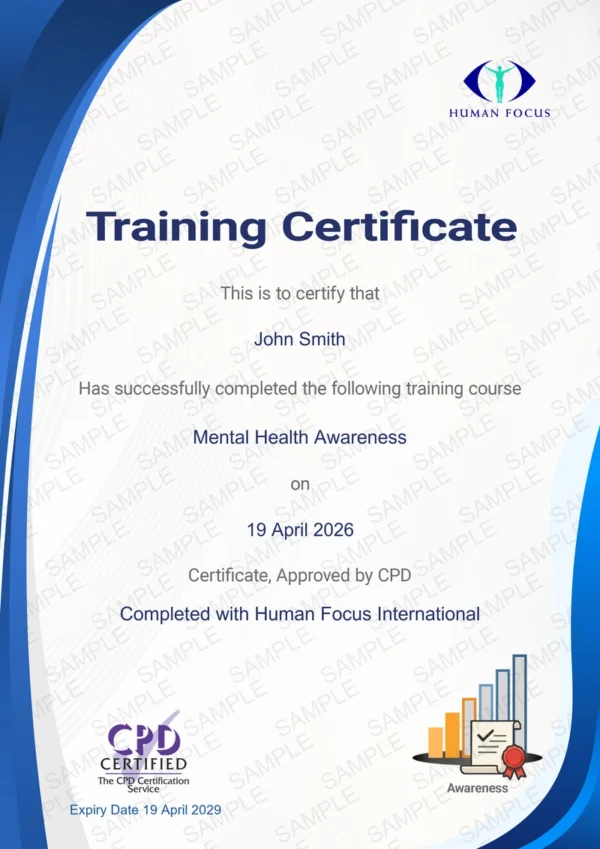
Mental Health Awareness Training Course Certificate
mental health awareness training
cpd certified
£25.00 +VAT

Discounts  for bulk purchases

Need Help?

£25.00 +VAT

Course Preview

Course Details

Course Duration 50+ minutes
Approval body CPD
Format Fully online
Assessment Multiple choice
Certification Same-day digital certificate
Certificate Valid For 3 years

Suitable For

Employees and Managers

Healthcare Professionals

Social Workers

Educators

HR Professionals

Frontline Workers

Course Content

This course contains the following sections:

This section explores the scale of mental health problems that occur in the workplace each year. It also covers how much this costs businesses and how to create a working environment that nurtures good mental health.

This section explores the fluid nature of mental health and how our behaviours and external factors influence it.

This section explores how thoughts, emotions and behaviours interact to affect mental health. It also explains how certain behaviours can help or hinder good mental health.

This section teaches strategies to manage thoughts and remain calm in difficult situations. It also explains brain training techniques that help individuals cope with common types of mental health problems they may experience.

This section explores the mental health issues frequently associated with worrying, anxiety and depression. It also covers the range of symptoms associated with anxiety and how to spot it in the workplace.

Highlights the types of mental health problems that require urgent support and useful emergency contacts.

This section explores the stigma around mental health at work and how hiding issues leads to prolonged suffering.

This section covers the signs of poor mental health, why it’s difficult to identify and how to support those suffering.

This section explores how to develop a positive work culture and realise the benefits of mental health in the workplace.

What You Will Learn

Key mental health terms and concepts

Practical strategies to address workplace mental health problems

Ways to combat the stigma surrounding poor mental health

Lifestyle changes proven to improve resilience and wellbeing

Steps to build a positive work culture and support employees

Available in 20+ Languages

Course subtitles are available in multiple languages, including:

French

Dutch

German

Italian

Spanish

Polish

Course Approval Body

cpd certified

Certified by CPD

This course is certified by the Continuing Professional Development (CPD) Certification Service.

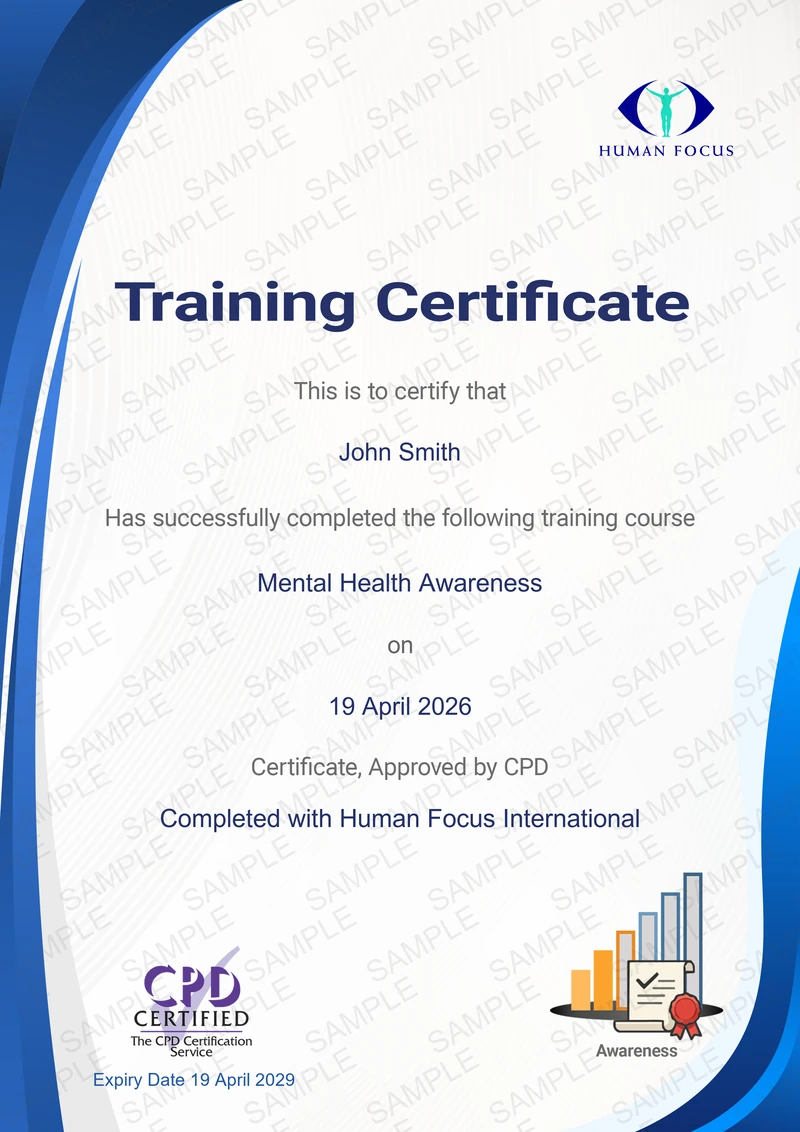
The course certificate includes:

  • User name
  • Company name
  • Course name
  • Completion date
  • Expiry date
  • Approval body

A CPD-certified Mental Health Awareness Training certificate will be available for download and printing instantly upon course completion.

Users must complete an assessment before earning their certificate.

The end-of-course test is:

  • Fully online
  • Multiple choice

A score of 80% is required to pass.

Mental Health Awareness Training Course Certificate

Customer Feedback

Why is Mental Health Awareness Training Important?

Every year, an estimated one in four adults in England experience a mental health problem. For those in employment, these problems can significantly affect their work performance. Deloitte estimates that poor mental health costs employers around £51 billion annually in lost time and productivity.

Investing in workplace mental health support can significantly reduce these costs. It helps employees improve and maintain their mental health, enabling more consistent and better job performance.

Workers who understand how to cultivate good mental health report higher levels of satisfaction, creativity and engagement. Training also promotes empathy and helps break the stigma that prevents too many from speaking openly or seeking support.

The State of Mental Health in UK Workplaces

Work-related stress, depression and anxiety are now the largest category of work-related ill health in Great Britain. The latest figures from the Health and Safety Executive (HSE), covering 2024/25, show that:

  • Around 964,000 workers reported work-related stress, depression or anxiety, accounting for 52% of all work-related ill health cases and up from 776,000 the previous year.
  • An estimated 22.1 million working days were lost due to work-related stress, depression or anxiety, making these conditions the largest contributor to working days lost from work-related ill health.

HSE analysis identifies workload pressures, including tight deadlines and too much responsibility, as common work factors. Other factors include lack of managerial support, organisational change, role uncertainty, violence and bullying.

The cost to employers is also substantial. Deloitte estimates that presenteeism — where people work while unwell and are unable to perform at their best — costs UK employers around £24 billion a year.

Managers play an important role in creating supportive workplaces and responding appropriately when employees may be struggling. Figures cited by MHFA England suggest only 45% of managers have been trained to have mental health conversations.

For employers, this highlights the need to treat mental health risks as seriously as physical health and safety risks, while ensuring managers know how to listen, support and signpost employees to appropriate help.

Are you aware of your responsibilities?

Employers have a moral and legal obligation to support workers and promote good mental health and wellness at work.

Some key responsibilities employers have regarding their workers’ mental well-being include:

  • Risk assessment: Employers are required to undertake a thorough risk assessment of their workplaces to identify the potential stressors that can contribute to employees’ poor mental health
  • Support: Employers should consider appropriate support to their workers who might be experiencing mental health issues, including counselling, mental health services or other tools
  • Training: Employers should provide suitable information, instruction and training where needed to manage identified stress or mental health risks.
  • Policies: Employers are also required to have effective procedures and policies in place that support workers suffering from mental health issues. This includes making reasonable adjustments in the workplace or offering flexible work schedules
  • Communication: Employers should promote open communication between all staff and foster a positive work environment to lessen the stigma associated with mental health conditions

About This Training

This online Mental Health Awareness Training gives employees and managers a practical understanding of how mental health affects people at work, and how to support themselves and others.

Learners build skills they can use day to day. They learn how to manage worry, anxiety and low mood, challenge unhelpful thinking and strengthen everyday resilience. They also learn how to recognise the signs of poor mental health in themselves and colleagues, and when to seek professional help.

The course also helps employers reduce the stigma that stops people speaking up. By encouraging open conversation and a more supportive culture, it helps staff feel confident asking for help before problems escalate.

How This Training Benefits Your Business

This course helps organisations:

  • Improve how managers and staff recognise the early signs of poor mental health
  • Reduce the absenteeism, presenteeism and lost productivity linked to poor mental health
  • Reduce the stigma that stops people raising concerns or asking for help
  • Support compliance with employer duties under the Health and Safety at Work Act 1974 and the Equality Act 2010
  • Build a more consistent, supportive approach to wellbeing across teams

Frequently Asked Questions

Mental health awareness is an understanding of ill mental health and the common causes and symptoms of it. This includes how to identify people who might be struggling and the effective strategies that can support your own and others’ mental wellbeing and help create a healthier work environment.

This mental health awareness e-learning course is suitable for all employees, including managers.

Everyone’s mental health suffers occasionally. Understanding how to identify and challenge negative thought patterns helps people maintain their own mental health and recognise when others are struggling. Early intervention can prevent mental health problems from escalating and promote better outcomes.

Employers that provide MHA training courses at work can see improvements in productivity, attendance, morale and turnover.

Training helps employees understand the nature of mental health, and how it can be managed and maintained. A healthier mindset leads to better focus, stronger collaboration and increased productivity. Training also develops empathy for a more open and supportive professional environment. Anyone struggling with their mental health will feel more confident and motivated to ask for help before problems escalate.

Our online mental health awareness course covers the following topics:

  • The nature of mental health
  • An overview of mental health issues and their symptoms
  • Positive lifestyle changes for better mental health
  • How stigma can prevent people from seeking support and what to do about it
  • Steps to develop positive mental health within your organisation

Mental health training isn’t required in every workplace. However, if a risk assessment identifies mental health hazards, training may be a suitable control measure under the Management of Health and Safety at Work Regulations 1999.

Additionally, the Equality Act 2010 recognises some mental health conditions as disabilities. Awareness of these conditions can help employers to make reasonable adjustments and prevent discrimination.

For other workplaces, mental health training can still be beneficial. It can help employers meet their general duty of care under the Health and Safety at Work Act 1974.

The course is priced at £25 +VAT for a single trainee. Discounts are available if you’re looking to make a volume purchase – speak to one of our sales team to learn more.

Yes. This course is certified by the Continuing Professional Development (CPD) Certification Service. Learners receive a Mental Health Awareness Training certificate after successful course completion.

Small, consistent habits make the biggest difference to everyday mental health. The NHS sets out five evidence-based steps to mental wellbeing:

  • Connect with other people and build supportive relationships
  • Be physically active, choosing activity you enjoy
  • Learn new skills to build confidence and a sense of purpose
  • Give to others, through small acts of kindness or volunteering
  • Pay attention to the present moment, sometimes called mindfulness

Looking after the basics also helps — getting enough sleep, eating well, staying connected and managing stress before it builds up. If low mood, anxiety or stress start to affect daily life, it is important to speak to a GP or other qualified professional. This course covers practical techniques for managing worry, anxiety and low mood, and how to recognise when more support is needed.

The “5 C’s” is an informal wellbeing framework rather than an official clinical model, and different sources define it slightly differently. The version most often used in a workplace context is Competence, Confidence, Connection, Character and Caring:

  • Competence — feeling able to cope with everyday challenges
  • Confidence — believing in your own abilities and self-worth
  • Connection — having supportive relationships and a sense of belonging
  • Character — acting with integrity and responsibility
  • Caring — showing empathy and compassion for yourself and others

Other versions replace some of these with terms such as coping, control or compassion. Whichever wording is used, the underlying idea is the same: good mental health is supported by a mix of personal resilience and strong relationships.

Mental health conditions are usually grouped into a few broad categories. The main types include:

  • Mood (affective) disorders, such as depression and bipolar disorder
  • Anxiety disorders, such as generalised anxiety disorder, panic disorder, phobias and OCD
  • Trauma and stress-related conditions, such as post-traumatic stress disorder (PTSD)
  • Psychotic disorders, such as schizophrenia
  • Personality disorders
  • Eating disorders
  • Substance use and addiction-related problems

In the workplace, the most common conditions are anxiety and depression, which is why this course focuses on helping staff understand, recognise and respond to them. A person can experience more than one condition at once, and symptoms vary from person to person. For more detail, the NHS and Mind provide clear, reliable information on each type.

Yes, this course is designed for both managers and employees, making it a practical way to equip line managers to recognise and respond to mental health issues in their teams. It is delivered online and self-paced, so managers can complete it around their workload, and it can be rolled out consistently across an organisation.

It depends on the role. In a clinical setting, “wellbeing practitioner” usually refers to a Psychological Wellbeing Practitioner (PWP) — an NHS Talking Therapies role supporting people with common conditions such as anxiety and depression. The typical route is:

  • A degree (Level 6) in psychology or a related subject — or an equivalent qualification, the Knowledge, Skills and Abilities (KSA) route, or a Level 6 PWP apprenticeship
  • A trainee PWP post with an NHS Talking Therapies service
  • A British Psychological Society (BPS)-accredited training course, usually a Postgraduate Certificate in low-intensity psychological interventions, taken over around 12 months alongside supervised practice

Outside the NHS, “workplace wellbeing practitioner” and “wellbeing coach” roles are less formally regulated, and requirements vary by employer.

It is worth noting that this Mental Health Awareness course is awareness training — it builds understanding and confidence to support good mental health at work. It is not a professional qualification to practise as a wellbeing practitioner.

Yes. Alongside its library of ready-made courses, Human Focus offers bespoke training solutions for organisations that need training tailored to their own tasks, sites, policies and standards.

Existing internal materials — such as documents, presentations or procedures — can be converted into interactive online courses, delivered consistently across teams and locations, with completions tracked automatically for compliance. This makes it straightforward to align mental health and wider safety training with the way your organisation actually works.

Related Courses