In short. UK REACH Entry 74 compliance depends on procurement, training and supervision, as the regulation requires task-matched safe-use training before any use of products containing 0.1% diisocyanates by weight or more, individually and in combination, and no single certificate alone covers that requirement (European Commission, 2020). Procurement must identify restricted products before they reach the site. Training must match the actual task at the General, Intermediate or Advanced level. Supervisors must reinforce the trained controls where the work happens.
UK REACH Entry 74 and Diisocyanates: Why Compliance Depends on Procurement, Training and Supervision
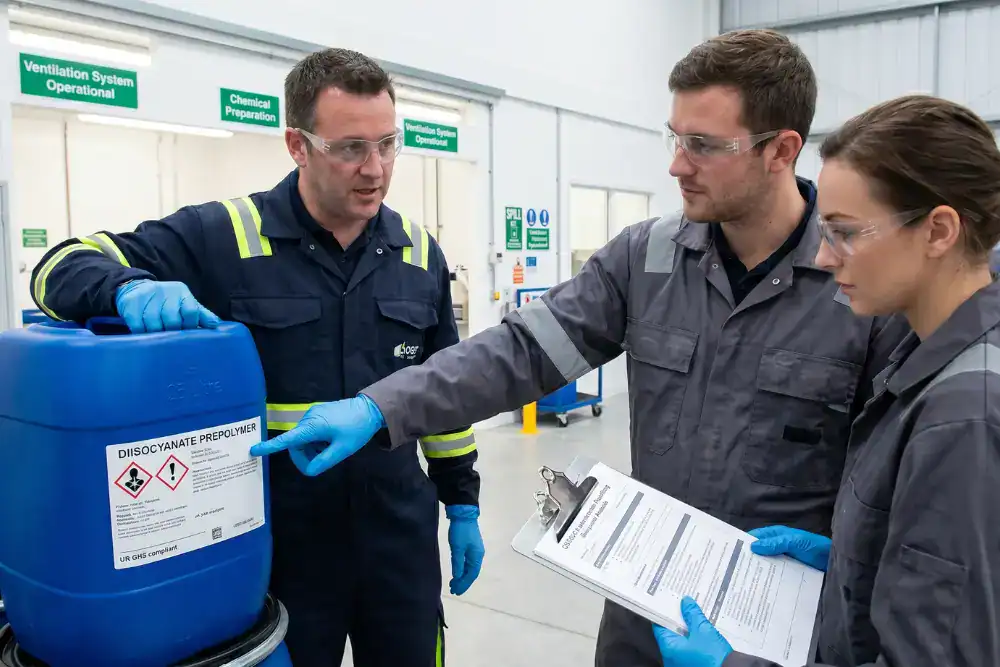
This article explains how UK REACH Annex XVII Entry 74 applies to diisocyanate products and what duty holders need to understand to manage the safe-use training requirement in practice.
A common challenge is knowing where Entry 74 fits within existing chemical safety controls.
It covers what the regulation adds, how it sits alongside COSHH, and how to apply the requirement through procurement checks, task-matched training and supervision where the work takes place.
Key Takeaways
- Entry 74 adds a safe-use training condition to the existing chemical safety law, not a replacement for COSHH.
- Training must match the actual task at General, Intermediate or Advanced level, not a generic diisocyanates certificate.
- Restricted-product identification under Entry 74 must be built into procurement and subcontractor controls.
- Booking the correct training level requires supervisors to confirm the task scope before a course is selected.
- Employers must reinforce safe-use competence between five-year refresher cycles through supervision, toolbox talks and updated method statements.
What does UK REACH Entry 74 Require for Diisocyanates?
UK REACH Annex XVII Entry 74 requires worker training before any industrial or professional use of products containing 0.1% diisocyanates by weight or more, individually and in combination (European Commission, 2020).
Products Covered by the 0.1% Threshold
The threshold applies whether the diisocyanate is present on its own or as part of a mixture. Many polyurethane foams, two-pack adhesives, sealants and coatings can exceed the 0.1% threshold and fall within the rule.
Employers must document that each worker has completed the required training before they handle the product. Records must be retained, and training must be refreshed at least every five years.
How the Three Training Levels Work
Health and Safety Courses
Our health and safety courses support legal compliance and effective risk management. They raise awareness of common workplace hazards and teach the fundamentals of safe working.
Entry 74 divides training into three levels, based on the risk of the task:
- General level. Suitable for most industrial and professional users.
- Intermediate level. Covers higher-exposure tasks, including open handling at ambient temperature and mixing operations.
- Advanced level. Required for the highest-exposure tasks, including spraying outside an enclosed booth.
The required training level is the benchmark. The duty holder must match the booked course to the work actually being done (HSE, n.d.a).
For a more complete breakdown of who needs each level and what the courses cover, see our existing guide on the mandatory training requirement.
What does UK REACH Entry 74 Add to Existing Chemical Safety Law?
Entry 74 adds a safe-use training condition for industrial and professional use of diisocyanates above 0.1% by weight (European Commission, 2020). That condition sits alongside COSHH; it does not replace it (UK Government, 2002).
How Entry 74 Fits Alongside COSHH
COSHH remains the substance-control framework UK duty holders already use. It covers risk assessment, prevention or control of exposure, equipment maintenance, and information, instruction and training under Regulations 6, 7, 9 and 12 (UK Government, 2002). Entry 74 adds a further training condition at the point of industrial or professional use.
Supplier and Employer Duties Under Entry 74
Two further duty types support that condition. Suppliers must label diisocyanate-containing products to state that adequate training is required before industrial or professional use. They must also provide training material in the official language of the country of supply and inform the recipient of the requirement.
Employers must then verify and document that each worker has completed the appropriate training before handling, with refresher training at least every five years. A duty holder dealing with Entry 74 and COSHH must be able to evidence compliance with both sets of duties.
Where the Compliance Gap Commonly Appears
Compliance commonly breaks where the two regimes meet. Training teams may treat Entry 74 as a certificate validity issue without involving the people responsible for COSHH risk assessment.
The certificate is then in place, but the risk assessment has not been updated to reflect the use of an Entry 74-restricted product. The paperwork may look complete, while the practical link between training, risk assessment and use of the product is missing.
Entry 74 does not replace the existing chemical safety framework. It adds a specific training condition, and compliance depends on how well employers link it to procurement, COSHH assessments and supervision.
Why was a Training Condition Added for Diisocyanates?
Regulators added the training condition because existing substance controls had not reduced occupational asthma cases linked to diisocyanates sufficiently.
The European Commission introduced the original EU restriction in 2020, citing an estimated 5,000-plus new EU cases of occupational disease from diisocyanates each year (European Commission, 2020).
The European Chemicals Agency’s Risk Assessment Committee concluded that appropriate training was essential for workers handling diisocyanates. That training should give workers sufficient knowledge of the hazards, the risks associated with use, good working practices and appropriate risk management measures, including correct use of personal protective equipment (ECHA RAC, 2017).
In the UK, the Health and Safety Executive identifies isocyanates as the most commonly cited cause of occupational asthma, followed by flour (HSE, n.d.a).
The disease pattern matters because it shapes what counts as adequate control. Occupational asthma occurs when exposure to a respiratory sensitiser causes a hypersensitive state. Once a worker is sensitised, further exposure — even at quite low levels or in tiny amounts — can trigger symptoms or an asthma attack (HSE, n.d.b). For that reason, controls need to address routine work practices and foreseeable exposure routes, not just obvious high-exposure incidents.
Repeated exposure during ordinary work can create a serious health risk, even when there has been no obvious one-off failure. If training is the additional control, the next question is who must make it happen across the supply chain.
How are the Duties Under UK REACH Entry 74 Distributed Across the Supply Chain?
Entry 74 places duties on four parties, including manufacturers, suppliers, employers and workers, as well as supervisors of workers handling diisocyanates (European Commission, 2020). These duties depend on one another in practice.
Manufacturer and Supplier Responsibilities
Manufacturers and suppliers must label restricted products with a statement that adequate training is required before industrial or professional use. The label is the primary signal procurement teams can use to identify restricted products on arrival.
Suppliers must provide training material in the official language of the country of supply and inform the recipient of the training requirement. This is a supplier duty, not a goodwill gesture.
Employer, Worker and Supervisor Responsibilities
Employers must verify and document that each worker has completed the appropriate training before handling the product. This requires active checking, not simply keeping paperwork on file.
Workers and supervisors who oversee diisocyanate work must hold the relevant training certificate.
How Supply Chain Gaps Can Develop
Long subcontractor chains show how the gap can appear. A manufacturer correctly labels a sealant cartridge. An intermediate distributor stocks the cartridge but does not pass on the training material. The end-user employer then receives a labelled product without the supporting supplier information.
The employer may not be able to confirm that the worker has received training that matches the product and task. A compliance gap has been created before the product reaches the point of use.
The duties above describe what Entry 74 expects across the chain. The next section sets out where the regulation commonly fails in practice and what UK employers need to do to close the gap.
What Do UK Employers Need to Do Differently Under UK REACH Entry 74?
Three operational shifts determine whether Entry 74 compliance holds in practice, including under HSE scrutiny. Each depends on the employer’s system of work, not on individual workers alone.
Match the Training Level to the Actual Task
Employers need a booking process that matches the training level to the work. Supervisors should confirm the task scope before selecting training. Otherwise, HR or facilities may book a cheaper General-level course centrally, unaware that workers perform Advanced-level tasks, such as spraying outside enclosed booths.
Assurance checks commonly confirm the certificate is valid, but not that it matches the work. A fully certified workforce can therefore still hold the wrong level of certificate for the tasks being performed. In that case, the certificate is a documentation gap, not compliance.
Identify Restricted Products at Procurement, Not at the Worker Level
Employers need a restricted-substance flag inside procurement and subcontractor-onboarding processes. The safety data sheet (SDS) check should happen at the order stage, before the product reaches the site. That check also needs to cover client-specified products and subcontractor-supplied consumables, which can bypass central procurement under deadline pressure.
Without that flag, restricted products can arrive on site before anyone has identified them as restricted. The training check is never triggered. Entry 74 compliance should therefore be designed into procurement and subcontractor controls, rather than left to workers at the point of use.
Reinforce Competence at Point of Use
Training only has value if it is reinforced where the work happens. Employers should reflect Entry 74-restricted use in toolbox talks, method statements and supervision. Method statements also need to be reviewed when restricted products enter the workflow.
The common pressure is supervisor workload. Productivity demands can reduce toolbox talks, and method statements are often left unchanged after the original version is written. The certificate remains valid, but the worker may not be applying the controls the task requires.
A five-year refresher cycle is not the same as five years of assured competence; employers still need task-relevant competence between renewals. The certificate is the starting point for Entry 74 compliance. It is not the whole control.
What Should UK Employers Take from UK REACH Entry 74?
UK employers should take from Entry 74 that the training certificate is necessary but not sufficient, and that compliance depends on three operational systems working together.
Entry 74 adds a REACH-specific training condition alongside COSHH, which means duty holders must evidence compliance under both regimes. Regulators introduced that condition because repeated low-level exposure during routine diisocyanate work was causing occupational asthma that existing substance controls had not prevented.
Meeting the condition in practice requires procurement to identify restricted products before they reach use, training to match the actual task at the correct level, and supervision to reinforce competence where the work happens.
A paint refinisher holding the wrong training level and a subcontractor whose product bypassed procurement both illustrate how compliance can fail when those systems are not connected. Employers who build restricted-product identification, task-matched training and supervisory reinforcement into their existing COSHH processes can close the gap before it reaches the point of use.
How does Human Focus Support Diisocyanates Compliance Competence?
Human Focus provides diisocyanates training for workers and managers involved in the industrial or professional use of products that may fall under UK REACH.
The IIRSM-approved Diisocyanates Awareness Training course covers diisocyanate health hazards, exposure routes, control measures and the correct use of personal protective equipment. It is designed for workers in sectors where diisocyanate-containing products may be used, including manufacturing, automotive, construction and related work environments.
The IIRSM-approved Diisocyanates Training for Managers course covers the legal background, risk controls, training responsibilities and supervisory checks relevant to managing work with diisocyanate-containing products. It is designed for those involved in planning, overseeing or checking work where UK REACH may apply.
Both courses generate a record of completion, which employers can retain as part of their wider training and compliance evidence.