In short: The employer or organisation controlling the use of a hired ladder is normally responsible for ensuring it is suitable and safe, even though it does not own the equipment. The hire company has separate duties as a supplier and may remain responsible for matters within its control. Current inspection evidence from the supplier can form part of your compliance arrangements, but hiring a ladder does not remove your own duties.
Ladder Inspection for Hired Equipment: Who Is Responsible?
Responsibility for the safe use of hired ladders normally sits with the employer or organisation controlling the work. The hire company retains its supplier duties and any responsibilities arising from matters within its control.
It is easy to assume that the hire company is solely responsible for inspecting a hired ladder because it owns the equipment. However, the organisation using the ladder retains its own duties.
This article is written for site managers, facilities and maintenance managers, contractors and health and safety leads who hire ladders as part of normal work. It explains how the hire company’s duties as a supplier overlap with your organisation’s duties, and sets out a defensible process for hired equipment that you can put in place straight away.
Key Takeaways
- When you hire a ladder, the employer or organisation controlling its use normally keeps the legal duty to make sure the ladder is suitable, safe and inspected as required. Ownership by the hire company does not move that duty to them.
- The hire company has its own duties as a supplier under health and safety law and may keep responsibility for matters within its control, such as the ladder’s condition when it leaves the depot. Responsibilities can overlap, so a hire agreement should set out clearly who does what.
- A supplier’s inspection record can support your compliance arrangements, but it does not automatically prove the ladder is safe for your task, and it does not take away your ongoing responsibilities.
What Law Applies to a Hired Ladder?
A hired ladder is governed by the same core health and safety law as any other ladder used for work. In Great Britain, a ladder used at work is work equipment subject to relevant general duties under PUWER, while its use for work at height is also governed by the Work at Height Regulations 2005.
The hire company, as the supplier, also has duties under Section 6 of the Health and Safety at Work etc. Act 1974.
How PUWER and the Work at Height Regulations Apply to a Hired Ladder
Under PUWER, a ladder used at work must be suitable for the task, maintained in a safe condition and used by people who have received adequate information, instruction and training.
Where the ladder is used for work at height, the Work at Height Regulations 2005 govern its planning, supervision, selection, positioning, use and inspection. The applicable inspection requirements arise under regulation 12 of those Regulations rather than regulation 6 of PUWER.
The relevant duties apply to employers and self-employed people. They also apply to anyone who controls the ladder, its use or the work at height, to the extent of that control. It is worth being clear from the outset about the legal requirement to inspect your ladders.
Passing an inspection does not, on its own, make a ladder the right choice for a task. A risk assessment should show that equipment offering a higher level of fall protection is not justified because the risk is low and the work is of short duration, or because existing workplace features cannot be altered.
The Hire Company’s Duties as a Supplier
Section 6 of the Health and Safety at Work etc. Act 1974 places duties on suppliers, including hire companies. So far as is reasonably practicable, a supplier must make sure that equipment provided for use at work is safe and without risks to health when it is used properly, and must give adequate information about how the equipment is meant to be used and the conditions needed to use it safely.
Why LOLER Does Not Apply
One set of regulations that does not apply is the Lifting Operations and Lifting Equipment Regulations 1998, known as LOLER. These cover lifting equipment, and an ordinary portable ladder is not lifting equipment. A “current LOLER certificate” is therefore not the relevant evidence for a portable ladder, and it does not replace the PUWER and Work at Height requirements that do apply.
How the Legal Duties Overlap
More than one organisation can hold a legal duty at the same time. The hire company holds supplier duties under Section 6 and may keep responsibility for matters within its control, while the employer or organisation controlling how the ladder is used keeps its own duties under PUWER and the Work at Height Regulations. A hire agreement can hand over practical tasks such as maintenance and inspection, but neither party should assume the agreement removes its legal duties.
Does the Hire Company's Inspection Remove Your Duty?
No. A hire company’s inspection is valuable evidence, but on its own it does not remove the duties of the organisation using the ladder. Current evidence from the supplier can support your arrangements; it cannot replace them.
What Inspection Evidence Must Accompany the Ladder
Where regulation 12 of the Work at Height Regulations requires an inspection, a ladder must be accompanied by physical evidence of the most recent required inspection when it leaves one undertaking or is obtained from another for use.
This evidence can support the supplier’s and user organisation’s arrangements, but it does not by itself demonstrate that every supplier duty has been met or that the ladder is suitable for the user’s task.
When Supplier Evidence Can Support Your Arrangements
Adequate, current supplier evidence can form part of your compliance arrangements and can save you duplicating the same detailed inspection, but it does not make the ladder automatically suitable and safe at your site. The ladder still has to be right for the specific task and environment, and it still has to be checked and inspected in use.
What to Do if Evidence Is Missing or There Is Doubt
If the required inspection evidence is missing or out of date, or if there is any doubt about the ladder’s condition or suitability, do not use the ladder until a competent person (someone with the knowledge, experience and training to assess it) has confirmed it is safe and any required inspection has been completed.
A supplier’s inspection record is important evidence, but it is not a transfer of all responsibility. If something goes wrong, an inspector may examine the arrangements and records of every organisation involved, including the supplier’s inspection records and your own decisions on equipment selection, pre-use checks, inspection and supervision.
What Must You Do When You Hire a Ladder?
When you hire a ladder, you should manage its safety through three practical layers of control: verifying it on arrival, checking it before each use, and arranging recorded detailed inspections at set intervals. Together, and alongside the supplier’s evidence, these layers give you a defensible process for hired equipment.
Arrival verification
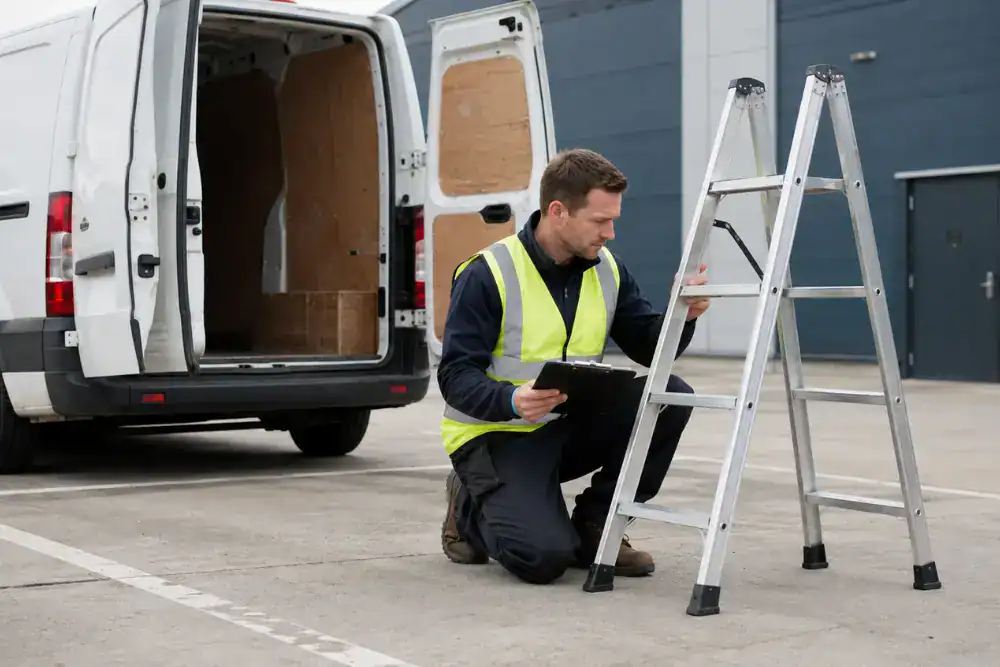
On arrival, confirm the ladder is the right type for the task, undamaged and complete. Obtain the user information and, where an inspection is required, physical evidence of the most recent inspection. You do not automatically need a fresh, duplicate detailed inspection when adequate current evidence already exists. If evidence is missing or the ladder’s condition is uncertain, do not use it until a competent person has confirmed it is safe.
Pre-use checks
Before each use, the person using the ladder carries out an informal visual and functional check, at the start of each working day and again after anything happens that may have affected its condition. The simplest pre-use checks do not normally need to be recorded, but users need adequate information, instruction and training to carry them out properly.
Detailed inspections
A competent person carries out recorded detailed inspections at fixed intervals. Those intervals are set through risk assessment, taking account of the manufacturer’s instructions, the conditions the ladder is used in, industry advice and the ladder’s inspection history. A detailed inspection is also needed after any exceptional event that may have affected safety, such as a fall or a heavy impact. Keep the inspection record until the next inspection has been carried out and recorded.
Taken together, these three layers mean your organisation should be able to show that it checked the ladder’s suitability and condition on arrival, obtained appropriate supplier inspection evidence, made sure users carry out pre-use checks, and arranged further recorded inspections where they are needed. The supplier’s evidence and your own controls should work as one system, not as two separate records that never meet.
What Should a Ladder Inspection Check?
A ladder inspection should cover safety-related parts, including the stiles, rungs or steps, feet, locking mechanisms, hinges and the ladder’s general condition. The aim is to find damage, wear or missing parts before the ladder is put under load.
- Stiles (the two long side rails). Check for bending, denting, cracking, splitting or corrosion. A damaged stile can fail suddenly under load.
- Rungs and steps. Make sure they are all present, secure, undamaged and free of anything, such as mud, oil or grease, that could cause a slip.
- Feet. Check that the anti-slip feet are present, undamaged and gripping. Worn, damaged or missing feet can cause a ladder to slip.
- Locking mechanisms and hinges. On stepladders and combination ladders, confirm that the locks, stays and hinges engage correctly and are not worn or damaged.
- General condition. Check tie rods, welded joints, rivets, stays and any stepladder platform for damage, looseness or missing parts. Look for makeshift repairs or modifications, and do not assume an altered ladder is safe without a competent person confirming it.
Some of these faults are easy to overlook at a glance, which is why it helps for the people carrying out checks to know the ladder hazards most workers miss.
What Should You Do With a Defective Hired Ladder?
If you find a defect in a hired ladder, take it out of use immediately and stop anyone from using it. The steps below set out how to handle it.
- Move the ladder away from the work area, quarantine it and tag it clearly with a “Do Not Use” label, so no one can pick it up and use it by mistake.
- Report the defect to the hire company and follow the agreed procedure for return, repair or replacement.
- Do not attempt an unauthorised repair, and do not return the ladder to service until it has been competently repaired and confirmed as safe.
Whatever the hire agreement says about repairs, the organisation controlling the ladder’s use must ensure that a known defective ladder is taken out of use and cannot be used again until it is safe. The defect should also be reported to the hire company and handled under the agreed return, repair or replacement procedure.
How Does Control Affect Responsibility for a Hired Ladder?
Control is central to determining responsibility, but it is not the only factor. The employer or organisation controlling the ladder’s use must manage its safety on site, while the hire company retains its duties as supplier and any other responsibilities arising from matters within its control.
A supplier’s inspection record can support your compliance, but it does not make the ladder automatically suitable or safe for your task. Your duties under PUWER and the Work at Height Regulations stay with you even when the ladder is hired, so it is worth setting out clearly in the hire agreement who is responsible for what. Arrival verification, current supplier evidence, trained pre-use checks and further recorded inspections where they are required all work together to support compliance.
If you want to build that knowledge in the people who carry out these checks, Human Focus Ladder Inspection Training provides awareness and supporting knowledge on ladder checks, common defects and inspection records. As an employer, you would still need to confirm that anyone inspecting your ladders has enough knowledge and experience for the task and is authorised to carry it out.