The Building Safety Regulator (BSR) can require information, decide building control and assessment applications, investigate breaches and take enforcement action in England. Since leaving the Health and Safety Executive (HSE) on 27 January 2026, it has operated as a standalone executive non-departmental public body sponsored by the Ministry of Housing, Communities and Local Government (BSR et al., 2026).
Dutyholders receiving a request or notice need to establish what must be supplied or changed, who will organise the response and when it is due. Where corrective work is required, the response should explain what has been completed and checked, and identify anything still outstanding.
On 16 May 2023, Lancashire Fire and Rescue Service visited a warehouse being converted into apartments in Preston. Fire safety concerns led the service to prohibit use of the building. Residents already living there had to leave while construction work was still underway (HSE, 2025).
HSE’s subsequent inspection found no fire detection system or means of raising the alarm, inadequate escape plans and work that had not been phased to maintain fire compartmentation. It issued a prohibition notice requiring work to stop until adequate precautions were in place. An improvement notice also required the company to prepare and implement a fire management plan (HSE, 2025).
Visits in June and November 2023 found that construction had continued without action to comply with either notice. The company was subsequently found guilty of four offences and fined £165,000. The published account does not confirm whether the defects were later corrected or residents returned (HSE, 2025).
This was an HSE and fire service prosecution. BSR uses different statutory powers, so dutyholders need to identify the legal basis of each request or notice before deciding what evidence to provide and what action to arrange (BSR, 2023).
BSR regulates higher-risk buildings in England, oversees building standards and regulates the building control profession. Its wider competence and professional registration functions also extend across England and Wales (BSR, n.d.-a).
The January 2026 move from HSE changed BSR’s organisational status (BSR et al., 2026). It exercises powers under the Building Safety Act 2022 and related legislation.
HSE and the fire service took the enforcement action at Glovers Court (HSE, 2025). BSR has separate powers. Its involvement does not remove dutyholders’ responsibilities or replace fire and rescue authorities’ own enforcement functions (BSR, 2023).
The relevant interaction depends on the building and the activity taking place. The higher-risk building threshold is at least 18 metres or at least seven storeys, combined with use criteria. During design and construction, this includes buildings containing at least two residential units, hospitals and care homes (MHCLG, 2025a).
During occupation, the regime generally requires at least two residential units and excludes buildings used entirely as hospitals or care homes. Other statutory exclusions apply, so use the definition for the relevant phase (MHCLG, 2025b).
For occupied buildings, an accountable person (AP) is an organisation or individual that owns or has relevant repairing obligations for common parts. A sole AP is also the principal accountable person (PAP). Where there are several APs, the PAP is the one responsible for the structure and exterior (BSR, 2024d).
The evidence BSR needs differs at each stage.
Planning permission does not provide building control approval. Registration is not a BAC assessment, and a BAC is not a completion certificate (BSR, 2026c; BSR, 2026b; BSR, 2024c; BSR, 2026d).
Check exemptions and transitional arrangements before deciding which building control route applies. Work in an occupied higher-risk building can bring construction and occupation duties into play together. The client and construction dutyholders’ responsibilities do not replace the APs’ ongoing duties (BSR, 2026c; BSR, 2024d).
Some contact with BSR must also be initiated by dutyholders. Principal designers and principal contractors during building work, and APs during occupation, have mandatory notification and reporting duties for qualifying safety occurrences. Apply the official reporting criteria, rather than wait for a request. A resident complaint is not automatically a reportable occurrence (BSR, 2025).
BSR can require information for applications, assessments and investigations. For a design submission, the evidence explains proposed work; for an occupation assessment, it shows how building safety risks are being managed.
For building control approval, evidence must explain how the work will comply with building regulations and how the project will be controlled. Documents can include plans, the building regulations compliance statement, the client’s competence declaration and construction and change control plans. Requirements vary with the application and work (BSR, 2026e).
In a study involving ten building professionals in England, a director of a chartered surveying company described their experience of construction records. “Clients rarely provide us with as built construction drawings but when they do, they are never correct!” (Çıdık & Phillips, 2021).
The account came from a small qualitative study published before the current regime was implemented. It cannot establish how common inaccurate drawings are today. A team preparing a submission needs to check whether its drawings reflect the building.
For a BSR application, identify the relevant version and check what supports it. Where the work has changed, the record needs to follow that change. At completion, BSR reviews updated documents and the change log, inspects completed work and considers the required handover (BSR, 2026b).
BSR also warns against substituting a construction phase health and safety plan for a construction control plan. The building regulations principal designer role likewise has different competence requirements from the role under the Construction (Design and Management) Regulations 2015 (CDM) (BSR, 2026e).
BSR’s general contact service cannot provide building regulations compliance advice or advice on English building control applications before they have started. Teams should obtain the competent design and compliance advice their project needs (BSR, 2024a).
A BAC application must show how the relevant occupation duties are being met. The PAP has 28 calendar days to apply when instructed by BSR. Required material includes the safety case report, resident engagement strategy and information about the mandatory occurrence reporting system (BSR, 2026a).
The application also requires current information, details of compliance notices in force and confirmation that relevant building information is being provided to the required people and organisations (BSR, 2026a).
The safety case report explains the building’s fire spread and structural failure risks and how they are managed. BSR’s guidance asks for outstanding actions, completion timescales and relevant temporary measures, alongside completed work (BSR, 2024b).
When an inspection identifies a defect, a work order records the request for a repair. The organisation needs to establish whether the repair happened, how completion was checked and what precautions apply while the defect remains.
BSR may ask for further records, discussions or demonstrations of management systems after receiving a BAC application (BSR, 2026d). Teams therefore need to be able to explain how the arrangements described in the report work in practice.
Routine application material is different from a formal investigatory requirement. Under Schedule 2 of the Building Safety Act 2022, an authorised officer can require specified information or documents for a relevant purpose by a specified time. A written notice must identify the statutory requirement and consequences of non-compliance (Building Safety Act 2022, Sch. 2, para. 4).
The purpose must fall within the officer’s authorisation, and legally privileged material is protected. Entry powers distinguish non-domestic premises from private dwellings, for which Schedule 2 provides a warrant procedure. Establish the notice’s basis and scope promptly and obtain appropriate advice where needed (Building Safety Act 2022, Sch. 2, paras. 1–3, 7–8).
BSR can require breaches to be remedied, stop specified building work where the legal conditions are met, investigate and prosecute. The applicable power depends on which regime is involved.
At Glovers Court, HSE’s prohibition notice required work to stop until adequate fire precautions were established. Its improvement notice required a fire management plan. The company was later fined £165,000 (HSE, 2025).
As building control authority, BSR can issue compliance notices requiring specified steps or a breach to be remedied within a stated period. Stop notices can prohibit specified work. Grounds include work without required approval, a breached compliance notice or non-compliance meeting the serious harm condition (Building Act 1984, ss. 35B–35C; BSR, 2023).
For occupied higher-risk buildings, BSR can serve a compliance notice on an AP who appears to have breached, be breaching or be likely to breach a relevant requirement. Where the contravention has placed or will place people in imminent danger, it can designate the notice an urgent action notice (Building Safety Act 2022, s. 99).
BSR can also apply to the tribunal for a special measures manager. The tribunal can make an order where there has been a serious failure, or failures on two or more occasions, to comply with relevant AP duties (Building Safety Act 2022, Sch. 7, para. 4).
Teams should not assume there will always be another warning before stronger action. BSR’s enforcement policy bases decisions on the circumstances, risk and seriousness of non-compliance (BSR, 2023).
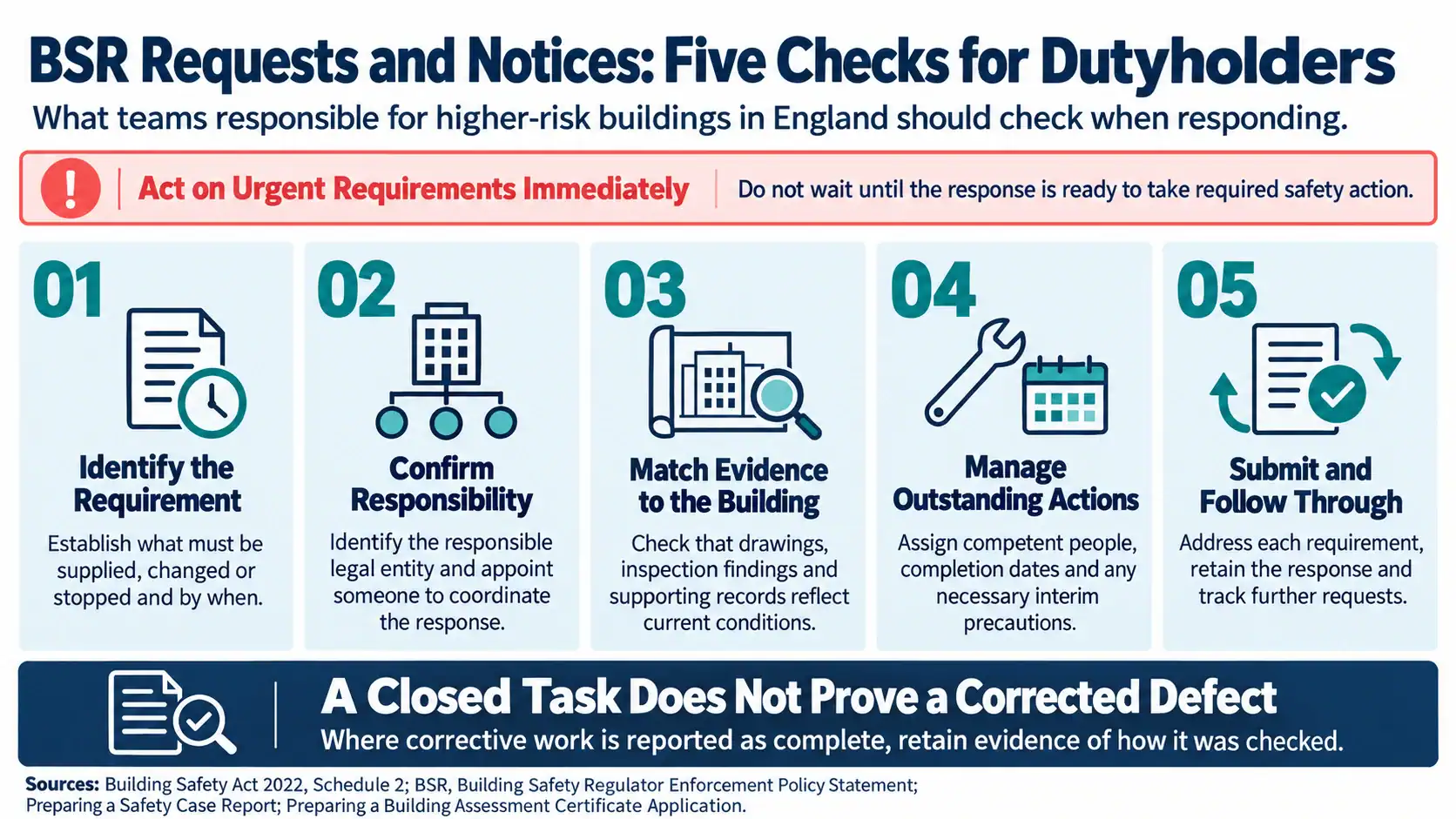
Start by establishing what must be supplied or changed, then put someone in charge of coordinating the response.
- Establish whether the correspondence concerns an application, assessment evidence, a formal information notice or corrective action. Record what is due and when. Raise unclear points promptly, but do not assume a clarification request suspends a deadline.
- Identify the legal entity responsible and the person coordinating its response. A client can authorise an applicant, and a PAP can use a managing agent, while retaining the relevant legal responsibility. Make sure the coordinator can obtain decisions and records from the people involved (BSR, 2026c; BSR, 2024d).
- Create a short schedule linking each requested item to its supporting record. Check the building, date and version. Where an inspection report and an action tracker disagree, resolve the discrepancy before relying on either.
- Give outstanding assessments, records and repairs to competent people with clear completion dates. Establish what precautions are needed while work remains outstanding. Retrieving a document and correcting an unsafe condition require different actions, even when both appear on the same response schedule.
- Retain what was submitted and track further questions. For corrective work, check the evidence that the required action has been completed. A submitted plan or a closed administrative task should not be treated as proof that conditions have changed.
Prepare the safety case report, engagement strategy and reporting arrangements without waiting to be called for a BAC assessment (BSR, 2026d).
In July 2026, BSR announced plans for a more proportionate BAC process, including calling in new applications only when necessary while improvements were developed. The announcement expressly retained AP and PAP duties to manage fire spread and structural failure risks (BSR & MHCLG, 2026).
A BAC records an assessment of specific duties at that time. It does not guarantee continuing safety (BSR, n.d.-b).
Human Focus’s Building Safety Act Duties and Compliance for Accountable Persons & Principal Accountable Persons course supports teams in understanding occupied-building duties and how to evidence the management of building safety risks. Teams need to apply that understanding in their building’s management arrangements, using accurate records and competent advice.
The follow-up visits at Glovers Court found work continuing without action to comply with either notice. Before submitting a BSR response, check that it addresses each requirement and identifies any outstanding work. Where corrective work is reported as complete, include the evidence of how it was checked.