In short: This article explains what a lift plan under the Lifting Operations and Lifting Equipment Regulations 1998 (LOLER) should contain and gives readers a practical way to check whether it is suitable for a workplace lifting operation (lifting or lowering a load) in Great Britain. A LOLER lift plan should record the information, decisions and controls that a competent person (someone with the training, knowledge, skills and experience needed to plan the operation) needs to plan the use of lifting equipment (work equipment for lifting or lowering loads, including attachments used to anchor, fix or support it). The plan should also support appropriate supervision and safe completion of the operation.
What Must a LOLER Lift Plan Include? A Guide for Duty Holders
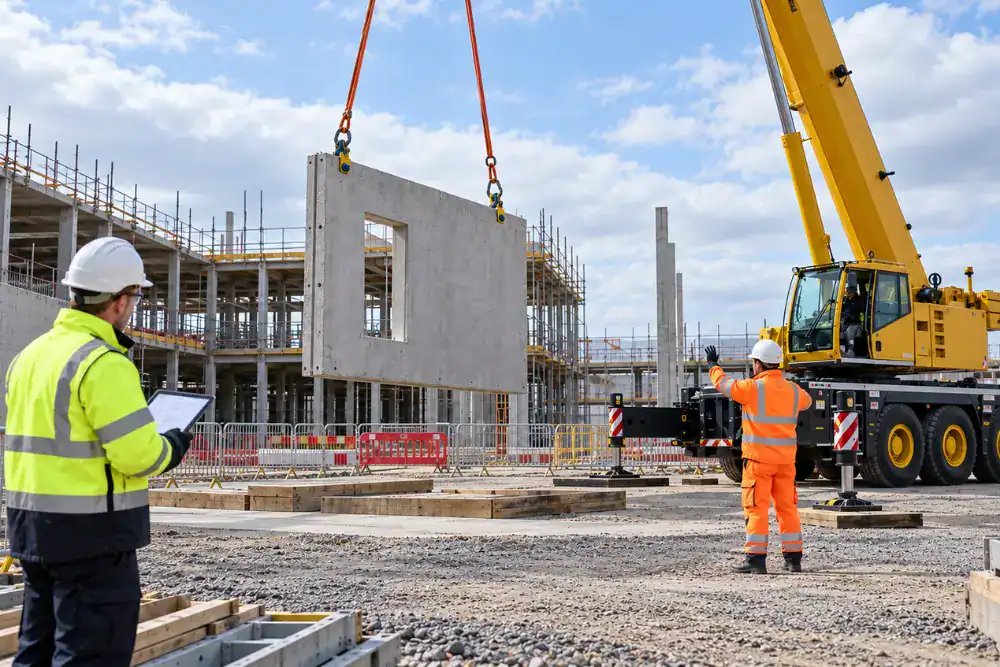
The guide shows duty holders how the information a LOLER lift plan needs to contain depends on the lifting equipment, complexity and foreseeable risks of the operation, so they can identify what is relevant to a particular lift rather than treat the plan as a fixed checklist. The detailed sections below therefore describe information to record where it is relevant to the lift and necessary to support safe planning (HSE, 2024a).
In Great Britain, the legal basis for lift plan duties is Regulation 8 of the Lifting Operations and Lifting Equipment Regulations (LOLER) 1998 (Great Britain, 1998a).
The guide covers duty holders in Great Britain: employers, self-employed people to whom Regulation 3 applies and people with relevant control to the extent of that control; Northern Ireland has separate 1999 regulations (Great Britain, 1998a; Northern Ireland, 1999).
Does Every LOLER Lifting Operation Need a Separate Written Lift Plan?
No. LOLER does not prescribe a separate written document for every lifting operation (Great Britain, 1998a; HSE, 2024a).
Health and Safety Executive (HSE) guidance says a generic plan (one plan prepared for repeated similar operations) may be sufficient for straightforward common work. A complex or high-risk operation, such as a tandem lift in which two or more cranes lift one load, needs more extensive planning and usually a written plan (HSE, 2024a).
HSE’s Approved Code of Practice, which is not legislation but can be used in criminal proceedings as evidence of whether the law was complied with, explains that the person planning the operation should understand both the principles behind lifting operations and how they work in practice, and should have experience planning them (HSE, 2014).
What Should a LOLER Lift Plan Define About the Lift Scope?
A LOLER lift plan should define the load, the intended lifting sequence and the limits of the operation.
Under LOLER, a load can include material, a person or an animal (Great Britain, 1998a; HSE, 2024b).
The plan should identify:
- The load’s description, total mass, dimensions, shape and contents, including any container or lifting accessory (equipment used to connect the load to lifting equipment) whose mass forms part of the lifted load.
- The centre of gravity (the point through which the load’s weight can be treated as acting), including any uncertainty caused by liquid, or loose or shifting contents.
- The lifting points (the attachment points provided on the load), their condition and any limits stated by the designer, manufacturer or other reliable source.
- The starting position, final position, intended orientation and prepared support at the landing area.
- The permitted movement and any limits on height, direction, speed, clearance or approach.
Where these stages apply, the lifting sequence should be set out in the order in which the work is carried out (HSE, 2014):
- Attachment: secure the selected slings (flexible assemblies used to support or connect a load), shackles (removable U-shaped connectors secured by a pin) or other lifting accessories to verified lifting points on the load.
- Initial take-up: apply the load gradually to the accessories before lifting clear so that balance and security can be checked.
- Lift: raise the load clear of its support without snagging or uncontrolled movement.
- Travel or slewing: move the load along the planned route; slewing means rotation of a crane’s upper structure or lifting arm.
- Landing: place the load on its prepared support in the intended orientation and release tension only when the load is stable.
- Detachment: remove the accessories only when the load no longer relies on the lifting equipment for stability.
For an unstable, flexible or shifting load, the plan should also specify any temporary support, restraint or controlled method needed during landing and release.
What Equipment Details Should a LOLER Lift Plan Record?
A LOLER lift plan should identify the selected lifting equipment, the way it is set up, the relevant accessories and the limits that apply during the operation.
Regulation 4 of LOLER requires lifting equipment to have adequate strength and stability for each load, with particular regard to stress at mounting or fixing points; each part of the load and anything attached to it and used in lifting must also have adequate strength (Great Britain, 1998a).
The plan should record the equipment type, model or identifier, its setup, its rated capacity (the manufacturer’s permitted load for that setup), operating limits and setup requirements. Where capacity varies, record the length of the boom or jib (a structural member that supports or positions the load), the operating radius (the horizontal distance between the equipment’s axis of rotation and the vertical line through the load), the manufacturer’s load chart (the table or diagram of permitted loads), counterweight (weight fitted to balance the equipment), support arrangement and any reduction in permitted capacity.
Lifting accessories (items used to connect lifting equipment to a load) may include slings (flexible assemblies used to support or connect the load), lifting chains, shackles (removable U-shaped connectors secured by a pin), lifting hooks and lifting beams (rigid devices suspended from lifting equipment to support a load at more than one point). The plan should identify each selected item and, where relevant, account for the capacity marked on it, its condition, length, connection method and the effect of the angle between the legs of a sling.
Regulation 4 of the Provision and Use of Work Equipment Regulations 1998 (PUWER) separately requires work equipment to be suitable for its intended use and conditions. This legal duty applies alongside LOLER. HSE planning guidance and the manufacturer’s selection instructions can help duty holders meet these duties, but those sources are not legislation (Great Britain, 1998a; Great Britain, 1998b; HSE, 2026).
The plan should use current equipment records and load information as inputs, but those records do not replace confirmation that the selected equipment and attachment method suit the planned lift (HSE, 2024b). A pre-use check is a user’s visual or functional check before use. A thorough examination is a systematic and detailed examination by a person who is competent for that specific examination task; lift-planning experience alone does not establish that competence. Under Regulation 9, thorough examination is required before an employer first puts lifting equipment into service unless an exception applies. Where safety depends on installation conditions, it is also required after installation and before first use, and after assembly at a new site or location and before use there. Lifting equipment exposed to conditions that can cause deterioration leading to danger must also be thoroughly examined at least every six months if it lifts people or is a lifting accessory, at least every 12 months for other lifting equipment, or in accordance with an examination scheme (a suitable schedule drawn up by a competent person for thorough examinations at appropriate intervals), and after exceptional circumstances that could have affected the equipment’s safety (Great Britain, 1998a; HSE, 2014).
What Stability Information Should a LOLER Lift Plan Include?
A LOLER lift plan should record the ground or supporting-structure information needed to show that the equipment can remain stable under the planned loads.
Relevant information may include:
- The manufacturer’s maximum loads passed to the ground through the base, wheels, tracks or an outrigger (an extendable support that transfers load from mobile equipment).
- The ground bearing capacity (the maximum pressure the ground can safely support under the assessed conditions) or the capacity of a floor, slab, deck or other supporting structure, including any uncertainty and stated limits.
- Ground type, level, slope, drainage, recent weather, filled or previously disturbed ground, and any signs of deterioration.
- Underground services, basements, culverts (channels or conduits beneath the ground), voids, trenches, excavations, edges and retaining structures (structures that hold back soil or other material) that could affect support.
- The need and design basis for a spreader mat or plate (a support that increases contact area and reduces pressure on the ground).
- The access and travel route where mobile equipment remains loaded or partly loaded.
‘The competent person should use manufacturer-supplied support-load data (the forces the equipment is expected to transfer through its base, wheels, tracks or outriggers) and reliable ground or structural information rather than visual appearance alone. If the information needed to assess stability cannot be established by the competent person, the operation should not proceed until advice from someone competent in ground or structural assessment resolves the uncertainty (HSE, 2014; Construction Plant-hire Association, 2014).
Nearby excavations, edges and underground features should be assessed for their effect on the support area; distance alone does not establish suitability. Adding mats or plates also does not establish suitability unless their size, strength and interaction with the ground or structure have been assessed (HSE, 2014; Construction Plant-hire Association, 2014).
How Should a LOLER Lift Plan Control the Load Route?
A LOLER lift plan should define the load path (the intended route of the load) and, where the risk assessment (the process of identifying hazards, evaluating risk and selecting controls) identifies the need, any exclusion zones (areas from which people are kept during specified stages).
The route should account for the load’s dimensions and balance, available clearance, possible swing or rotation, snagging points, areas outside the operator’s view and nearby people, vehicles, work machinery and equipment, structures or utility services. The plan should state how access is controlled and identify the person with authority to pause movement if the route or exclusion arrangements cannot be maintained.
Regulation 6 requires lifting equipment to be positioned or installed so that the risk of the equipment or load striking a person, or a load drifting, falling freely or being released unintentionally, is reduced to as low as is reasonably practicable (the legal test under which further risk reduction is required unless the time, trouble and cost would be grossly disproportionate to the risk) and the equipment is otherwise safe (Great Britain, 1998a; HSE, 2014).
HSE guidance says loads should not be suspended over occupied areas where this can be avoided. Where it cannot be avoided, safe systems of work (agreed arrangements specifying how the task is to be carried out safely) and appropriate precautions should be used to minimise the risk, and access beneath a load suspended for a significant period should be restricted as a danger zone (an area where access is controlled because of the risk) (HSE, 2024a).
How Should a LOLER Lift Plan Assign Roles?
A LOLER lift plan should identify the people assigned to each role that affects safe operation and set out the required communication arrangements before and during the operation.
Depending on the operation, the plan may identify:
- The person who planned the operation and the scope of that person’s authority.
- The person providing the level of supervision identified by the plan.
- The equipment operator and any limit on the operator’s field of view.
- The person attaching and detaching the load.
- The signaller (the designated person who communicates movement instructions to the operator).
- The person controlling the work area, access or interaction with other activities.
HSE guidance says the competence of the people who plan and supervise lifting should match the operation’s risk and complexity. Direct supervision is not necessary for every routine operation, but the level provided should be appropriate to the risk and the experience of the people involved (HSE, 2024a).
Communication arrangements should specify the approved signals or radio channel, who gives movement instructions, how instructions are acknowledged, the response to lost or unclear communication and a stop instruction understood by everyone involved. Where more than one organisation is involved, the plan should record how they coordinate. A contract may divide tasks, but it does not remove a legal duty that applies to an organisation because of its control and the circumstances (Great Britain, 1998a; Great Britain, 1998b).
What Environmental Conditions Should a LOLER Lift Plan Address?
A LOLER lift plan should address each foreseeable environmental condition and interface risk (a risk created by interaction with other people, vehicles, equipment or simultaneous work) that is relevant to the operation.
Relevant conditions may include wind, visibility, lighting, rain, ice, temperature, lightning, water movement, vehicle routes, public access and work taking place nearby. The controls should follow equipment-specific and manufacturer limits where available, with any assumptions stated in the plan.
The plan should state measurable conditions for delaying or stopping the operation and identify the person authorised to make that decision. A condition outside the plan’s assumptions or limits should be handled through the change process below (HSE, 2024a).
How Should a LOLER Lift Plan Address Abnormal Events?
A LOLER lift plan should include arrangements matched to the reasonably foreseeable abnormal events and emergencies.
Relevant events may include:
- Loss of electrical, hydraulic (fluid-powered) or other operating power.
- A snagged, unstable, damaged or shifting load.
- An equipment fault, alarm or overload warning.
- Loss of agreed communication.
- An obstruction or unauthorised entry into a restricted area.
- Weather or visibility deteriorating beyond a stated limit.
- A medical emergency during an operation that lifts a person.
For each relevant event, the plan should set out the equipment-specific means of holding, lowering or placing the load, the person with authority to act, the communication needed and any rescue arrangement. Specialist input may be necessary where recovery creates a risk not covered by normal operating procedures (HSE, 2014).
When equipment lifts people, Regulation 5 requires safeguards against the person being crushed, trapped, struck or falling from the carrier (the platform, cage, cradle or other device supporting the person); for activities carried out from the carrier, Regulation 5(1)(b) imposes a qualified rather than absolute duty, meaning that prevention is required only where the balance of risk against the time, trouble and cost of further precautions does not make those precautions grossly disproportionate (Great Britain, 1998a; HSE, 2024c).
Regulation 5 also requires suitable devices to prevent the carrier from falling and requires that a person trapped in a carrier is not exposed to danger because they are trapped and can be freed. If carrier-fall risk cannot be prevented for reasons inherent in the site and height differences, Regulation 5(2), which HSE guidance says relates solely to mine winding gear (equipment used to raise or lower people in a mine shaft), requires the carrier to have a suspension rope or chain with an enhanced safety coefficient (a higher ratio of breaking load to working load) and requires that rope or chain to be inspected by a competent person every working day (Great Britain, 1998a; HSE, 2014).
How Should a LOLER Lift Plan Control Changes?
A LOLER lift plan should distinguish permitted adjustments from changes that could invalidate its assumptions or controls.
A relevant change may involve the load, equipment, setup, lifting points, route, landing area, ground or supporting structure, weather, visibility, people involved or nearby work. A change is material when it can affect the validity of the risk assessment, equipment limits or planned controls.
When a material difference is identified:
- Stop the operation at a safe point and do not continue without review.
- Ask a competent person to assess the difference, including any effect on equipment limits, stability, the route, people and other controls.
- Revise and communicate the plan where necessary, record the authorisation required by the organisation’s arrangements, and resume only when the revised controls are in place.
How Can Duty Holders Judge Whether a LOLER Lift Plan Is Working?
Duty holders should judge a LOLER lift plan by whether it gives competent people an operation-specific basis for planning, supervising and carrying out the lift safely.
Relevant information should reflect the load, equipment, supporting conditions, route, roles, environment and foreseeable abnormal events that matter for the particular operation.
The document supports competent planning and supervision but does not replace competent decisions or effective controls in practice.
How Can Training Support a LOLER Lift Plan?
If you need structured learning to recognise and review the lift-plan components discussed in this article, Human Focus’s LOLER Management and Inspection for Duty Holders course covers relevant risks, equipment suitability and LOLER duties. It includes access to two LOLER inspection checklists, subject to the current course terms, and learners who complete the course and score at least 80% in the assessment receive a certificate.
Completion of the knowledge-based course does not by itself make a learner competent or authorised for a workplace role; where an employer assigns the role, it remains responsible for confirming the learner’s task-specific knowledge, skills and practical experience and for providing procedures, controls and supervision.