In short: IOSH Working Safely is a foundation-level health and safety course for workers across many roles and sectors. It helps workers recognise hazards, understand risk and know when to follow safety measures, stop work or raise a concern. The course is best suited to frontline workers, new starters and employees who need a shared safety baseline. Managers and supervisors with formal health and safety responsibilities usually need IOSH Managing Safely instead.
IOSH Working Safely: What the Course Covers and Who It’s For
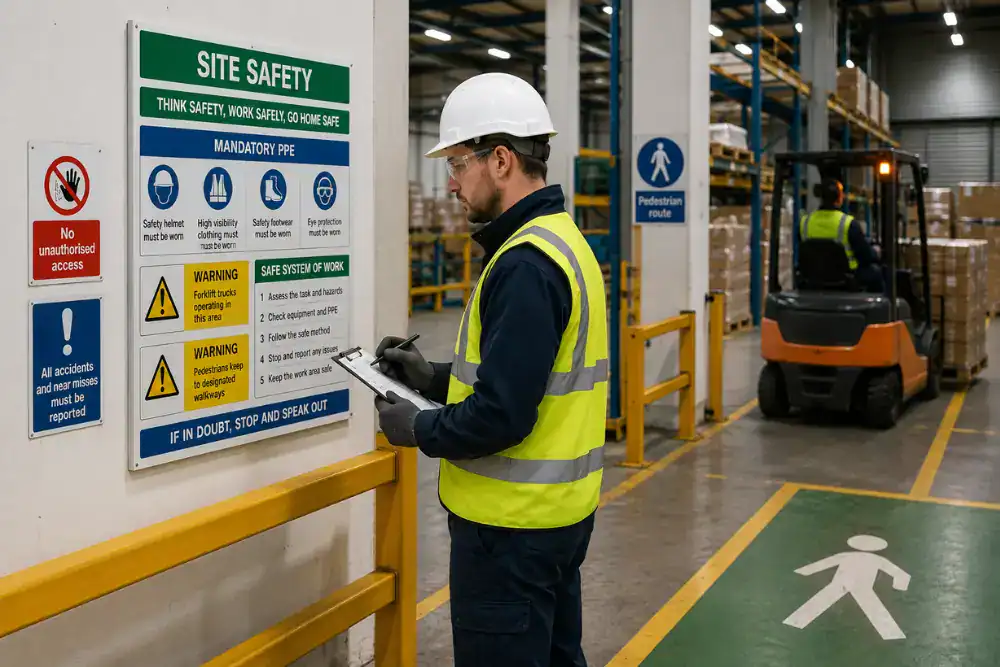
IOSH Working Safely helps workers understand the basics of workplace health and safety, and this article explains what the course covers, who it suits and when Managing Safely is the better fit.
In many workplaces, workers are told what safety rules to follow without always being shown why those rules matter.
Understanding the reason behind safety rules matters when work does not go exactly to plan. The value of IOSH Working Safely is that it gives workers a foundation for recognising hazards, understanding safety measures and knowing when to stop, check or raise a concern.
Key Takeaways
- IOSH Working Safely gives workers a shared starting point for understanding workplace hazards and risk.
- IOSH Working Safely helps workers spot hazards beyond the examples covered in a briefing.
- Workers need to understand why rules exist, so they know when to stop, check or raise a concern.
- IOSH Working Safely is mainly for workers. Managers and supervisors with formal health and safety duties need IOSH Managing Safely.
What Is IOSH Working Safely?
IOSH Working Safely is a foundation-level health and safety course for workers across many roles and sectors. The course is suitable for workers with no previous formal safety training. It is approved by IOSH, the Institution of Occupational Safety and Health, which is the world’s largest health and safety membership body. The course gives workers a recognised starting point for understanding workplace hazards, risk and safe behaviour.
IOSH Working Safely is not the whole of an employer’s safety arrangements. Employers still need site induction, task-specific training, suitable supervision and written instructions for higher-risk work.
The course can form part of an employer’s wider training arrangements under the Health and Safety at Work etc. Act 1974, but it does not, by itself, meet an employer’s training duties.
A safe system of work is a written method that explains how a task should be done safely. IOSH Working Safely helps workers understand why those instructions matter, but it does not replace the instructions themselves.
IOSH Working Safely
Learn more about common workplace hazards and discover how to keep everyone safe with our IOSH Working Safely course that helps develop and improve the safety awareness culture within the organisation or the workplace.
What Does IOSH Working Safely Equip Workers to Do?
IOSH Working Safely equips workers to recognise workplace hazards, understand how risk is judged and know when to follow safety measures, stop work or raise a concern.
The course builds that understanding in a clear order:
- Workers first look at why health and safety matters and where workers’ and employers’ responsibilities sit.
- Workers then learn how to recognise common workplace hazards and understand the main hazard categories.
- Workers consider how those hazards can lead to harm in day-to-day work.
- Workers learn how written instructions, reporting and safety measures help prevent harm.
The order matters because workers need to understand the reason behind a safety measure before they can apply it well. A rule is easier to follow when the worker knows what it is trying to prevent.
Understanding why a safety measure exists matters most when a task no longer matches the usual procedure. The right equipment might be unavailable, the work area might have changed or a colleague might suggest a shortcut. In that moment, the worker needs to recognise that the risk has changed and raise the concern rather than simply carry on.
A worker who completes IOSH Working Safely should be able to describe the main hazards in their work, explain the safety measures used to manage them and recognise when a task needs to be stopped or checked, before work continues.
Who Is IOSH Working Safely For?
IOSH Working Safely is for workers who need a clear grounding in workplace health and safety. The course is a good fit for people who need to recognise hazards, understand basic risk and know when to raise a concern.
In practice, IOSH Working Safely suits these groups:
- Frontline workers in any sector who have not had formal safety training.
- New starters who need a safety foundation before site-specific or task-specific training.
- Experienced workers whose safety knowledge has come from practice rather than formal training.
- Workers in higher-risk settings, such as construction, manufacturing, logistics, facilities management and utilities.
- Workers who need a recognised IOSH certificate but do not need the longer Managing Safely course.
Working Safely sets the starting point. It is not the full safety training a worker will ever need, and it is not the right course for people who manage health and safety for others.
Managers, supervisors and team leaders with formal health and safety duties need IOSH Managing Safely instead. Managing Safely covers manager-level tasks such as assessing risks, investigating incidents and checking whether safety arrangements are working.
In many cases, employers choose Working Safely for managers because it is easier to fit into the training schedule. Choosing Working Safely for managers may solve a timetable problem, but it does not solve a competence problem. A manager can finish Working Safely and still lack the training needed for the decisions their role requires.
What Changes When Workers Complete IOSH Working Safely?
When managers reinforce the learning, IOSH Working Safely can change how workers respond to everyday risk. Workers are more likely to report near misses, which are events that could have caused harm but did not. Workers are also more likely to challenge unsafe shortcuts and raise concerns when work appears unsafe.
The change comes from understanding why a safety measure exists, not just knowing the rule. A certificate completed once and never discussed again is only a training record. The course has more value when managers link the learning to workers’ day-to-day tasks.
Three supports matter most:
- Supervision that links the course to the hazards in each worker’s tasks.
- A near-miss process where managers review reports and take visible action.
- Shift briefings that apply hazard recognition to current tasks, site conditions and recent incidents.
Reinforcement takes time. Where managers do not make time for it, the learning is less likely to become part of daily work.
The scale of work-related harm is clear from the Health and Safety Executive’s 2024/25 statistics, published in November 2025. Around 1.9 million workers suffered work-related ill health, an estimated 680,000 workers sustained non-fatal injuries, and 40.1 million working days were lost. The latest annual cost estimate, for 2023/24, was £22.9 billion (HSE, 2025).
The HSE figures do not point to one cause. They show why training, supervision, reporting and task-specific safety measures need to work together. IOSH Working Safely can help workers understand hazards and safety measures, but employers should not treat the course as a safety measure.
For employers, the useful test is practical. Can workers describe the main hazards in their role, explain the safety measures in place and recognise when work needs to stop or be checked?
If not, the organisation may need to strengthen workers’ basic understanding of safety before relying on role-specific training and supervision.
Is IOSH Working Safely Enough on Its Own?
On its own, IOSH Working Safely is not enough, so employers should treat it as the starting point for further training and supervision. It gives workers a shared, structured way to think about hazards and risk that role-specific training can then build on. Whether the course makes a difference depends less on the certificate than on what the organisation does next.
For employers choosing a first workforce-wide safety course, IOSH-approved Working Safely e-Learning is a practical starting point.
Teams can complete the training online, helping employers provide consistent safety training across different sites and shift patterns without removing large groups from the workplace at the same time.