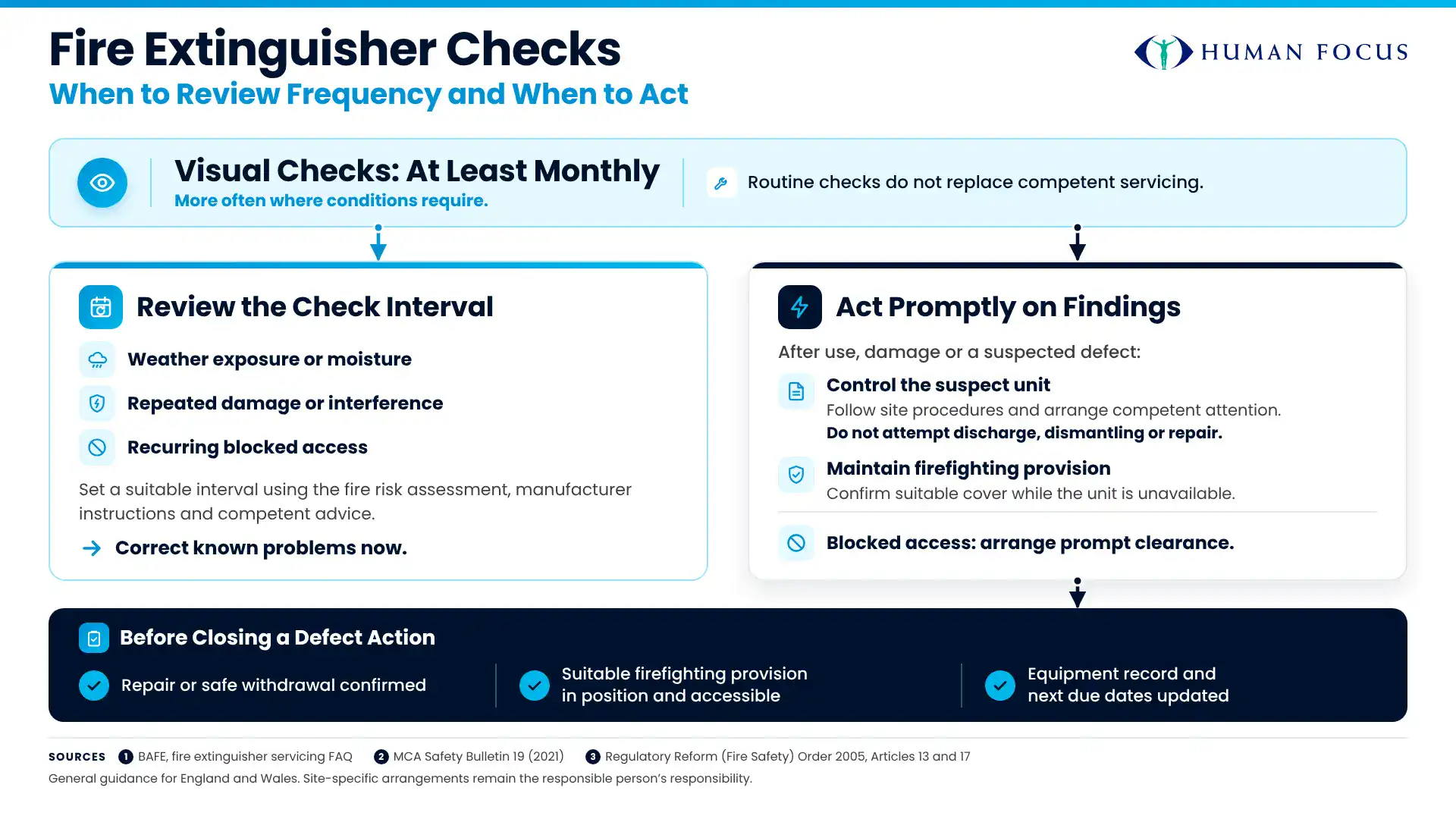
Fire extinguishers should be visually checked at least once a month, with more frequent checks where conditions require. Conventional units normally also need a basic service every 12 months, plus extended servicing or overhaul at intervals appropriate to their type. Use, damage or suspected defects require attention before the next scheduled date.
Finding a defective extinguisher creates two connected responsibilities. Managers need to control the suspect unit safely and maintain suitable firefighting provision while it is unavailable. The arrangements should name who will organise competent attention and who will confirm that any replacement is suitable and in position.
BAFE’s published summary of BS 5306-3 provides the routine intervals below (BAFE, n.d.-b).
Match the schedule to the actual equipment. Primary-sealed powder units normally have a ten-year extended service interval (BAFE, n.d.-b). Some designs follow the manufacturer’s own regime, but service-free equipment still needs the checks in its instructions (Britannia Fire, n.d.).
In England and Wales, Article 17 of the Regulatory Reform (Fire Safety) Order 2005 requires, where necessary to safeguard relevant persons, a suitable maintenance system and equipment kept in efficient working order and good repair. The article does not set monthly or annual intervals (Regulatory Reform (Fire Safety) Order 2005, art. 17).
BS 5306-3:2017 provides the maintenance code of practice (BSI, 2017). Its recommendations inform the arrangements alongside manufacturer instructions and the fire risk assessment.
For a workplace under an employer’s control, the employer is the responsible person under Article 3. Appointing a checker does not transfer that status. Scotland and Northern Ireland have separate fire safety legislation (GOV.UK, n.d.).
The maintenance system also needs to control what happens after a defect is identified. One documented fatality shows why that handover matters.
In June 2021, the Marine Safety Forum published an alert about a corroded cartridge-type dry-powder extinguisher on a rig. An annual third-party inspection had condemned it, but it had not been removed from the rig. A person subsequently discharged it. When its internal carbon dioxide cartridge pressurised the extinguisher, the corroded base ruptured, causing fatal head injuries (Marine Safety Forum, 2021).
The inspection had identified the danger. The failure described in the alert occurred during the handling that followed. The account does not establish that routine inspection dates had been missed.
For a workplace manager, the transferable responsibility is to control what happens to a suspect unit while maintaining suitable firefighting provision. The conditions around the equipment also deserve attention when deciding how often to check it.
The planned interval needs to reflect the conditions around each unit. BAFE’s guidance calls for more frequent visual inspections where circumstances require them (BAFE, n.d.-b).
Weather exposure and moisture trapped beneath an extinguisher are relevant examples. The Maritime and Coastguard Agency (MCA) highlights both in its corrosion bulletin, including the need to inspect exposed cartridge-type units (MCA, 2021).
As a practical review, consider where units are kept and what previous checks have found. Repeated damage, interference or blocked access gives managers a reason to revisit the interval as well as the cause of the recurring condition.
Use the fire risk assessment, manufacturer instructions and advice from the servicing provider to set a suitable interval. Record why that interval fits the conditions and review it after relevant changes. BAFE’s advice does not prescribe one universal shorter interval.
A reported defect still needs prompt action. Reviewing the interval determines the routine for future checks; it does not resolve a fault already identified.
Appointed checkers need clear responsibilities and limits. Identifying a concern does not authorise someone to undertake whatever work follows.
Monthly fire extinguisher checks look for observable changes between service visits. The appointed person should follow the instructions for the equipment and understand the conditions that require referral.
The check should cover the designated location, accessibility, visible damage or corrosion, evidence of use, instructions and applicable status indicators. Visibility includes whether the extinguisher and its fire extinguisher signs remain unobstructed. These observations cannot establish everything a technical service examines.
Consider an extinguisher with a current service label hidden behind newly stacked goods. The checker reports the location and blocked access. The supervisor arranges for the goods to be moved, then the appointed person confirms that the extinguisher and sign are visible and access is clear. The record can then show what was corrected and who checked it. If the obstruction recurs, review the storage arrangements and whether checks need to be more frequent.
Basic servicing, extended servicing and overhaul require competence in the relevant work. A monthly visual check does not replace these activities.
When selecting a provider, BAFE SP101 third-party certification offers evidence of assessed competence. The scheme includes technician training, examination and on-the-job assessment. It is one route to checking provider competence, rather than a universal statutory requirement to use a particular registration (BAFE, n.d.-a).
Agree the provider’s scope, including responsibility for condemned equipment.
Alongside the planned fire extinguisher inspection frequency, staff need a route for reporting changes between checks.
An extinguisher that has been used needs appropriate servicing or replacement before it is relied on again. Firechief’s maintenance instructions, for example, require its extinguishers to be refilled by a competent person after any use (Firechief Global, n.d.).
A missing tamper seal, suspected pressure loss, corrosion or impact damage also warrants prompt reporting and competent assessment. Record the unit’s identity, location and observed condition so the manager and provider know which extinguisher needs attention.
Follow the employer’s procedures and obtain competent advice on handling suspect pressurised equipment. Routine checkers should not improvise discharge, dismantling or repair.
The manager arranging the work should also confirm how suitable firefighting cover will be maintained while the extinguisher is unavailable. When arranging collection, establish whether the provider will bring a suitable replacement and who will confirm it is in position.
Relocation calls for a different assessment. Confirm that the new position is suitable, accessible and visible. A layout change may leave an extinguisher behind a partition, while a new process may introduce a hazard that existing provision does not address.
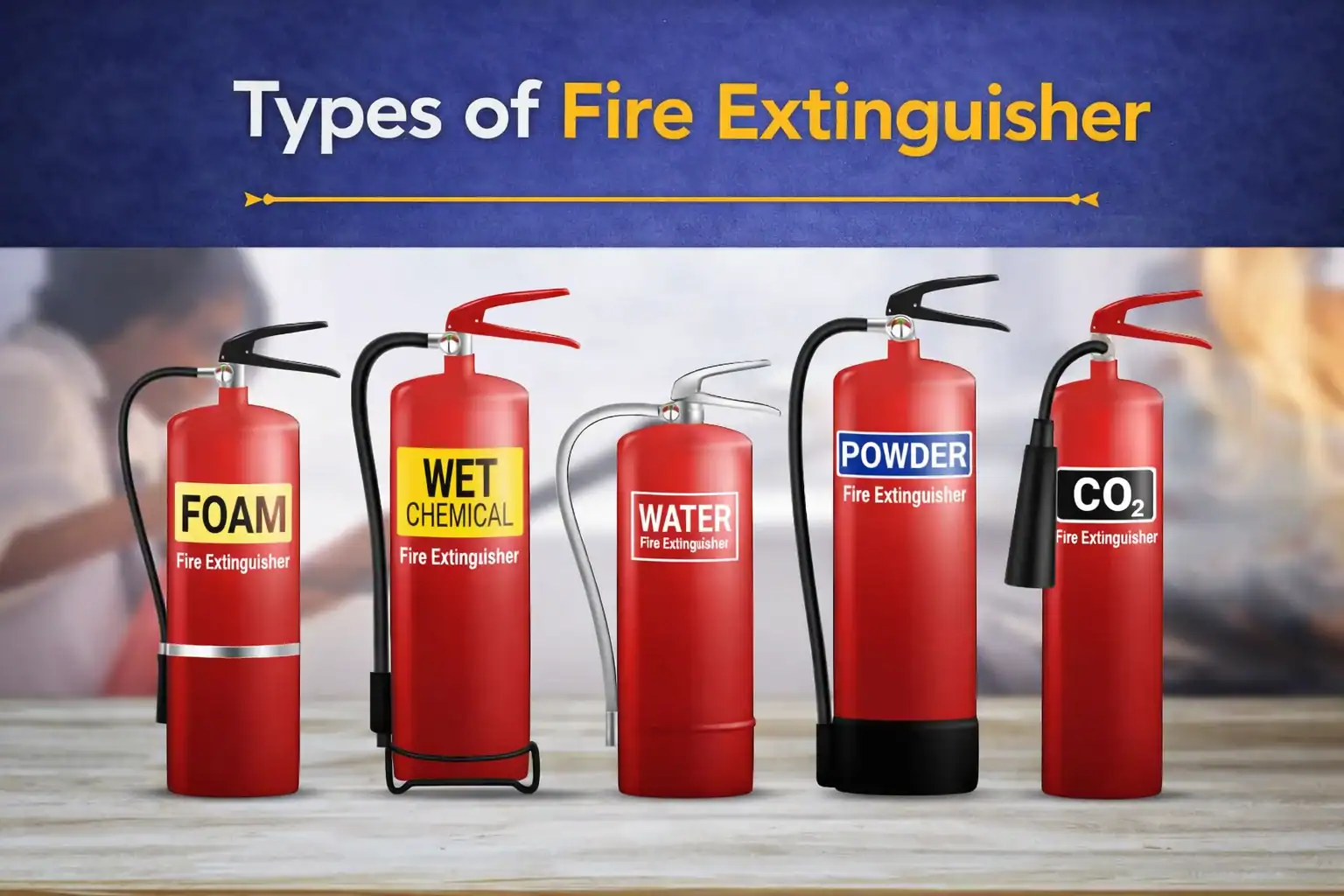
Review the fire risk assessment where relevant and check that the types of fire extinguisher provided remain appropriate. A sound service history cannot settle whether equipment still suits the work taking place around it.
Before closing an action, the manager should be able to confirm three outcomes:
- The defective unit has been repaired or safely withdrawn, with competent handling and any required disposal arrangements confirmed.
- Suitable firefighting provision is in position, accessible and appropriate for the hazard.
- Equipment records show the outcome and the applicable inspection and service dates for the repaired or replacement unit.
The Home Office recognises either a logbook or an electronic record for testing and maintenance (Home Office, 2025). Connect each unit’s identity and location with completed work, findings, action ownership and next due dates. Keep routine visual checks distinct from basic servicing and longer-interval work.
Replacement equipment needs to be reconciled with the register. Its identity and service history may differ from those of the unit removed. Confirm it is in position and check its applicable dates rather than automatically transferring the outgoing extinguisher’s schedule.
Human Focus’s Fire Extinguisher Inspection Training covers visual inspection criteria, common faults and post-inspection actions, supporting the knowledge needed by staff appointed to undertake routine checks. Employers still need to confirm competence and authorisation.
The offshore alert records an inspection that identified danger, followed by handling that proved fatal. For managers, completing the response means confirming both that the suspect extinguisher has been dealt with appropriately and that suitable firefighting provision is available. Each responsibility needs an owner and evidence of the outcome.