DSEAR is a set of regulations that require employers to control risks from dangerous substances in the workplace. They apply wherever work involves substances that could harm people through fire, explosion, similar energetic events or corrosion of metals. Substances used in ordinary workplaces can trigger DSEAR duties where they create those risks.
This guide helps you better understand where DSEAR applies, highlights eight workplace examples and provides a checklist to help employers recognise hazards that need further attention.
Dangerous Substances and Explosive Atmospheres Regulations 2002 (DSEAR) is legislation in Great Britain that requires employers and the self-employed to protect people from safety risks arising from dangerous substances at work. These include fire, explosion, other events with similar harmful physical effects and corrosion of metals.
Under regulation 5, employers must carry out a suitable and sufficient risk assessment where a dangerous substance is present or liable to be present. This DSEAR risk assessment considers the substance’s hazardous properties and the circumstances of the work to identify the risks and the measures needed to control them.
Employers must then eliminate those risks or reduce them so far as is reasonably practicable. Other duties cover controlling releases and ignition sources, providing information, instruction and training, preparing for emergencies where required and classifying places where explosive atmospheres may occur.
HSE explains that DSEAR applies where work is being carried out, a dangerous substance is present or liable to be present, and that substance could put people’s safety at risk through fire, explosion, similar energetic events or metal corrosion.
An energetic event can include an uncontrolled chemical reaction that rapidly releases heat. DSEAR also covers gases under pressure, including pressure hazards from gases that are not flammable.
The risk assessment must consider how a substance is stored, used or produced. A liquid may present different risks when heated or sprayed, while a solid material may produce combustible dust during processing.
An explosive atmosphere is a mixture of air and dangerous gases, vapours, mists or dust in which combustion can spread throughout the mixture after ignition. However, DSEAR can apply without an explosive atmosphere, for example through pressure or metal-corrosion hazards.
Supplier labels and safety data sheets help identify hazards. They need to be considered alongside workplace conditions, including substances generated by the work itself.
These examples show why the product name or type of business is not enough to decide whether DSEAR applies. Each needs to be considered in its actual working conditions.
Flammable solvents in paints, varnishes and adhesives can release vapour that ignites when mixed with air. Decanting, mixing and application can create different conditions from storage in a closed container.
A maintenance team using a solvent-based coating should consider the quantity in use, ventilation and nearby ignition sources. Heat and spraying can also change the risk. HSE’s guidance on flammable liquids explains that heating or release as a mist can create an ignitable mixture even where one would be less likely during normal storage.
Aerosol paints, lubricants and cleaning sprays may contain flammable propellants or contents. They can be overlooked because each can is small and arrives as a finished product.
HSE’s chemical warehousing guidance identifies both releases from damaged cans and rupture from overheating as hazards. For a stockroom or maintenance store, the relevant checks include product classification, accumulated stock, damage during handling and exposure to heat. A sealed can still needs suitable storage; its contents do not have to be in use for a risk to arise.
Liquefied petroleum gas (LPG) used for work equipment and fuel gases used for welding are familiar fire hazards. A leak can release flammable gas that mixes with air and reaches an ignition source.
There are also hazards beyond flammability. Compressed gases store energy under pressure, while oxygen can make combustion more intense even though it does not itself burn. HSE’s guidance on compressed gases explains these differing properties. Employers should check the gas, cylinder condition and handling arrangements rather than treating all cylinders as the same hazard.
Some cleaning products release readily ignitable vapour. This can matter during equipment cleaning, vehicle valeting or maintenance, especially where ventilation is restricted.
An assessment under the Control of Substances Hazardous to Health Regulations 2002 (COSHH) may identify inhalation or skin risks without adequately addressing ignition. HSE’s cleaning and degreasing guidance specifically highlights flammable vapours from some cleaners and advises comparing suppliers’ safety data sheets when selecting products.
Employers should check the actual formulation and method of use. A general description such as ‘cleaner’ does not establish whether the product is flammable or whether DSEAR applies.
Charging lead-acid batteries, such as those used in some forklift trucks and backup power systems, can produce hydrogen. Vented batteries can release this into the surrounding air, where accumulation and an ignition source can create an explosion risk.
HSE’s battery safety guidance also warns that valve-regulated batteries, often described as maintenance-free, can release gas if pressure builds up during incorrect charging. The assessment should consider the battery type, charging arrangements and ventilation.
This example concerns hydrogen from lead-acid charging. Employers should assess other battery technologies using information specific to their chemistry and design.
Materials that appear unremarkable in bulk can become hazardous as fine airborne dust. HSE identifies flour and sugar among food dusts capable of explosion. The risk depends on factors including dust concentration, particle properties and ignition sources.
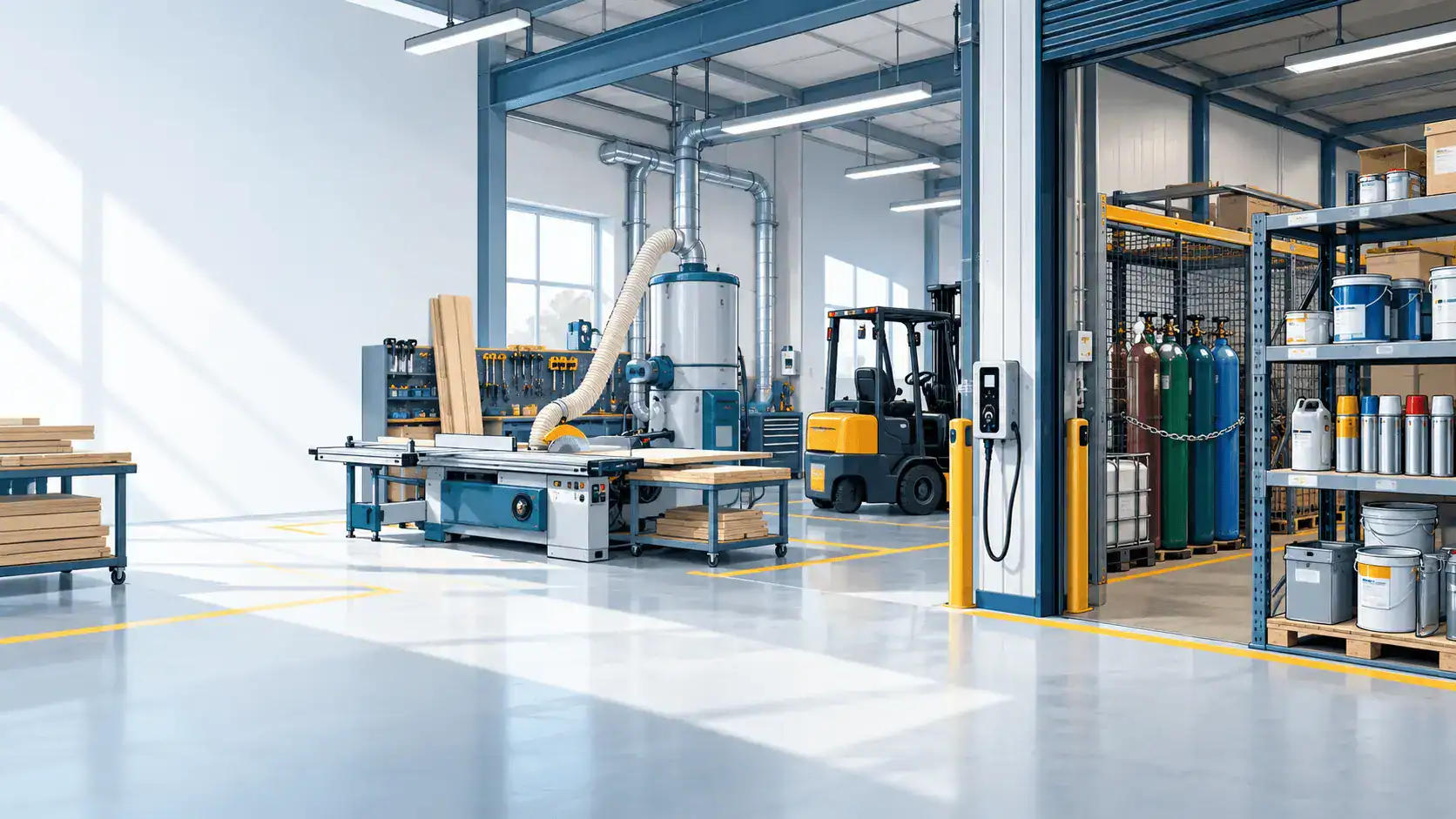
Woodworking can create similar concerns. HSE’s woodworking guidance highlights fires in extraction systems, so assessment should include the equipment collecting dust as well as the machine producing it.
Review dust generation, transfer, collection and cleaning. A substance does not need to arrive with a flammable-liquid label to present a DSEAR risk.
Waste solvent, contaminated materials and residues inside equipment can remain hazardous after the main work has finished. An apparently empty drum is a particularly important example. HSE’s guidance on hot work on tanks and drums explains that residues can remain in seams and crevices and produce flammable vapour when heated. Hot work includes activities such as welding, cutting and grinding.
Before maintenance starts, assess what the equipment previously contained and whether safer methods are available. Emptying a container does not establish that it is safe to cut, weld or heat.
A cleaning or treatment chemical classified as corrosive to metals can create a safety risk even if it is not flammable. For example, leakage onto incompatible metal equipment or supports may weaken them and compromise their integrity.
The relevant issue is the substance’s effect on metal. A warning about skin burns alone does not establish a metal-corrosion hazard, so employers should check the supplier’s classification and compatibility information.
HSE’s guidance on corrosion and material selection explains why materials must suit the substances they contact. Include containers, pipework and foreseeable spill locations in the assessment.
DSEAR addresses safety risks arising from the physical and chemical properties of dangerous substances. COSHH addresses risks to health from exposure to hazardous substances.
The same task can involve both. With a flammable solvent, DSEAR concerns may include vapour ignition, while COSHH concerns may include harmful inhalation or skin contact. Controlling exposure does not automatically address fire and explosion risks.
HSE’s COSHH guidance covers substances in forms including dusts, vapours, mists and gases. The Human Focus guide to the Control of Substances Hazardous to Health Regulations 2002 explains the wider health protection duties.
Review purchasing records, supplier information and the work itself, including storage, cleaning and maintenance. Ask:
- Are any substances classified as flammable, explosive, oxidising or otherwise physically hazardous? Oxidising substances can cause or intensify fire.
- Are gases stored or used under pressure, including non-flammable gases?
- Can processing or handling create combustible dust clouds?
- Can work release flammable gases, vapours or mists, including through heating, spraying or charging batteries?
- Could those releases mix with air to form an explosive atmosphere?
- Could flames, hot surfaces, sparks or static electricity ignite a release?
- Are any products classified as corrosive to metals, and could contact or leakage affect people’s safety?
- Could waste, residues or non-routine work introduce hazards missing from the normal operating assessment?
- Have substances, quantities, equipment, ventilation or work methods changed?
A ‘yes’ identifies something to investigate; it does not automatically establish a hazardous zone, where special precautions against explosive atmospheres are needed. An uncertain answer needs information, not an assumption that the hazard is absent.
Use the difference between safety data sheets and COSHH assessments to understand why supplier information cannot replace assessment of the actual task. The same principle matters when identifying DSEAR risks.
Under regulation 5 of DSEAR, employers must make a suitable and sufficient risk assessment where a dangerous substance is present or liable to be present. New work involving it must wait until the assessment is completed and the necessary measures are in place.
The next steps depend on the findings:
- Assess the actual activity. Consider quantities, releases, interactions between substances, ignition sources and the possible consequences. Include maintenance and foreseeable failures.
- Eliminate or reduce the risk. Follow the control hierarchy in regulation 6, considering a safer substance or process first. Where risk remains, reduce it so far as reasonably practicable through measures such as minimising quantities, containing releases, suitable ventilation and controlling ignition sources.
- Make storage and waste arrangements suitable. Check compatibility, containers and handling methods. The guide to handling, storing and disposing of hazardous substances provides further practical context.
- Assess where explosive atmospheres may occur. Regulation 7 requires classification into hazardous or non-hazardous places and zoning of hazardous places. Equipment and protective systems must suit the identified hazards.
- Prepare for foreseeable incidents. Put emergency arrangements in place appropriate to the risks. These may include warnings, evacuation procedures and relevant drills. The emergency provisions in regulation 8 include an exception where quantities create only a slight risk and existing controls sufficiently address it.
- Inform workers and coordinate activities. Explain the assessment findings and relevant precautions. Where employers share a workplace in which an explosive atmosphere may occur, regulation 11 requires the employer responsible for the workplace to coordinate the protective measures.
Existing precautions may already address some risks. Assessment should establish whether they are suitable and maintained, and identify any gaps that need action.
The person assessing risks needs knowledge and experience appropriate to the substances and processes involved. HSE’s guidance on competent assistance advises seeking external help where the necessary competence is unavailable internally.
Specialist advice may be needed for uncertain dust properties, complex releases, hazardous-area classification, equipment selection or significant process changes. Equipment for potentially explosive atmospheres is often described as ATEX equipment. Selection must account for the actual hazard, not simply the presence of an approval mark.
HSE’s guidance on explosive atmospheres also explains the requirement for competent verification of overall explosion safety before a workplace containing hazardous zones first comes into use.
Workers also need information, instruction and training relevant to their work. Regulation 9 requires this to reflect the assessment and significant changes in work methods.
Human Focus DSEAR Training provides awareness of dangerous substances, risk assessment, control measures, area classification and emergency arrangements. It can support understanding of these responsibilities alongside workplace-specific instruction. Completing awareness training alone does not establish competence to carry out complex assessments or hazardous-area classification.
It can, depending on the substances and activities present. Check cleaning stores, maintenance products and relevant battery installations. HSE explains that DSEAR does not cover every material that can burn, so applicability should follow the hazards identified rather than the building’s description as an office.
There is no general small-quantity exemption from assessing dangerous substances. Quantity affects the risk and precautions needed. HSE’s flammable-liquid storage guidance requires employers to justify the quantities kept in working areas; a small container should not simply be disregarded.
Yes, where their properties and storage conditions create relevant risks. Assessment should consider foreseeable damage, leakage, overheating and incompatible storage. Keeping a product unopened may reduce release during normal use, but it does not remove every storage hazard.
Yes. The Regulations expressly cover dust capable of forming an explosive mixture with air, including dust created during work. Supplier labels are useful for purchased products, but employers also need to identify what their processes generate.
Employers with five or more employees must record the significant findings. Smaller employers still have to assess the risks and implement the required measures. Keeping a record can help demonstrate decisions, communicate precautions and support later reviews.
Regulation 5 requires regular review, particularly where there is reason to doubt the assessment remains valid or where significant changes occur. It does not prescribe one fixed renewal period. Changes to products, equipment, ventilation or work processes may require an earlier review.