Introduction to the Building Safety Act 2022

for Accountable Persons & Principal Accountable Persons
schedule

Course Duration: 25+ minutes

Introduction to the Building Safety Act 2022 helps teams understand how the Act regulates higher-risk residential buildings in England. Where many households share one structure, a fire or structural failure can affect them all.

The Act places clear duties on Accountable Persons, but those duties are met or missed through the daily work of many people. This training gives everyone involved a shared understanding of the framework, so building safety risks are recognised, recorded and acted on.

live_tv
100% online training
volume_up
Full audio voiceover
repeat_on
Fully online assessment
account_balance_wallet
Discounts when you buy in bulk
important_devices
Access on any device
app_shortcut
App available for iOS & Android
Training You Can Trust

Approved by IIRSM

Aligned with UK Legislation

Certificate on completion

Developed by health and safety professionals

Dangerous Goods Transport for Shipping and Transport Office Staff
IIRSM-logo-for-website-131224
£25.00 +VAT

Discounts  for bulk purchases

Need Help?

£25.00 +VAT

Course Preview

Course Details

Course Duration 25+ minutes
Approval body IIRSM
Format Fully online
Assessment Multiple choice
Certification Same-day digital certificate
Certificate Valid For 3 years

Suitable For

This course is for organisations managing occupied higher-risk residential buildings within England’s building safety regime. Relevant sectors include housing associations, registered housing providers, local authority housing, residential property management and build-to-rent. Freeholders, managing agents, high-rise residential asset managers and student accommodation providers are included where the relevant regime applies.

APs and PAPs

Directors and board members

Building and fire safety managers

Housing and resident liaison staff

Asset and facilities managers

Managing agents and freeholders

Course Content

The Introduction to the Building Safety Act 2022 course includes the following sections:

Understand why the Act followed the Grenfell Tower fire, which buildings and people it affects, and the enforcement, penalties and extended defect liability it brings.

Recognise who counts as an Accountable Person or Principal Accountable Person, what their duties involve, and how roles that share CDM 2015 titles carry different duties.

See how the Building Safety Regulator, Architects Act changes and a construction products regulator strengthen oversight, and why reporting, the golden thread, change control and gateways matter.

Understand how the safety case, maintenance schedules, regular inspections and risk assessment reviews after changes in use or structure help duty holders manage building safety risks.

This course provides awareness of specific duties under the Building Safety Act 2022. Completion does not constitute a formal assessment of competence to undertake statutory dutyholder responsibilities.

What You Will Learn

Understand why the Act followed the Grenfell Tower fire and how it strengthens accountability

Recognise which buildings are higher-risk, including the Regulation 8 exclusions

Recognise who holds Accountable Person and Principal Accountable Person duties

Understand why principal designer and principal contractor duties differ under the Act and CDM 2015

Know why changes must be recorded in the golden thread and assessed for safety impact

Understand what the three gateways check, from planning to occupation

Recognise how safety cases, inspections and resident engagement keep risks under control

Know why safety issues should be reported, and the consequences of non-compliance

Available in 20+ Languages

Course subtitles are available in multiple languages, including:

French

Dutch

German

Italian

Spanish

Polish

Course Approval Body

IIRSM-logo-for-website-131224

Approved by IIRSM

This course is approved by IIRSM – the International Institute of Risk & Safety Management.

The course certificate includes:

  • User name
  • Company name
  • Course name
  • Completion date
  • Expiry date
  • Approval body

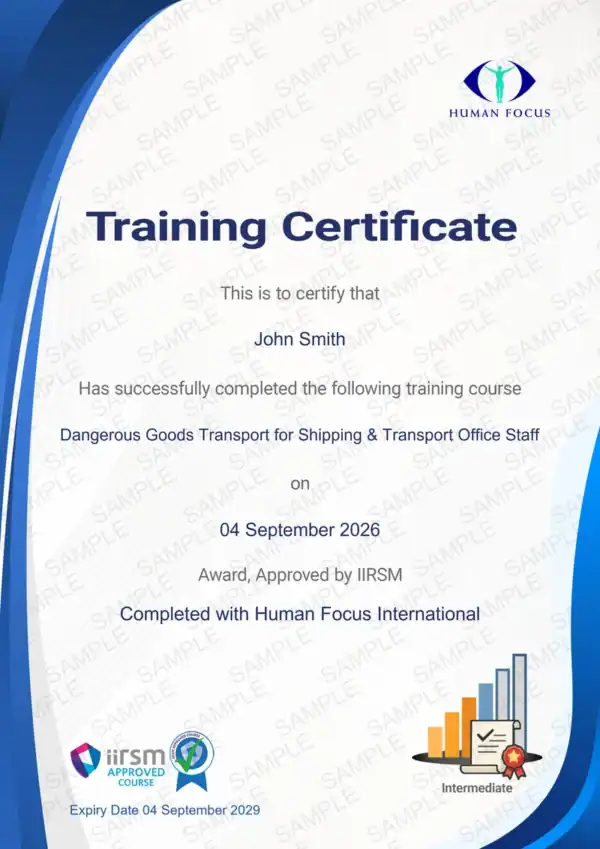
An IIRSM-approved course certificate will be available for download and printing instantly upon course completion.

Users must complete a final theory test before earning their certificate.

The end-of-course test is:

  • Fully online
  • Multiple choice

A score of 80% is required to pass.

Dangerous Goods Transport for Shipping and Transport Office Staff

Customer Feedback

Why This Training Is Important

The Grenfell Tower fire claimed 72 lives. Dame Judith Hackitt’s independent review, published in 2018, called for a complete overhaul of the regulatory system. The government accepted all of its recommendations, and the Building Safety Act 2022 is the direct result.

In a higher-risk building, many households depend on the same structure and the same fire safety measures. An unassessed alteration, a missing record or an unanswered resident concern can affect all of them.

The Act sets clear duties for higher-risk buildings in England: those at least 18 metres or seven storeys high with at least two residential units. Under the regime:

  • Accountable Persons — whoever owns or must repair the common parts — must assess the risks of fire spread and structural failure and take all reasonable steps to control them
  • The Principal Accountable Person must register the building and apply for a Building Assessment Certificate when directed by the Building Safety Regulator
  • A safety case report, prepared by the Principal Accountable Person with input from each Accountable Person, must show how building safety risks are identified and managed
  • golden thread of digital safety information must stay accurate, up to date and accessible, with changes recorded and assessed
  • Residents must be kept informed about safety decisions and given a clear route to raise concerns
  • New higher-risk buildings go through three gateways: at planning, before building work starts and before occupation

The Act also amends the Housing Act 1996 to strengthen residents’ access to the Housing Ombudsman, and provides for a New Homes Ombudsman scheme.

The duties above sit with a small number of duty holders. They are met through the work of many people.

Housing officers hear residents’ concerns. Asset teams commission works that change materials or systems. Procurement teams appoint designers and contractors whose duties differ from their roles under the Construction (Design and Management) Regulations 2015. If any of them misunderstands the framework, safety information fails to reach the people accountable for acting on it.

Non-compliance carries serious consequences. The Building Safety Regulator can inspect, issue notices requiring corrective action and halt work until compliance is achieved. Penalties include fines and, in serious cases, imprisonment, alongside reputational damage.

The Act also extended limitation periods for building defect claims. For work completed before 28 June 2022, claims under the Defective Premises Act 1972 can now be brought up to 30 years later, rather than 6.

Organisations need to keep comprehensive records for far longer, hold adequate professional indemnity insurance and recognise that historic projects can still give rise to claims.

Training gives everyone involved the same clear understanding of the framework. Teams can recognise when their work affects building safety and understand why changes must be recorded and issues reported. That shared understanding helps turn legal duties into everyday practice.
How This Training Helps Your Organisation

This course helps organisations responsible for higher-risk buildings:

  • Give every team that works on or around higher-risk buildings the same baseline understanding of the Act, its roles and its systems
  • Help teams understand why changes must be recorded and assessed and resident concerns escalated, strengthening the flow of safety information to duty holders
  • Support Accountable Persons and Principal Accountable Persons with teams who understand why the duties exist and how their own work contributes
  • Reduce misunderstandings over building scope, dutyholder roles and gateways, including confusion between CDM 2015 and Building Safety Act roles
  • Provide a proportionate first step: an introductory overview for wider teams, with a clear route into the full Accountable Person and Principal Accountable Person course

Start Your Building Safety Act Introduction Today

Give everyone involved in managing your higher-risk buildings a clear, shared understanding of the Building Safety Act 2022. Training your teams now helps them recognise when their work affects building safety and understand why changes must be recorded and concerns raised early. For people who hold Accountable Person or Principal Accountable Person duties, the full course builds on this introduction and examines each duty in detail.


Related Courses