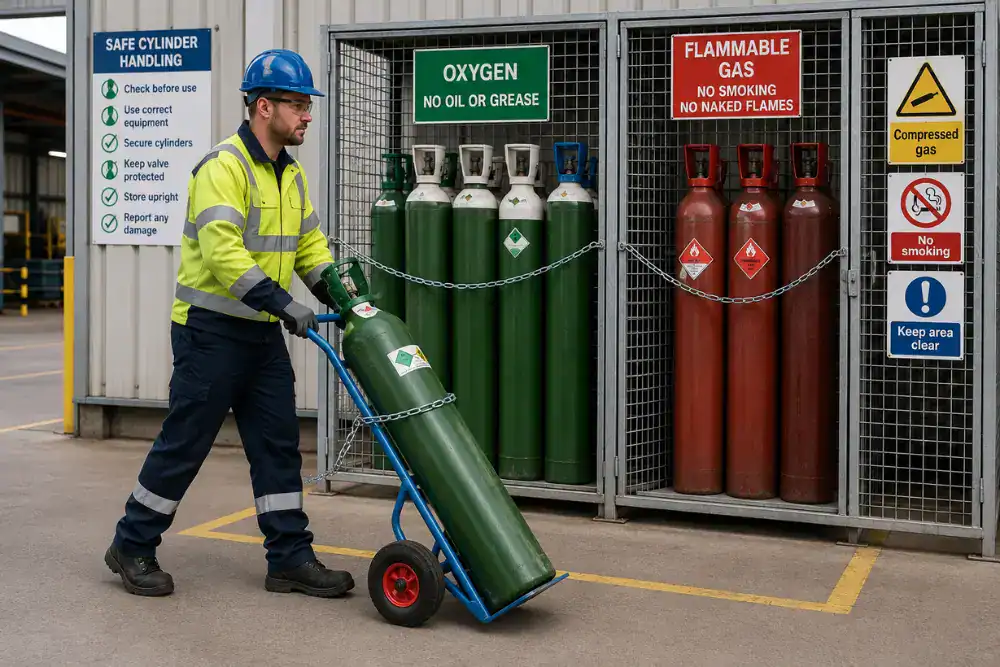
Compressed Gas Cylinder Handling & Storage Safety Training

schedule

Course Duration: 45+ minutes

This IIRSM-approved Compressed Gas Cylinder Handling & Storage Safety Training gives staff clear, practical guidance on cylinder hazards, safe handling and storage, and emergency response.

It supports a consistent, site-wide approach aligned with risk assessments, safe systems of work and emergency procedures. Staff learn how gas contents affect cylinder behaviour, how to identify, check, handle and store cylinders correctly, and when to stop work, report unsafe conditions and raise the alarm.

The training also supports employer duties to assess and control compressed gas risks and provide suitable information, instruction and training.

live_tv
100% online training
volume_up
Full audio voiceover
repeat_on
Fully online assessment
account_balance_wallet
Discounts when you buy in bulk
important_devices
Access on any device
app_shortcut
App available for iOS & Android
Training You Can Trust

Approved by IIRSM

Aligned with UK Legislation

Certificate on completion

Developed by health and safety professionals

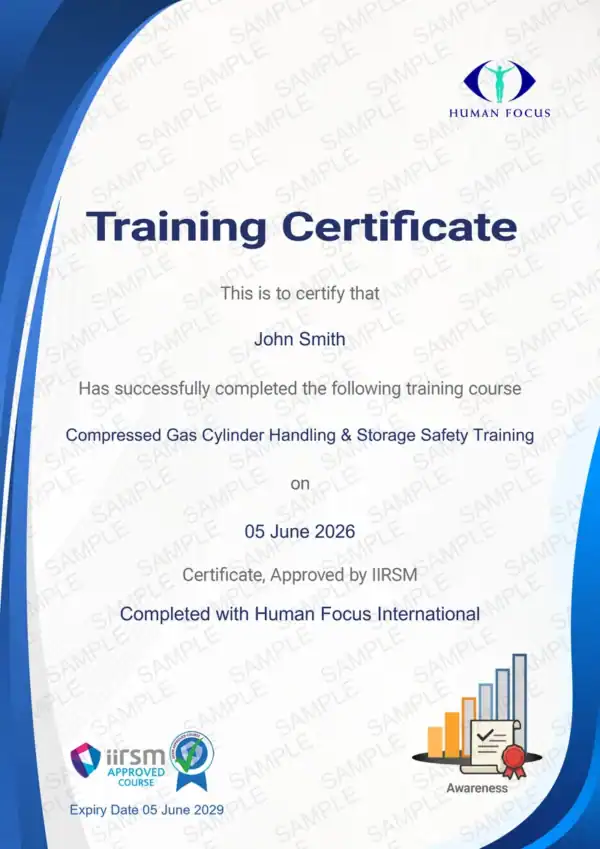
Compressed Gas Cylinder Handling & Storage Safety Training Certificate

Disclaimer: This course builds awareness and knowledge of the safe handling and storage of compressed gas cylinders. Completing it does not by itself make a learner competent or qualified for any task or role — under UK law, competence combines training, knowledge, skills and experience, and confirming it is the employer’s responsibility.

IIRSM-logo-for-website-131224
£25.00 +VAT

Discounts  for bulk purchases

Need Help?

£25.00 +VAT

Course Preview

Course Details

Course Duration 45+ minutes
Approval body IIRSM
Format Fully online
Assessment Multiple choice
Certification Same-day digital certificate
Certificate Valid For 3 years

Suitable For

This course is suitable for anyone who handles, moves, uses or works near compressed gas cylinders. It is relevant to:

Operatives and technicians

Warehouse and stores personnel

Welders and fabricators

Maintenance engineers and facilities teams

Delivery and logistics staff

Laboratory and research staff

Catering and hospitality staff

Supervisors, team leaders and health and safety officers

Course Content

This Compressed Gas Cylinder Handling & Storage Safety Training contains the following sections:

Understand what gas cylinders are, their main components and how the gas inside determines the way each cylinder behaves and must be handled.

Learn what UK health and safety law requires of employers and employees, and why following safe systems of work is a personal legal responsibility.

Recognise the main hazards cylinders present, from stored pressure and fire to asphyxiation, toxic exposure and cold burns, including the risks empty cylinders still carry.

Learn how to identify a cylinder’s contents and hazards using the safety data sheet, label, hazard pictograms, shoulder colour coding and inspection markings.

Learn how to check a cylinder before handling it, including the risk assessment, label, condition, route to destination and the right personal protective equipment (PPE).

Learn how to move cylinders safely using approved equipment, when the limited “churning” method is permitted and the practices that are never allowed.

See how to unload cylinders from vehicles and move them across site safely, including why acetylene must stay upright and when to stop and seek help.

Learn how to store cylinders safely, including securing them upright, segregating gas types, keeping clear of heat and applying separation distances that reduce fire risk.

Know what to do in a gas leak, fire or cylinder incident, how to protect yourself and others and why prompt reporting of damage and near misses matters.

What You Will Learn

How to recognise the main cylinder hazards, including stored pressure, fire, asphyxiation, toxic exposure and cold burns

Your legal responsibilities, and your employer’s, when handling and storing cylinders

How to identify a cylinder’s contents using its label, hazard pictograms, shoulder colour and safety data sheet

How to carry out pre-task checks and select the right equipment and PPE before moving a cylinder

How to move, unload and store cylinders safely, including securing, segregation and acetylene-specific rules

How to recognise unsafe conditions and know when to stop work and report a problem

The correct emergency response to a gas leak, fire or damaged cylinder

Available in 20+ Languages

Course subtitles are available in multiple languages, including:

French

Dutch

German

Italian

Spanish

Polish

Course Approval Body

IIRSM-logo-for-website-131224

Approved by IIRSM

This course is approved by IIRSM – the International Institute of Risk & Safety Management.

The course certificate includes:

  • User name
  • Company name
  • Course name
  • Completion date
  • Expiry date
  • Approval body

An IIRSM-approved course certificate will be available for download and printing instantly upon course completion.

Users must complete a final theory test before earning their certificate.

The end-of-course test is:

  • Fully online
  • Multiple choice

A score of 80% is required to pass.

Compressed Gas Cylinder Handling & Storage Safety Training Certificate

Customer Feedback

Why Is Compressed Gas Cylinder Safety Training Important?

Compressed gas cylinders can present serious risks when they are not identified, handled, moved or stored correctly. A damaged valve, unsecured cylinder, poor segregation or missed leak can lead to fire, explosion, asphyxiation, toxic exposure or serious injury.

The risk is not limited to specialist users. Cylinders may be received, moved, stored or worked around by different teams, so safe practice must be consistent. Staff need to know what they are handling, check labels and markings, use the right equipment, secure cylinders properly and recognise when to stop work and report a problem.

Employers must assess workplace risks and provide suitable information, instruction and training under the Health and Safety at Work Act 1974 and the Management of Health and Safety at Work Regulations 1999.

The Dangerous Substances and Explosive Atmospheres Regulations (DSEAR) 2002 also apply where dangerous substances, including relevant compressed gases, could create fire or explosion risk. COSHH may also apply where gases are hazardous to health. Employees must follow safe systems of work, use controls correctly and report damage, leaks or unsafe conditions.

This IIRSM-approved Compressed Gas Cylinder Safety Training  gives staff a practical baseline for working safely with compressed gas cylinders. It supports risk assessments, safe systems of work and emergency procedures by explaining how gas contents affect cylinder behaviour, how to identify and check cylinders, how to move and store them correctly, and what to do if something goes wrong.

How Compressed Gas Cylinder Safety Training Helps Your Organisation

This Gas Cylinder Safety Training helps you:

  • Give staff a consistent baseline for safe cylinder handling and storage.
  • Support employer duties to provide suitable information, instruction and training.
  • Reduce the risk of avoidable fires, explosions, leak-related incidents and handling injuries.
  • Improve consistency in cylinder identification, pre-task checks, movement, storage and segregation.
  • Provide a completion certificate for staff who complete the training.

Build a Consistent Standard for Safe Gas Cylinder Handling and Usage

Give staff who handle, move, store or work near compressed gas cylinders a clear understanding of the risks and the controls they must follow. Enrol your team in this gas cylinder safety course to support your safe systems of work and help reduce avoidable incidents.


Related Courses