In short: Acoustic doors and fire-rated doors serve entirely different functions and are certified to different standards. On site, they can look identical. An acoustic door reduces sound transmission between spaces and is rated in decibels for the sound it blocks, shown as an Rw value; a fire door resists the passage of fire for a defined period and must be evidenced as a complete assembly tested to BS EN 1634-1 (BSI, 2018), with smoke-control performance confirmed separately where required.
A common inspection failure is not misidentifying the door itself – it is failing to verify that the door installed matches the evidence held, and that this evidence still covers the as-installed configuration.
Acoustic doors and fire-rated doors are two distinct product types, certified to different standards, and a fire door inspector’s ability to distinguish between them directly affects inspection accuracy. For an inspector, getting that distinction right is central to a defensible inspection.
A common refurbishment scenario illustrates the risk: two sets of doors line the same corridor, one set acoustic-rated and the other fire-rated, they look identical, and an inspector signs off three doors against the wrong standard.
The checks, certification and documentation that settle which door is which are the same evidence an inspection report must stand on.
Acoustic doors are designed to reduce sound transmission between spaces; fire-rated doors are designed to hold back fire for a defined period – and the two functions are tested to entirely different standards. They measure different physical properties and confer different protections, which is why one cannot stand in for the other.
A fire door must be evidenced as a complete assembly, with the frame, seals, ironmongery (the door hardware) and threshold all covered by test evidence, assessment or certification. An acoustic door should not be treated as fire-rated unless separate test evidence, assessment or certification confirms it.
The purpose of a fire door is to resist the passage of fire for a defined period, commonly expressed in the UK as ratings such as FD30 or FD60. Fire-resistance evidence commonly refers to BS EN 1634-1, while older evidence may refer to BS 476-22 (BSI, 1987); it should state what performance has been tested, assessed or certified.
That performance is typically integrity – resisting the passage of flames and hot gases – and, where applicable, insulation, which limits heat transfer to the unexposed side. Smoke-control evidence is separate, where required.
The evidence covers the complete assembly: the frame, seals, ironmongery and threshold are all part of what is tested or certified, and a door leaf label alone is not enough to prove the installed assembly’s fire performance.
An acoustic door may carry seals, drop seals and a close-fitting frame, which can resemble fire door features. These features should not be assumed to provide fire performance unless they are within fire test, assessment or certification evidence.
Inspection errors involving acoustic and fire-rated doors can arise from a gap between what was specified, what was installed and what the available documentation confirms, rather than from misreading the door itself. The patterns below usually involve an organisational cause that a visual inspection alone cannot resolve.
One failure route is an acoustic door fitted where the specification required a fire rating. Fire-rating specification and door procurement can be handled separately, so an acoustic option may be ordered without a check against the fire strategy. An inspector arriving at completion without the original specification cannot tell, from the door alone, which door was meant to go where.
An installer fits a certified fire door without its specified frame or threshold seal, or with ironmongery outside its certification scope. Fitting it this way can invalidate the certification, though that loss of certification is not visible without checking the documentation against the installed configuration.
A risky site assumption is that a high Rw-rated door provides smoke or fire resistance. It does not, unless it has been separately tested and certified to a fire standard such as BS EN 1634-1. Rw and FD30 measure different physical properties.
Later modifications can void certification that was valid at handover. During fire door maintenance, replacing ironmongery without reference to the certification scope means the assembly certificate no longer holds, even though the label may still be on the door.
In the mixed-specification case, the failure is rarely that the inspector misidentified the door. It is that no documentation connects the installed door to the fire strategy, so a visual check alone cannot confirm compliance. Schemes such as Certifire and the BM TRADA Q-Mark can provide third-party evidence for specified fire door configurations, but the certificate scope must be checked against the installed leaf, frame, seals, glazing, ironmongery and any stated limitations.
BS 8214:2026 (BSI, 2026) is the current code of practice for fire-resisting and smoke control doors; installation should be checked against the manufacturer’s instructions and the certified scope. When a door is substituted during procurement or installation, that change can go unrecorded, leaving no clear paper trail.
Across all four patterns, the decisive question is not what the door looks like but whether the evidence places it within a valid fire-performance claim. Without supporting evidence, the door should be recorded as unverified and escalated for follow-up in line with the inspection scope, fire risk assessment and the responsible person’s procedures.
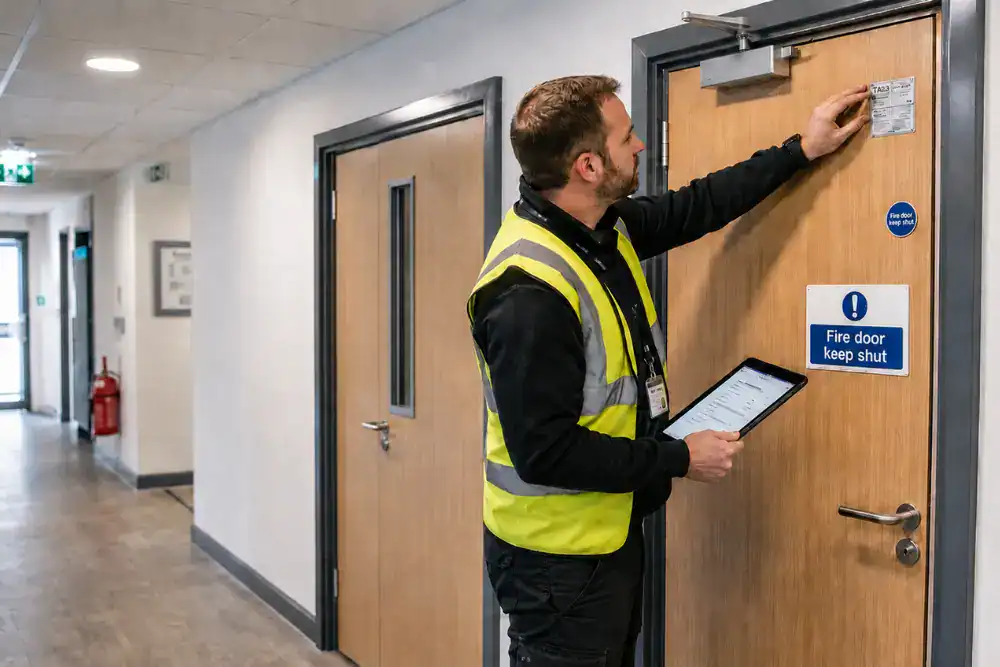
Verifying a fire door’s compliance requires confirming that its fire-performance evidence covers the complete as-installed assembly – not simply that a label is present. An inspector who checks only that a label is present, without confirming what that evidence covers, may pass a door that has been modified after installation. The label is still there, but the configuration it covered is not. The checks below apply to fire-rated doors only.
For fire-rated doors, confirm:
- Where present, check that the certification label is legible and matches the documentation. Where no label is present, seek other evidence, such as the fire strategy, specification, test report, assessment, manufacturer confirmation or competent assessment.
- Certification scope covers all installed components: frame, seals, ironmongery and threshold.
- Where required by the door’s specification or smoke-control rating, intumescent strips (which expand under heat to seal the gap around the door) and cold smoke seals (which limit smoke passing at normal temperatures) are present, undamaged and correctly seated.
- Door closes fully into the frame from any angle under the action of its self-closing device, where a closer is required.
- Threshold gap within the certified tolerance.
- No post-certification modifications unless they are covered by the certificate, the manufacturer’s permitted scope, test evidence or competent assessment.
When you suspect the wrong door has been installed, look for:
- No visible intumescent strip or smoke seal may require further verification, especially for newer doors or those specified for smoke control. Do not treat absence alone as conclusive without checking the door’s age, specification and the fire risk assessment.
- A drop seal on the threshold – an automatic seal that lowers as the door closes. A drop seal may reflect an acoustic requirement and is not automatically non-compliant, so confirm whether it is included in the fire door’s test evidence or certification scope.
- A label showing only acoustic performance, such as an Rw rating, does not prove fire performance. If no fire certification label is present, seek other evidence before confirming or rejecting the fire rating.
- Frame construction or ironmongery inconsistent with any certified fire door set you can verify against a manufacturer’s specification.
- Installation that cannot be matched to any fire door manufacturer’s installation instructions.
Together these two lists form a practical fire door inspection checklist for separating a certified fire door from one that is not. If fire-performance evidence cannot be verified, record the door as unverified and specify the follow-up action required. Do not confirm it as fire-rated on appearance alone.
The strongest evidence is third-party certification, or equivalent test or assessment evidence, showing that the installed configuration falls within the scope of the relevant fire-performance evidence, such as BS EN 1634-1 or BS 476-22 evidence.
A fire door’s documentation should establish a clear evidence path, ideally through three records:
- Third-party certification, or equivalent test or assessment evidence, stating the scope of what is covered, with reference to BS EN 1634-1 (or BS 476-22 for older stock). This evidence supports the fire strategy, fire risk assessment and the responsible person’s duties under the Regulatory Reform (Fire Safety) Order 2005 (HM Government, 2005).
- An installation record confirming the door was fitted in line with the manufacturer’s instructions and the certified assembly specification.
- Any post-installation inspection record that applies.
For higher-risk buildings in England, the golden thread duties introduced by the Building Safety Act 2022 (UK Parliament, 2022) reinforce the need to keep accurate building safety information available. In other premises, fire safety law and applicable guidance still support an inspector’s request for the fire strategy, specification and handover evidence where relevant.
Where a door cannot be positively confirmed as fire-rated, the responsibility does not transfer to the inspector’s judgement of how the door looks. Inspectors can face pressure in this situation. The responsible person may be senior, present and certain the door is compliant, and that confidence can feel as though it shifts the burden of proof. It does not. Follow the escalation in order:
- Flag the door as unverified in the inspection report, recording what documentation was requested and what was provided.
- Request the original project specification or handover documentation from the responsible person.
- If documentation cannot be produced, escalate through the responsible person’s fire safety management process. Depending on the premises and issue, this may involve the fire risk assessor, manufacturer, original specifier, competent contractor, building control or enforcing authority.
- Do not pass a door as fire-rated on the basis of appearance alone.
An inspector who passes a door on appearance when documentation is absent has not exercised professional judgement – they risk accepting responsibility for an unverified assumption while the risk stays with the building. The absence of documentation is itself a finding. Record it, escalate it and do not sign it off.
Acoustic doors and fire-rated doors can look similar on site, but they are not proved in the same way. An acoustic door reduces sound transfer. A fire-rated door must be supported by fire-performance evidence that covers the installed configuration, including the leaf, frame, seals, hardware and threshold.
The practical inspection task is to confirm whether the door in front of you matches the evidence available for it. Where the fire rating cannot be verified from the label, specification, certificate, installation record or competent assessment, inspectors should record the door as unverified and escalate the evidence gap rather than confirm fire performance from appearance alone.
If you need to develop the competence to verify fire doors against evidence rather than appearance, Human Focus’s Fire Door Inspection Training gives trainees an in-depth understanding of fire door inspections, including fire door regulations, standards, design, components and inspection procedures.
The RoSPA-assured course includes a free fire door inspection e-Checklist to help trainees evidence inspection steps and digitally record inspection outcomes.