In short: To verify RPE fit tester competency on your site, apply six checks before and during any testing session. Confirm the tester’s training covers the RPE types and test methods in use on your site, inspect the kit, observe at least one complete test from toolbox talk through to the reveal, review the records for completeness and wearer signature, and ask the questions a competent tester must be able to answer correctly.
The COSHH Regulations 2002 require RPE fit testing to be conducted by a competent person but prescribe no mandatory qualification – the verification obligation falls on the employer, who must define, apply and evidence the standard.
In many organisations, competency verification amounts to confirming that a training certificate exists – without establishing whether it covers the specific test method, RPE type and conditions on site[LS2.1]. The HSE defines competency through the SKATE framework: Skills, Knowledge, Attitude, Training and Experience. A fit tester’s competency must be assessed against all five dimensions, not simply confirmed by the existence of a certificate.
Employers need to understand that the Control of Substances Hazardous to Health (COSHH) Regulations 2002 place the verification obligation on them, that no mandatory qualification exists to rely on, and that a certificate alone does not confirm whether a tester is qualified to work with the specific RPE types and test methods in use on site.
This article explains how to verify respiratory protective equipment (RPE) fit tester competency in practice – covering the regulatory requirements, what a competent fit tester must be able to demonstrate and the six checks employers can apply to confirm that a tester is qualified for the specific test method, RPE type and site conditions in use.
COSHH requires employers to prevent or adequately control exposure to hazardous substances, and RPE provided for that purpose must be suitable and properly maintained (HMSO, 2002).
HSE guidance and the COSHH ACOP framework explain that tight-fitting RPE should be face fit tested as part of selection, and HSE states that fit testing should be carried out by a competent person.
The regulations and guidelines do not specify what training a fit tester must have completed, require certification from any particular body or tell employers how to verify a tester’s competency. The obligation to verify the fit tester’s competency falls on the employer.
Health and Safety Executive (HSE) guidance HSG 53, Respiratory Protective Equipment at Work (4th edition, 2013), specifies that tight-fitting RPE must be fit tested by a competent person before use (HSE, 2013a).
The COSHH Approved Code of Practice, which carries legal weight and explains how employers can comply with the Regulations, reinforces this:
“Fit testing must use a suitable method and must be repeated whenever the RPE type changes or the wearer’s facial characteristics change in a way that affects fit (HSE, 2013b).”
HSE guidance document INDG 479, Fit Testing of Respiratory Protective Equipment Facepieces, sets out the practical requirements for fit testers and the protocol standards against which tests are conducted and records should be assessed (HSE, 2025).
No syllabus specifies what fit tester training must cover. No regulation prescribes a minimum training duration. No law requires a certificate from any particular provider. Voluntary accreditation schemes exist, and many employers use them as reference points, but the government has not made any of them mandatory.
The absence of a mandatory fit tester qualification is not, by itself, a defect in the legislation. The COSHH framework places responsibility on the employer to select competent people and retain suitable evidence (HMSO, 2002).
Confirming that testing has occurred is not the same as confirming it was conducted by a qualified person. An employer can hold complete documentation without ever having established whether the tester was competent for the specific method, RPE type and site conditions in use.
A certificate alone does not prove RPE fit tester competency because no mandatory qualification standard exists, certificates vary in the test methods and RPE types they cover, and holding one does not establish whether the tester can perform the specific test required on your site.
Certificates vary in ways that are not always clear from the document itself. Fit testing uses two main methods. Qualitative fit testing is a pass/fail, taste-based method used with disposable and reusable half-masks.
Quantitative fit testing uses specialist equipment to produce a numerical measure of how well the mask seals. It is required where qualitative methods are not suitable. A certificate covering qualitative fit testing does not confirm that the tester is competent to carry out quantitative testing.
A tester trained to work with disposable filtering facepieces, such as FFP2 or FFP3 masks (half-masks rated for different levels of particulate filtration), may not be competent to test full-face respirators used on the same site. The certificate may not make this distinction clear. The employer must establish whether the tester’s competence matches the actual masks, methods and working conditions on site.
For internal testers, maintaining the required level of competence is not guaranteed by initial training alone. An employee may be trained to conduct fit testing, designated as the site’s fit tester and then left without any formal process for reviewing whether their competence remains current.
New RPE types may be introduced. Protocol guidance may be updated. The testing environment may change. None of these changes is likely to prompt reassessment unless the employer has a formal review process in place.
Competency gaps can remain hidden. In many cases, the tester produces records, the records are filed and the system appears to be working. An employer who reviews records only for completeness may not detect whether the tester’s practice has drifted from the required standard.
An RPE fit tester is competent if they can select the correct test method for the facepiece in use, screen wearers for conditions that would make the test invalid, conduct the full protocol correctly and produce a record that accurately reflects what happened.
A competent fit tester is also expected to hold a suitable risk assessment for conducting face fit testing, covering whichever method they are using. The assessment should identify hazards associated with the test agent, the equipment and the testing environment, and set out the controls the tester applies.
A competent person is someone with sufficient training and experience, or knowledge and other qualities, to take the steps required to protect workers from harm. Applied to fit testing, this is a performance standard, not a credential that, once obtained, remains valid regardless of what the tester does in practice.
A competent fit tester must be able to do the following correctly, consistently and without prompting.
Before screening begins, the tester should provide the employer or responsible person with key information on how to prepare workers in advance of a session. A short health and suitability questionnaire confirms the worker is medically suitable for the mask type – for example, that they have no unmanaged respiratory conditions – and that they understand what the test involves. Face fit testing is not suitable for workers with acute respiratory illness, significant claustrophobia or certain unmanaged medical conditions. If a worker has a known allergy to the test agent or has asthma, the tester may need to adjust the method or use quantitative testing rather than a taste-based test.
Facial hair in the seal area (stubble, a beard, a moustache or sideburns) prevents a tight-fitting respirator from sealing and makes the test invalid. The same applies to facial piercings in the seal area, makeup that sits on the surface of the skin rather than sinking into it, and any PPE the wearer normally uses during work that might affect the fit. Long hair must be tied up. The tester must confirm that the wearer has not eaten, drunk anything other than plain water, smoked or vaped or chewed gum in the thirty minutes15–30 minutes (or at least one hour for smoking or vaping) before the test, as any of these affects the ability to detect the taste agent.
Workers should be advised in advance to: avoid smoking or vaping for at least one hour before testing; avoid eating, chewing gum, sweets, mints or flavoured drinks for 15–30 minutes before the test; avoid strong flavours such as mints, coffee or spicy food immediately before a taste-based test; and be well enough to take part, as those with an acute respiratory illness or who are pregnant should not be tested without medical advice.
Before testing begins, the tester must observe the wearer perform a pre-use seal check. A negative pressure check requires the wearer to block the filter and breathe in sharply; the mask should crumple onto the face. A positive pressure check requires the wearer to exhale through the mask’s one-way exit valve (the exhalation valve); air should exit only there. If the RPE fails a pre-use seal check, the tester does not proceed to fit testing. The tester should also walk the wearer through checks of the facepiece condition before the test begins: inspecting seals for damage or deformation, confirming straps are in good condition and correctly adjusted, and ensuring the facepiece is clean and free from contamination.
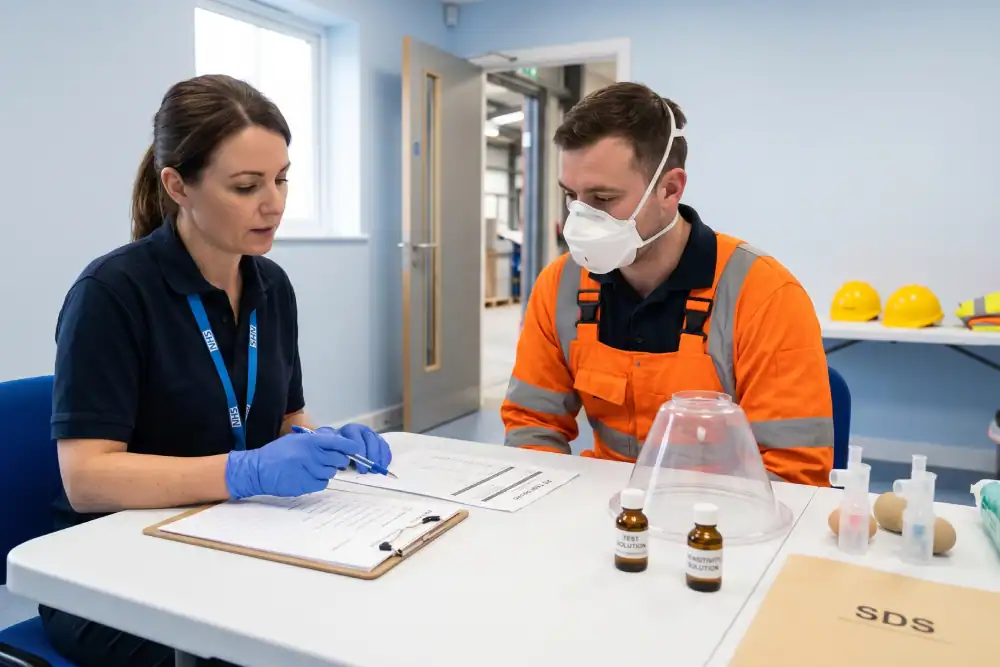
Before beginning any sensitivity or fit test, the tester should be wearing nitrile gloves. The testing area should be set up with hygiene wipes, cleaning cloths and a disposal bin, and the equipment should be neatly laid out on a clean surface with adequate space and ventilation. The tester should also have a first aid kit and a spill kit (including provision for vomiting) available in the testing area in case of any adverse reaction.
Before the fit test begins, the tester must conduct a sensitivity test to establish how readily the wearer can detect the taste agent (HSE, 2025). The procedure is:
- The wearer puts the hood on and holds it in place[LS10.1], with the hood approximately 15 cm from the wearer’s mouth. The hood must be cleaned thoroughly before each use; all spray dispensers, nozzles and atomisers should also be cleaned between uses, and the tester should keep spare nozzle components available.
- The tester pumps the Bitrex bitter-taste sensitivity solution (Solution A) through the hood window to a maximum of 30 pumps. Both Solution A and Solution B must be within their use-by dates; the tester should also hold a COSHH safety data sheet (SDS) for each solution on site.
- The tester records the number of pumps at which the wearer first detects the taste and rounds this figure up to the nearest ten.
- The resulting figure (10, 20 or 30 pumps) is the Protocol Number. It sets the initial number of pumps at the start of each exercise; the solution is replenished at the required intervals using half the Protocol Number.
- If the wearer cannot detect the taste agent during the sensitivity test, that test method/test agent cannot be used; the tester must use an appropriate alternative method or agent in accordance with the relevant protocol and equipment instructions.
A tester who cannot explain the sensitivity test or the Protocol Number has not understood how a valid qualitative fit test is structured. The tester should also be able to explain why equipment hygiene, solution maintenance and use-by date compliance matter, and describe the correct procedure for a wearer who has not fully shaved or who presents with a respiratory condition such as asthma.
A qualitative fit test comprises seven one-minute exercises, each designed to replicate a realistic work movement (HSE, 2025). The tester must perform them in this order:
- Breathing Without Movement (through the mouth)
- Deep breathing
- Head movement from side to side
- Head movement up and down
- Talking, using the Rainbow Passage (a short standardised text containing a wide range of speech sounds, used as the script for this exercise) or a suitable equivalent
- Bending
- Breathing Without Movement (through the mouth, repeated)
At the end of the final exercise, the tester conducts the reveal:
- The wearer reaches inside the hood and pulls the mask away from their face.
- The wearer takes a breath in through their mouth.
- The tester lifts the hood and asks whether the wearer can taste the solution.
If the wearer can taste the solution at this point, this confirms they retained the ability to taste throughout the test, which validates the result. The reveal is conducted as a surprise and must not be mentioned before this point.
A valid fit test record names the facepiece by make, model and size; states the test method and which sensitivity solution was used; records the Protocol Number; names the assessor and the wearer; records the result of each individual exercise; notes the date and any significant PPE worn and/or glasses worn[LS13.1] during the test; and carries the signatures of both the tester and the wearer. The tester must communicate the result to the responsible person or employer.
The employer’s verification process must reflect the specific facepieces, conditions and test methods in use.
RPE fit tester competency can be verified through six checks: confirming the training scope, establishing the test method and RPE type covered, checking the kit, observing a complete test, reviewing the records produced and asking practical scenario questions. Each check is within the reach of any employer with RPE responsibilities; no specialist audit is required.
Ask what the certificate covers, when it was issued and whether it has been renewed. Confirm that the training covers the specific RPE types and test methods in use on your site.
A certificate that covers qualitative fit testing, the pass/fail taste-based method, does not confirm competency for quantitative testing, which uses specialist equipment to produce a numerical result.
Whether the training has been independently approved by a relevant professional body is also worth confirming. A professional body’s approval signals that the course content has been assessed against a recognised standard, rather than designed and certified solely by the provider.
Before approving a tester to work on your site, confirm that their training and experience cover the specific RPE types and test methods in use. Map the RPE in use on site. Identify the facepiece types and the test method each requires.
Set a minimum standard in your RPE policy covering what qualifications, experience and ongoing training a tester must hold to be authorised to work on site, so there is a defined benchmark to verify against.
The validity of a test depends partly on the condition of the equipment that the tester brings. For qualitative testing, kit contents are standardised under ISO 16975-3, the internationally recognised specification for fit testing procedures (ISO, 2017).
Ask to see the Bitrex bitter-taste sensitivity solution (Solution A) and the fit test solution (Solution B), and confirm both are within their use-by dates and have not been diluted or contaminated.
Check that the hood is undamaged and that the nebuliser (the hand-pumped device that disperses the solution as a fine mist inside the hood) is functioning correctly, with spare nozzle components (atomisers) present.
If the tester cannot identify the two solutions or explain the difference in concentration between them, treat this as a competency concern before the session proceeds.
Observation is the most direct form of verification available. Before any testing begins, confirm that the testing environment is suitable: the tester must conduct fit testing indoors, in a well-ventilated, cool room. Wind can interfere with the aerosol solution and make results unreliable. A complete test, including pre-briefing, should take approximately 30 to 45 minutes per wearer; allow adequate time in the schedule for each session.
Direct observation gives you information that a certificate review alone cannot provide. Observe at least one complete test and consider the following questions:
- Has the tester conducted a toolbox talk, briefing each wearer on preparation requirements, what the test involves and how to report a taste during the test?
- Has the tester screened each wearer for conditions that would make the test invalid and confirmed that long hair is tied up?
- Has the tester observed a pre-use seal check before the test starts?
- Has the sensitivity test been conducted, with the Protocol Number established and recorded before the fit test begins?
- Is each exercise timed to exactly one minute, with the solution topped up at the correct intervals?
- Does the tester conduct the reveal at the end of the test to validate the result?
A valid fit test record is described in full in the section above. Review the records the tester produces against that standard.
If a re-test is required, the record must show how many repeat attempts were made. If the wearer fails twice with a given facepiece, do not keep repeating the test to force a pass; try an alternative make, model or size.
Records that omit individual exercise results, do not identify the facepiece specifically or carry only the tester’s signature, indicate that the tester may not have conducted the tests to a valid standard.
A session producing identical results for every wearer, with no variation and no re-tests, may warrant review; fit testing is an individual assessment, and some variation in results is expected.
A competent tester must be able to answer the following without hesitation:
- What do they do if a wearer presents with facial hair in the seal area?
- What if the wearer has gained or lost weight since their last test, or has recently undergone dental work?
- If a wearer cannot taste the Bitrex bitter-taste solution at all, what is the correct protocol? A competent tester should be able to describe the correct fallback procedure without prompting.
- What if a strap breaks mid-test?
- What does a toolbox talk cover, and why does it matter before testing begins?
- What is the Protocol Number for a wearer who first detected the solution on the eighth pump? (The correct answer: 10, rounded up to the nearest ten.)
The six questions test the practical judgements a competent fit tester routinely makes. Hesitant or incorrect answers indicate a gap in practical knowledge.
Using an external tester does not transfer the COSHH duty. Before the session starts, the employer should complete a short pre-approval check covering training scope, authorised RPE types, test methods and kit condition. The same check should be repeated at re-engagement, not treated as automatic renewal.
For internal testers, the difficulty lies in what happens next. An employer who designates an internal member of staff as the site’s fit tester and provides initial training has established competency at that point. Competency maintenance is not automatic.
If the employer assesses the internal tester’s practice only against whether the tester is conducting tests and completing records, rather than whether the tester is conducting the tests correctly, the employer has no reliable way to detect drift.
The records may look the same. The system can appear to be working. A drift in fit testing practice can remain difficult to detect until an incident, complaint, record review or inspection reveals it.
A scheduled review trigger, applied at defined intervals and additionally whenever new RPE is introduced or the working environment changes, provides a mechanism for maintaining competency rather than assuming it.
To support RPE fit tester verification, employers should retain records across seven areas, each set out below:
- The tester’s training certificate, including scope, provider and date of issue.
- Confirmation of whether the training was independently approved by a relevant professional body.
- A note of the RPE types and test methods the training covers, checked against the equipment in use on site.
- Notes from observation of a complete test, including which elements of the protocol were reviewed.
- A record confirming that fit test records were reviewed and found to be complete and accurate.
- A note of the scenario questions asked and the answers given.
- A record of re-engagement reviews for both external and internal testers, confirming that competency was verified, not assumed.
Employers should also establish defined retest triggers for workers (HSE, 2013b):
- Changes in RPE type, size, model or material
- Significant changes in facial characteristics such as weight loss or gain, substantial dental work, scars, moles or ageing
- New facial hair or facial piercings
- Changes to other head-worn PPE that might affect fit
Employers should schedule retesting at least every two years, with more frequent intervals in higher-risk industries. The employer or an inspector can retrieve and review the record for any specific test if its adequacy is in doubt. Evidence of the verification process belongs alongside the fit test records themselves. That is where an inspector is likely to look for it. Fit test records, together with the evidence generated by the verification process, should be retained for a minimum of five years.
This article has covered the regulatory position that COSHH 2002 places on employers, the performance standard a competent RPE fit tester must meet, and how employers can verify and retain evidence of that competency in practice using the six checks.
The COSHH framework places the verification obligation squarely on the employer, with no mandatory qualification to substitute for the employer’s judgement. A competent RPE fit tester must demonstrate practical ability – selecting the correct test method, conducting the full protocol correctly and producing a valid record – not simply hold a certificate. Applying the six checks and retaining the evidence they generate gives employers a clear, defensible standard for confirming that a tester’s competency is current, site-specific and demonstrated in practice, not assumed from credentials alone
Human Focus’s IIRSM-approved Face Fit Testing course provides a documented training record covering the theoretical knowledge required to carry out qualitative face fit testing. Completion of the course should be treated as one part of competency evidence; employers must still verify practical competence, experience and suitability for the RPE types and test methods used on site.
Employers who need to apply the six checks outlined in this article can use the course to establish the evidence base demonstrating a tester’s competency for the specific RPE types and test methods in use on site within the scope of the course.