Many organisations rely on spreadsheets to consolidate training records, external certificates, checklist activity, and risk data into monthly or quarterly reports. Even where online systems are in place, standard dashboards often fail to reflect internal governance models or board-level reporting requirements.
Human Focus Bespoke Safety Reporting with Power BI provides a structured Power BI connector that enables organisations to build enterprise-grade health and safety dashboards and reporting packs using live Human Focus data. Instead of rebuilding reports from exported spreadsheets, teams can implement a scalable reporting layer aligned to internal KPIs, governance frameworks, and organisational structures.
Manual reporting creates governance risk. Training records are exported, external certificates are manually merged, and checklists or risk activities are consolidated into reporting packs. Each cycle introduces reformatting, reconciliation, and version-control risk.
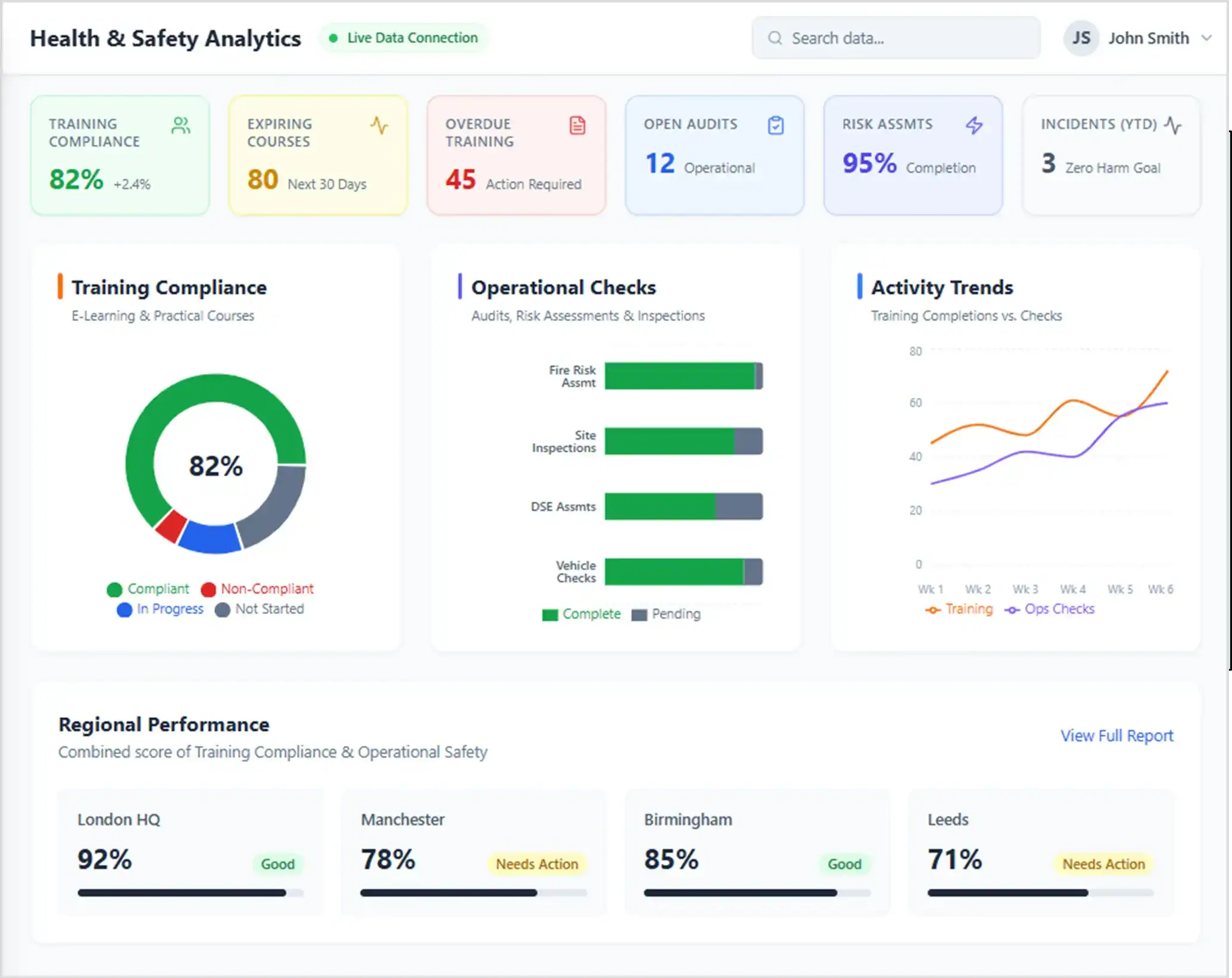
Even where dashboards exist, fixed views rarely reflect bespoke KPIs, assurance models, or multi-site reporting hierarchies. As a result, organisations continue exporting and manipulating data outside the system.
This Power BI integration replaces recurring spreadsheet consolidation with a structured, controlled reporting model suitable for operational and board-level reporting.
The Human Focus Power BI health and safety connector delivers approved e-learning records, external training data, and checklist and risk activities into a governed dataset designed for repeatable enterprise-level reporting.
Because reports are built from a consistent data model, compliance and training metrics remain aligned across dashboards, leadership packs, and stakeholder views. Reports can be reused, extended, and scaled without rebuilding underlying models as organisational structures evolve.
This integration enables Human Focus data to sit within your existing BI environment, aligning health and safety reporting with finance and operational performance dashboards. It reduces spreadsheet-driven governance risk while increasing transparency, auditability, and executive confidence.
This module is particularly suited to mid-sized and enterprise organisations seeking to embed Power BI health and safety reporting into their broader performance and governance framework.
For organisations not currently using Human Focus, this replaces spreadsheet-based tracking of training and safety activity that is often maintained separately by different teams.
For existing Human Focus users, it removes the limitations of standard dashboards, allowing teams to track and visualise the specific metrics used to manage safety performance – including bespoke measures, internal assurance views, and stakeholder-specific reporting.
Because data is structured and kept up to date on the platform, reports no longer depend on last-minute data cleaning or reconciliation before they can be shared.
Create reporting views that reflect how safety responsibilities are actually managed across sites and teams, rather than being constrained by fixed system dashboards.
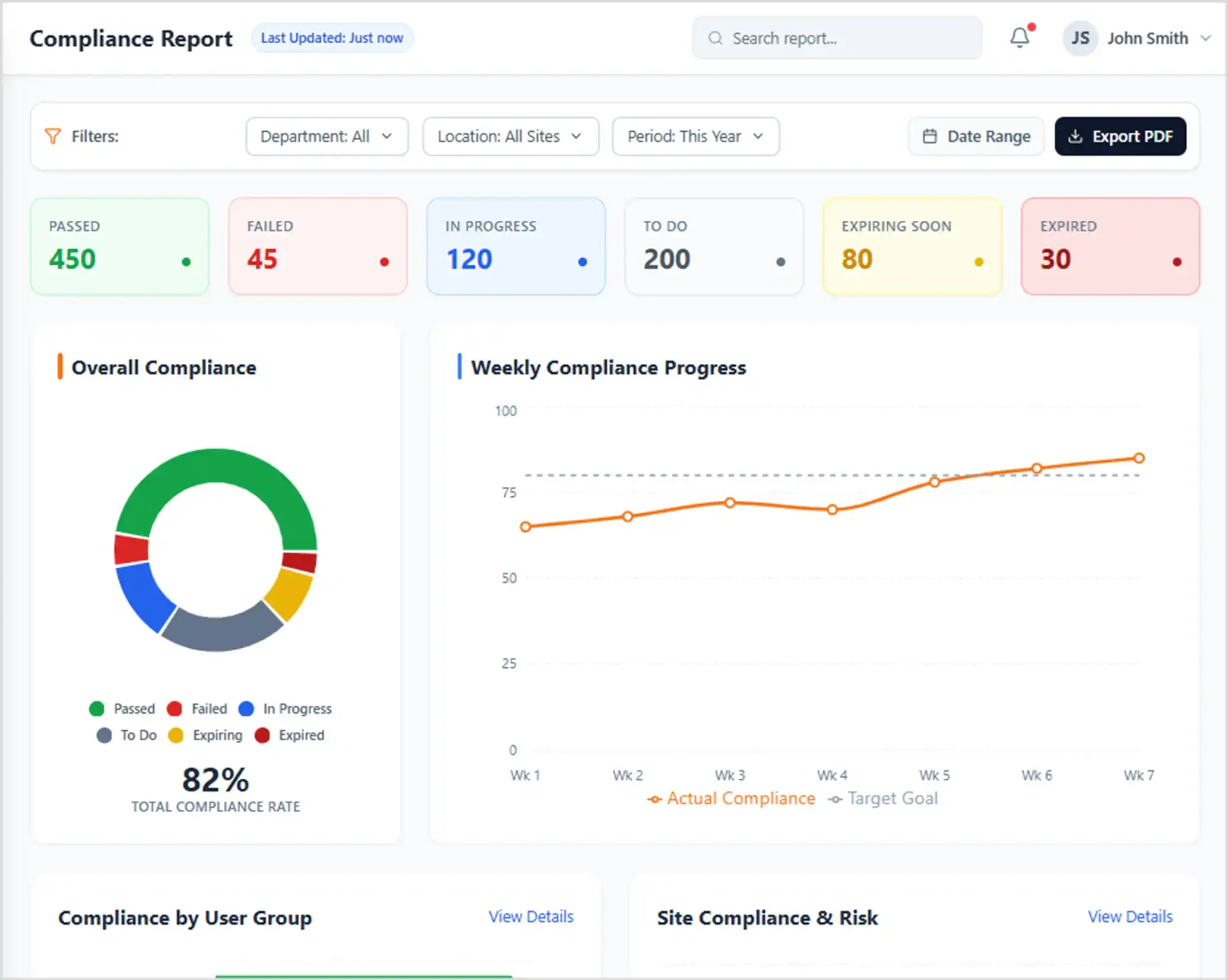
Track training coverage and gaps using combined views of Human Focus-approved learning and externally delivered training, structured by role, site, and department.
Review the checklist and risk activity across locations to support operational oversight and targeted follow-up without requesting bespoke reports each reporting cycle.
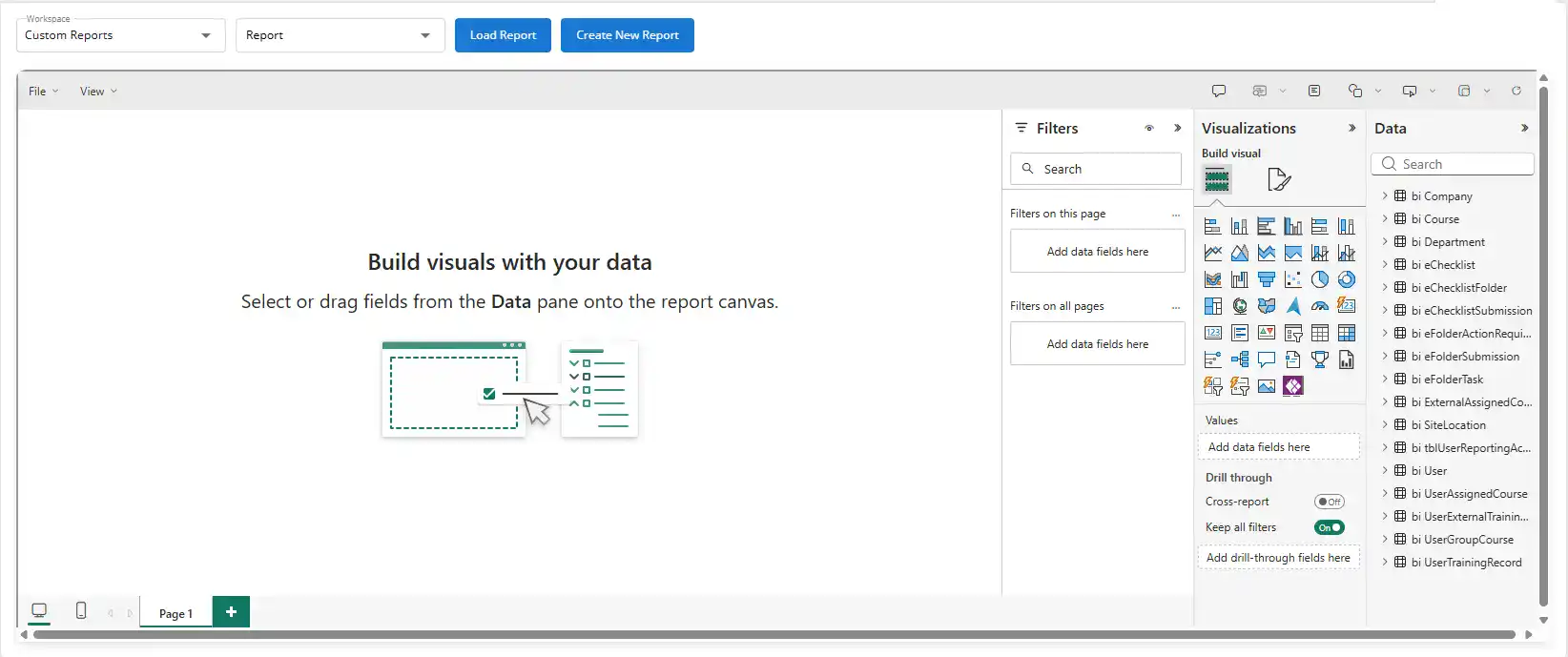
Use structured Human Focus reporting objects directly within Power BI so health and safety reporting aligns with existing data governance, publishing, and permission models.
Access consistent, reliable reporting built from live system data, without reliance on manually prepared summaries.
The Human Focus Power BI connector brings approved training records, external certificates, and safety activity into a structured dataset designed for repeatable reporting.
Because all reports are built from the same Human Focus data, training and safety figures stay consistent across Power BI health and safety dashboards and reporting packs, avoiding mismatches caused by different exports or versions.
Reports can be filtered by site, department, role, or user group without creating separate files. As sites expand or responsibilities shift, reporting continues to function without rebuilding underlying data models.
Human Focus Bespoke Reporting (Power BI) allows reports to be shared through established reporting channels, instead of circulating spreadsheets or static PDF files.
Human Focus Bespoke Reporting (Power BI) provides access to structured Human Focus reporting objects, enabling you to build dashboards and reporting packs to meet your specific needs.
This includes:
- Human Focus-approved e-learning and training records, including assignments, progress, and completions
- External training records uploaded into Human Focus, providing a complete view of training coverage
- e-Checklist and risk management activity to support operational oversight
- Organisational dimensions such as sites, departments, roles, and user groups
- Custom report building in Power BI to match internal reporting requirements
- Ready-made report templates for small and medium-sized organisations
- A choice of self-service reporting or supported report creation
- Reporting that can expand over time as new data objects and fields become available
For existing Human Focus users, this enables reporting that goes beyond standard dashboards to reflect internal structures, assurance requirements, and performance frameworks.
For new users, it replaces fragmented spreadsheet-based reporting with a single structured source.
Fixed dashboards often fail as organisations grow.
Human Focus Bespoke Reporting (Power BI) allows reporting to be filtered, extended, and reused as sites, departments, and roles change, without redesigning dashboards each time. This keeps reporting fit for purpose as organisational complexity increases.
For small and medium-sized organisations, Human Focus Bespoke Reporting (Power BI) includes ready-made reporting templates that provide a faster starting point.
These templates reduce the initial setup effort while still allowing reports to be tailored to internal roles, sites, and organisational structures. This makes it possible to establish consistent reporting without starting from scratch, while keeping ongoing maintenance effort low.
Human Focus Bespoke Reporting (Power BI) can be used either through self-service report building or with supported report creation.
Organisations with established reporting capability can build and manage reports internally. Where reporting capacity is limited, a supported setup allows teams to get reporting in place more quickly without long-term reliance.
Agreeing scope and reporting definitions early reduces rework and allows reporting to be extended as requirements change.
Human Focus Bespoke Reporting (Power BI) is commonly used for:
- Training visibility across approved and external records
- Compliance gap reporting by role or site
- Operational oversight using checklists and risk activity
- Leadership reporting across multiple locations
- Stakeholder-specific dashboards built on a single underlying dataset
Human Focus Bespoke Reporting (Power BI) brings Human Focus platform data into a reusable reporting layer so health and safety reporting can be produced with less manual effort and greater consistency.
It replaces recurring spreadsheet consolidation and fixed dashboards with structured, repeatable reporting that fits existing workflows and reflects how safety is actually managed.