Most confined space plans look adequate until the moment they are needed. Permits are in place, roles are named, and a rescue or escape method is written down — but when an entrant collapses or needs to get out quickly, the method that exists on paper often cannot be executed in the space, on that shift, with the equipment to hand.
The weakness is rarely a lack of intent. It is a mismatch between what the plan assumes will be possible and what the job, the access, and the site layout actually allow when time, visibility, and coordination start to collapse. Under those conditions, teams are forced to improvise — not because they are careless, but because the planned escape or rescue method does not hold up in real work.
Over time, this gap quietly widens. Handover assumptions replace explicit checks, rescue equipment migrates away from the entry point, and “good enough” becomes normal because nothing has gone wrong recently. This guide explains why escape and rescue plans fail in real confined space incidents, and what improves reliability on industrial sites so that getting people out is a tested capability, not an assumption.
Rescue failures repeat because many organisations treat rescue as a document they can point to, not a capability they can execute under time pressure. The failure modes below are the predictable ways in which the gap shows up in real sites.
The first failure is an assumption disguised as a method. The plan says “call emergency services” even when the hazard can incapacitate quickly and the site has not tested whether external responders can reach, enter, and recover in time for that specific space. (HSE (2014) makes clear this reliance is not sufficient on its own.
If an employer is relying on off-site responders, it still has to evaluate whether they are trained, equipped, and able to respond effectively for confined space rescue (OSHA, 2016).
The pattern usually looks like this.
- The plan escalates to public rescue without a space-specific capability check.
- Access constraints and communications are not jointly walked through in advance.
- The site has no credible bridge between collapse and external intervention.
Multi-casualty confined space events are not a “panic” story. They are a system outcome when the organisation has not made controlled rescue the only easy option.
HSE warns that fatalities include both entrants and people who attempt rescue without proper training and equipment.
NIOSH’s alert reports that, in the incidents it described, more than 60% of confined space fatalities involved would-be rescuers, which shows how often the escalation mechanism is uncontrolled entry rather than the original task (NIOSH, 1986).
The pattern usually looks like this.
- The first response is entry, not scene control.
- Breathing apparatus and retrieval capability are not immediately usable on shift.
- “No-entry rescue” exists as a concept but not as a hard operational stop rule.
A rescue plan can be technically compliant and still be physically impossible. Restricted entrances and internal constraints can make rescue harder than the document assumes, especially when the casualty must be moved with protective equipment. HSE explicitly flags that manhole-style access can make escape and rescue more difficult (HSE (2013).
Research on confined space risk assessment also treats rescue feasibility as a space-dependent factor, including whether external rescue is feasible and the rescue conditions (Burlet-Vienney et al., 2015).
The pattern usually looks like this.
- The plan assumes non-entry retrieval, but the geometry makes it unworkable.
- The plan assumes a clear extrication route, but bends, baffles, or obstructions block it.
- Anchor points, lift paths, and communications are assumed, not verified in the actual space.
This is the clearest evidence that a “plan” can exist and still be non-credible. In an HSE Improvement Notice issued at Grangemouth, the organisation had documented confined space rescue arrangements, but HSE identified missing elements required to make them effective, including breathing apparatus training, first aid training, and simulated rescue recovery training. HSE (2022).
The interpretive point is straightforward. A rescue plan is a performance claim. If the competencies and rehearsed readiness are not present, the plan functions as reassurance rather than control.
The pattern usually looks like this.
- Equipment lists exist, but competence to use it is not current or demonstrable.
- “Rescue team” exists as a label, but simulated recovery is not practised.
- The organisation cannot show that its chosen rescue method can be executed in a timely manner for its actual hazards.
Some rescue failures occur before rescue planning is even allowed to operate. In the Kettering General Hospital manhole case, HSE found the manhole was not identified and managed as a confined space, the work was not properly risk assessed, and confined space entry had become routine custom and practice over years. The worker was recovered by the fire and rescue service after being found unconscious.
The failure mechanism is not “no document.” It is misclassification and bypass. If the job is treated as normal maintenance, the permit triggers, standby roles, equipment staging, and rehearsed rescue method never switch on. The organisation ends up discovering its true rescue method after the collapse.
The pattern usually looks like this.
- Confined space controls are reserved for “big jobs,” while small tasks bypass them.
- Entry becomes normalised and unchallenged because nothing has gone wrong recently.
- Emergency response defaults to improvised action and external rescue.
Rescue plans depend on entry control being one operational system. When authorisation is fragmented across teams or activities, emergency arrangements become inconsistent and fragile.
HSE’s conviction record for Thames Water Utilities Limited relates to an incident during sewer work under the Confined Spaces Regulations 1997.
The interpretive implication is that rescue cannot hold if entry control does not hold. If multiple teams can change conditions, isolate systems, or alter access constraints without a single point of control, the rescue plan degrades into a generic intention.
The pattern usually looks like this.
- Multiple authorisation routes exist and do not reconcile into one live picture of control status.
- Outages, concurrent work, or changing conditions break assumptions the rescue method depends on.
- The rescue plan remains “true on paper” while becoming unreliable in the field.
Derive the rescue plan from the risk assessment, then align it to the space, the task and the shift. It’s also important to lock it into the permit-to-work so the job cannot start until the rescue arrangements are in place. The plan should assume non-entry rescue first. If the plan requires an entry rescue, it should state so and outline how it will be carried out without adding new casualties.
Start by naming the space. Include the site, unit, asset number and the exact access point. Describe the task and the method. Include tools, chemicals, hot work and how long people will be inside. Then map the route in and out.
Note ladders, hatches, bends, vertical lifts and the distance to a safe atmosphere. Finish by listing what could change during the job. For example:
- Nearby work
- Isolation points being reinstated
- Product movement
- Weather
- Shift handover
These changes often turn a workable plan into a failed rescue.
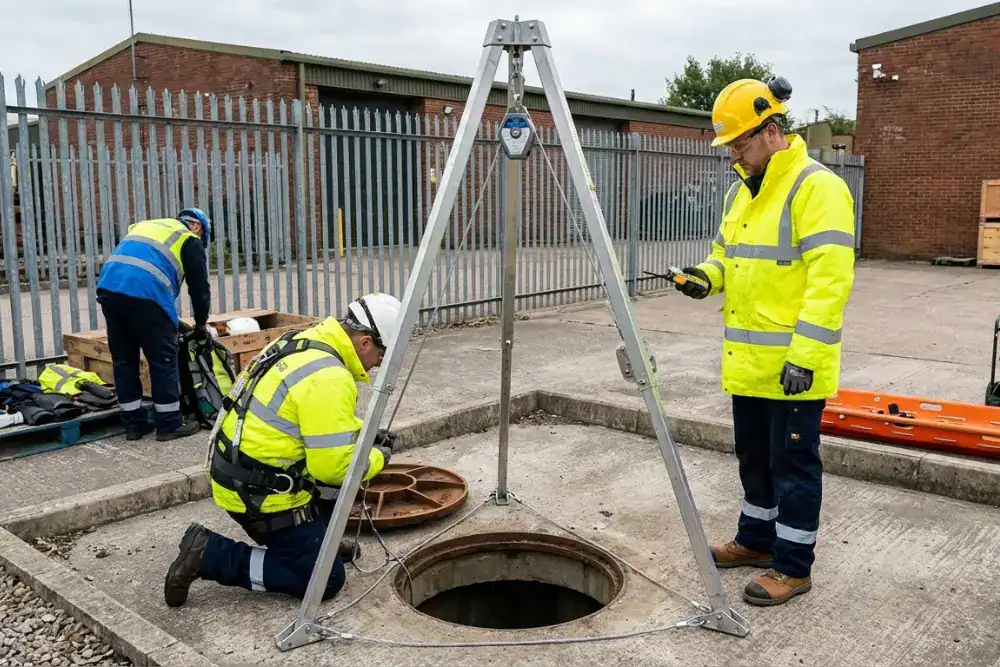
Pick the rescue method first. Build the plan around it. Use non-entry rescue as the default. That means retrieval from outside the space using a line and lifting device where the space allows it.
Only plan entry rescue if non-entry will not work. When entry rescue is possible, write clear trigger points for when the rescue team enters and when the attempt stops.
A simple way to make this clear is to write one line for each likely emergency, with a matching recovery method. For example: “Collapse at base of ladder: retrieval line and winch.” If the space has baffles, tight turns or a work point that blocks retrieval, say so and state the entry rescue method.
The plan should name who does what on that shift. It should also say who covers breaks. Keep the roles clear, then name the people against them in the permit documentation.
Use a short role list only where it removes doubt:
- Permit issuer and entry supervisor
- Topside attendant (outside attendant) and entrants
- Rescue lead and rescue team
- First aider
- Person to meet and guide emergency services
Then write two short lines that remove confusion in an emergency: who starts the rescue plan and who calls 999.
Add a minimum cover rule. For example: “No entry if the rescue team is not in position at the entry point”. If a breathing apparatus (BA) may be needed, state the BA competence needed and who has it.
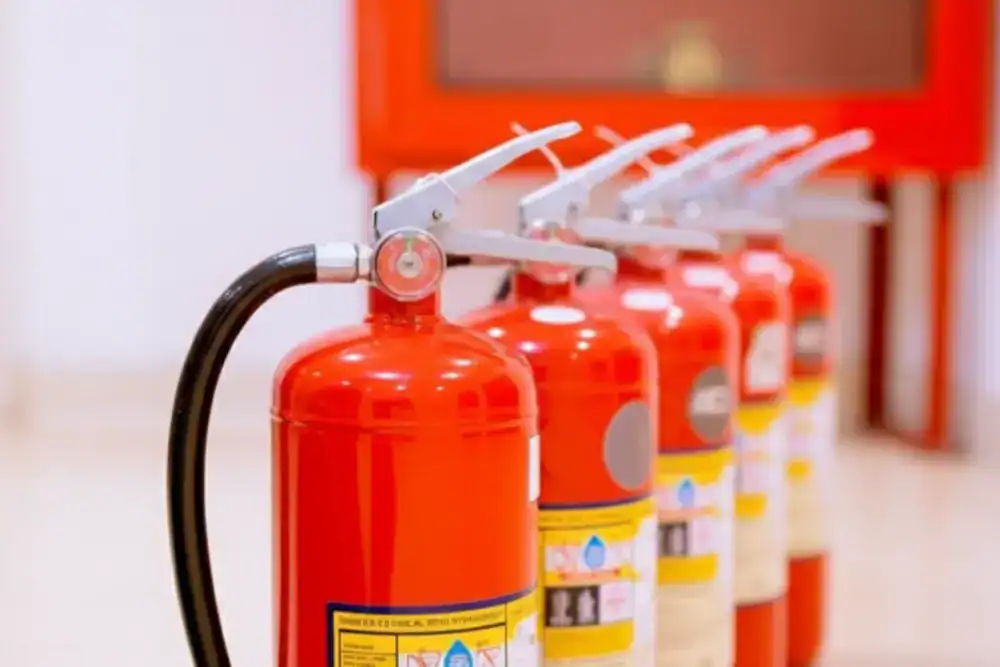
List kit based on the rescue method, not based on what is in the store. Put the kit at the entry point before entry starts. Your plan should also confirm it is serviceable on the day of entry. This is where many plans fail.
Keep the kit section tight. Focus on what is needed for rescue, not a general job kit. Include how readiness is checked. Pre-use checks should happen before each entry. Inspections should be up to date. Batteries should be charged. Gas monitor status should be known, including bump test (functional check) and calibration status. If cylinders are used, pressures should be checked and spares available.
Write what injuries are foreseeable for that space and task. Keep it job-based. Gas exposure, collapse, heat illness, burns, crush and entrapment are common. Then state what medical provision is on site and who uses it. If resuscitation is a foreseeable outcome, the plan should state what resuscitation equipment is available and who is trained to use it.
Finish with a handover. State where the casualty goes once out, who meets the ambulance and what information gets passed over. Include time in the space, gas readings, what work was underway and what treatment was given.
The rescue plan should be incorporated into the permit-to-work process. Either attach it to the permit or reference a controlled version. The permit checks should confirm the rescue team is present, the kit is in place and checked, communications work from the work position and access is clear.
Drills should match the real space. Use the same entry point, route and kit. Record what happened, fix what failed, then drill again after changes. Changes include plant layout, access, people, shift pattern, kit or method. Train teams to avoid unplanned entry rescues and to follow the agreed trigger points.
Confined space incidents escalate on a timescale that rarely matches “we’ll deal with it if it happens.” It is not enough to rely on the emergency services and you must think in advance about how you will know an entrant is okay and how you will get them out. That is rescue as an entry condition, not a post-event escalation step.
A rescue plan reduces delay and prevents unplanned entry only when its prerequisites are met at the point of work. That means the method is feasible for the specific space, the shift has defined roles and cover, and equipment and communications are staged and ready.
Where those conditions are assumed rather than verified, the plan becomes “work-as-imagined” and the response defaults to improvisation when seconds matter (Hollnagel, 2017).
Over time, normal production pressure can also push organisations toward small compromises that feel reasonable locally but erode the margin of safety. This drift is a recognised systems pattern in safety science, not a character flaw in workers (Morrison and Wears 2022).
Confined spaces training can help people recognise hazards, understand roles, and follow the intended method. It cannot compensate for a rescue method that is physically unworkable for the space, equipment that is not staged and ready, or a shift structure that does not sustain competent cover. If the work system makes the safe method hard to execute, training will not carry out rescue performance when pressure collapses, time and attention.