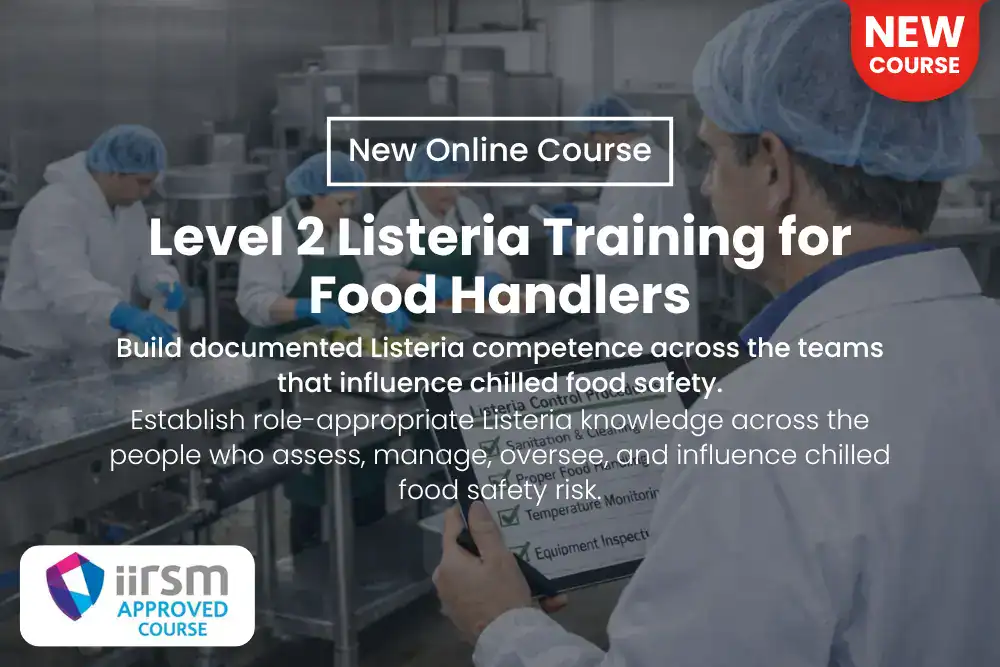
We are pleased to introduce our fully online course: Level 2 Listeria Training for Food Handlers.
Listeria monocytogenes is one of the most serious hazards in chilled and ready-to-eat food production. Unlike most foodborne pathogens, it can grow at refrigeration temperatures and survive in vacuum-packed and modified-atmosphere products. Because the foods it contaminates are eaten without a final cooking step, no further step removes the hazard before the product reaches the consumer.
Controlling Listeria depends on consistent hygiene behaviour among all workers on site. This IIRSM-approved course gives food handlers a clear, practical understanding of how Listeria enters food environments, where it survives and how it spreads through routine site activity. It covers the operational controls that prevent contamination from reaching ready-to-eat products, and what workers must do when a control failure occurs. Food businesses gain a repeatable tool to brief staff to a shared standard and record that the briefing has taken place.
Under UK food safety law, employers must ensure food hazards are properly controlled, staff are appropriately trained and hygiene procedures are consistently followed. Workers have corresponding duties: to follow site rules, report hygiene concerns and support the controls in place.
Those obligations are only met where food handlers genuinely understand them. Awareness of the rules is not the same as understanding why the rules exist. When workers do not understand the rationale behind specific controls, practices such as zoning, water management, and equipment cleaning tend to be applied inconsistently, particularly across shifts or when agency staff and new starters are involved.
Listeria adds a further complication. It can persist in harbourage sites and spread through equipment and routine site movement without obvious signs. High-risk production areas, where food reaches the consumer without a kill step, demand a higher, more reliable standard of hygiene behaviour from everyone working in them. This course builds that understanding. It covers how Listeria behaves in chilled food environments and the specific measures that help prevent contamination of ready-to-eat products.
This training is designed for anyone working in environments where chilled or ready-to-eat foods are handled, particularly in high-risk production areas. It is relevant for:
- Food production operatives and line workers
- Chilled and ready-to-eat food handlers
- Packing, portioning and slicing operatives
- Cleaning and sanitation operatives
- Food production supervisors and team leaders
- New starters and agency workers in food production settings
It is most important for workers operating in areas where food reaches the consumer without further preparation, where the consequences of inconsistent hygiene behaviour are most immediate and most consequential.
By the end of this course, trainees will understand:
- What Listeria monocytogenes is, why it causes serious illness and which groups are most at risk
- How Listeria enters food production environments and spreads through routine site activity and shared equipment
- Where the bacterium survives in harbourage sites and why these locations must be identified and controlled
- The hygiene, zoning, PPE and footwear controls that prevent contamination from reaching ready-to-eat areas
- How temperature control and date management limit Listeria growth in chilled food products
- The correct cleaning and disinfection sequence and how to avoid spreading contamination through equipment and drains
- What workers must do when Listeria is detected on site to contain the risk quickly
- The legal responsibilities of employers and workers under UK food safety law
Need to improve hygiene consistency across shifts and give every food handler a documented understanding of Listeria controls? Enrol your workforce on Level 2 Listeria Training for Food Handlers today. Build practical knowledge of contamination routes, hygiene controls and the specific site behaviours that protect consumers and support compliance with UK food safety law.
Enrol Now
For more details about this course, please contact us.