The Golden Thread, Gateways & Mandatory Occurrence Reporting
for Accountable Persons and Principal Accountable Persons
schedule
Course Duration: 30+ minutes
Understand how the Golden Thread of building safety information, the three gateway stages and mandatory occurrence reporting shape the duties of Accountable Persons (APs) and Principal Accountable Persons (PAPs) for occupied higher-risk buildings under the Building Safety Act 2022.
Through a missing fire-door records scenario, practical handover checks and a fire-stopping case study, the course shows how building safety information is checked on receipt, kept up to date and used to report serious safety occurrences to the Building Safety Regulator (BSR).
This course is designed for those who hold or support building safety duties in occupied higher-risk residential buildings, including:
Accountable Persons
Principal Accountable Persons
Building safety and records staff
Housing associations and councils
Freeholders and managing agents
Build-to-rent and student landlords
Course Content
Uses the example of a fire door with no installation or certification records to show why the Golden Thread is needed and what it should contain.
Explains the planning, pre-construction and pre-occupation gateway stages and what each one means for the information an AP or PAP receives at handover.
Covers the checks to make before accepting the Golden Thread at handover and how records should then be kept digital, secure, accessible and up to date.
Shows which inspection, maintenance and repair records feed into the Golden Thread once a building is occupied and how to record and respond to residents’ safety concerns.
Explains what counts as a mandatory occurrence, the two-stage notice and report process for informing the BSR and what can follow a report.
Follows a building manager deciding whether defective fire stopping found during routine maintenance must be reported to the BSR, even after a quick repair.
Disclaimer: This course provides awareness of specific duties under the Building Safety Act 2022. Completion does not constitute a formal assessment of competence to undertake statutory dutyholder responsibilities.
What You Will Learn
This course helps learners:
Understand the purpose of the Golden Thread and the building safety information it typically contains
Understand the three gateway stages and how each one shapes the information handed over at occupation
Identify the checks to make when receiving building safety information at handover
Recognise warning signs in handover records, such as an empty change control log
Understand how the Golden Thread should be kept digital, secure, accessible and up to date
Identify the inspection, maintenance and resident records that keep the Golden Thread current
Recognise when an incident or defect meets the threshold for mandatory occurrence reporting
Understand the notice and report stages for reporting a mandatory occurrence to the BSR
Available in 20+ Languages
Course subtitles are available in multiple languages, including:
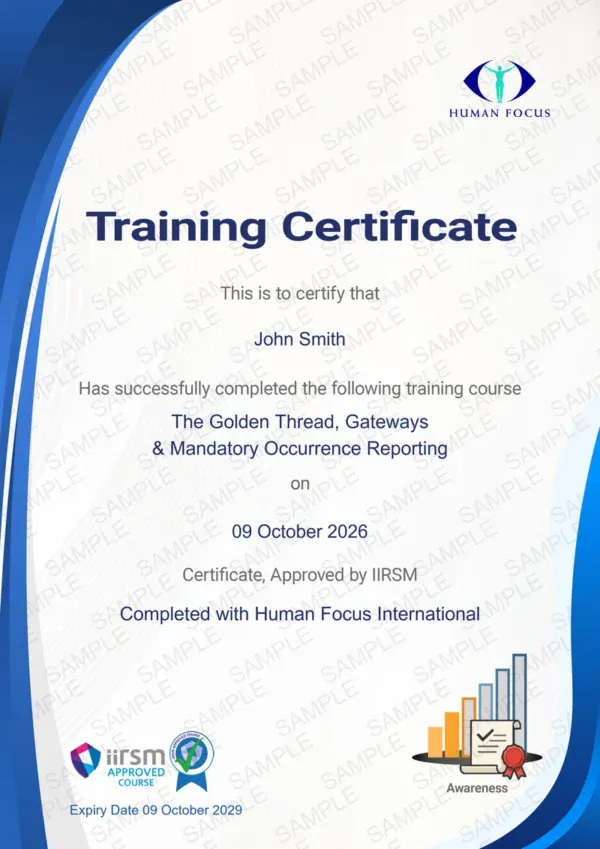
This course is approved by IIRSM – the International Institute of Risk & Safety Management.
The course certificate includes:
User name
Company name
Course name
Completion date
Expiry date
Approval body
An IIRSM-approved course certificate will be available for download and printing instantly upon course completion.
Users must complete a final theory test before earning their certificate.
The end-of-course test is:
Fully online
Multiple choice
A score of 80% is required to pass.
Customer Feedback
Why Is Golden Thread and Mandatory Occurrence Reporting Training Important?
Under the Building Safety Act 2022, APs for occupied higher-risk buildings in England must keep the prescribed building information known as the Golden Thread and keep it up to date as far as possible. They must also report safety occurrences in their part of the building to the BSR. The PAP must establish and operate an effective mandatory occurrence reporting system for the building.
In practice, missing or disorganised records can conceal fire and structural hazards. Information is often lost between contractors, owners and phases of a building’s life, so an incomplete handover can make it hard to establish what was installed and approved. Dutyholders can also be unsure what to record or when an occurrence must be reported.
An AP who fails without reasonable excuse to give the BSR the required information about a safety occurrence commits an offence under section 87 of the Act, punishable by a fine. If an AP breaches their duties under the Act without reasonable excuse and this places people in or about the building at significant risk of death or serious injury, they commit an offence under section 101, which carries up to two years in prison, a fine or both.
How This Training Helps Your Organisation
This training helps your organisation:
Build awareness of the Golden Thread among staff who receive, manage or rely on building safety records
Show staff why handover information should be checked and any gaps raised formally before it is accepted
Clarify which inspection, maintenance, repair and resident records should feed into the Golden Thread
Explain how the gateway stages shape the building safety information your organisation inherits
Outline which incidents and defects must be reported to the BSR and how the notice and report stages work
Give staff a shared understanding of how resident and contractor reports should be recorded and acted on
Start Training Today
Do your APs and building safety teams know what to check at handover and which occurrences must be reported to the BSR?
Enrol them on The Golden Thread, Gateways & Mandatory Occurrence Reporting.
The course is fully online, so learners can complete it at their own pace on any device.