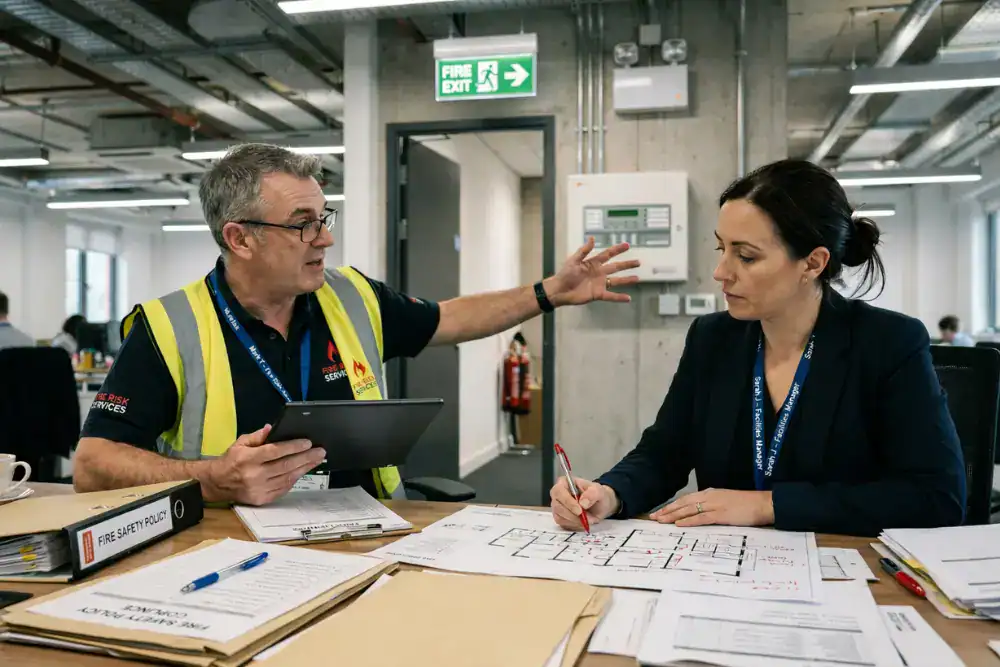
When Responsible Persons try to establish whether the person they have appointed to carry out a fire risk assessment is genuinely competent, they typically reach for a qualification, a professional body membership, or a register entry. The assumption behind that move is reasonable: somewhere in the market, there must be a recognised route that settles the question.
There is not. There is still no single statutory licence, protected title, or mandatory qualification route in force in England and Wales that conclusively proves fire risk assessor competence across all premises. Official guidance has become clearer since Grenfell and it does point in a consistent direction. But guidance is not a settled standard. Certification schemes and professional registers are useful inputs, not definitive answers. And the practical reality of the assessor market regularly diverges from the picture those credentials project.
Responsible Persons who have found this confusing are not misreading the situation. The residual uncertainty is real and institutionally produced. This article does not dissolve it. What it can do is explain where the guidance is clear, where the market still falls short, and what that means for how the appointment decision should be approached.
Under Article 9 of the Regulatory Reform (Fire Safety) Order 2005, the Responsible Person must ensure a suitable and sufficient fire risk assessment (FRA) is carried out. Where they lack the competence to do this themselves, they must appoint a competent person to assist (Regulatory Reform (Fire Safety) Order 2005, art. 18; GOV.UK, “Fire Risk Assessments,” n.d.).
The Order defines competence as having sufficient training and experience or knowledge and other qualities. That is the full extent of the legal prescription. There is no protected title, no statutory licence, no approved list.
That means a facilities manager, building owner, or specialist contractor could all lawfully carry out an assessment, provided they are competent for the type of premises and the level of risk involved (Home Office, n.d.). Fire and rescue authorities can offer guidance and advice, but they do not carry out assessments on a dutyholder’s behalf (GMFRS, n.d.).
That flexibility makes sense. The demands of a low-risk office are not the same as those of a care home, a residential block, or a crowded public venue. A single route to competence would struggle to reflect that.
The problem is that the flexibility which makes the system sensible for diverse premises is the same flexibility that leaves “competent” undefined in practice. In reality, that decision is often made by someone who may be accountable for it, but not expert enough to test it with confidence.
Section 156 of the Building Safety Act 2022 makes one part of the duty clearer. Responsible Persons in England must now record the fire risk assessment in full and note who carried it out (GOV.UK, “Section 156 Guidance,” n.d.).
What it does not do, at least not yet, is create a new practical test for deciding whether that person is competent. A further provision – subsection (4), which will insert a new Article 9A duty not to appoint someone unless satisfied they are competent – has not yet come into force. Government guidance in 2023 confirmed that this would be commenced separately.
Until then, competence at the point of appointment still sits within the existing Article 18 duty and the wider framework of fire safety law. That matters because Section 156 increases visibility and accountability, but it does not remove the need for judgement.
Responsible Persons may now be expected to record more, but they are still left to decide – and justify – how they concluded that an assessor was competent in the first place.
The duty is more explicit. The judgement behind it is still largely left to the Responsible Person.
Official guidance has become more coherent since Grenfell. It now points Responsible Persons towards third-party certification, relevant professional registration, and experience matched to the type of premises involved (Home Office, n.d.; FSF/FRACC, 2020; NFCC, n.d.).
BS 8674:2025 has also introduced a national competence framework for individual fire risk assessors, giving the market a clearer benchmark for what good looks like (BSI, 2025). What this guidance still does not do is resolve the appointment decision. These are indicators of competence, not a single mandatory route. Third-party certification is preferred, but not legally required.
BS 8674:2025 is an important step, but it does not yet carry statutory force or remove the need for judgement. Nor is there a widely adopted framework that clearly matches competence routes to different types of premises.
The government has committed to mandatory, independently verified accreditation through a UKAS-approved scheme as the eventual end state (Grenfell Phase 2 Government Response, 2024). But that is still a future direction, not the current law.
Key point: Official guidance gives direction. It does not give a single authoritative route that resolves the appointment question. The National Fire Chiefs Council (NFCC, n.d.) is explicit that dutyholders retain full responsibility for ensuring the FRA meets legal requirements — which means the RP must exercise judgement, not simply follow a checklist.
Official guidance points Responsible Persons towards certification, relevant experience, and due diligence. But the market still does not translate those signals into a reliable basis for appointment across all types of premises.
Any experienced safety professional knows that qualifications are, at best, a proxy for competence. Highly credentialed assessors can produce weak assessments. Equally, people with fewer formal credentials but deep experience of a specific building type can produce excellent ones.
The Home Office survey reflects that reality. It found wide variation in background, experience, and self-assessed competence across the profession, including among those with formal certification (Home Office, 2024). Certification is useful. It narrows some of the variation. It does not remove it.
Yet organisations still lean heavily on credentials because they are easy to evidence. They help procurement teams approve suppliers, satisfy internal governance, and create a documentable basis for decision-making. That makes them useful administratively, even when they are only partial evidence of practical suitability.
That distinction matters. In practice, the market often rewards what is easiest to verify, not what is most reliable as a test of competence. Research on training and transfer points in the same direction: competent performance depends not just on training or certification, but on context, method, and organisational support (Burke et al., 2006; Blume et al., 2010).
A third-party certificate shows that someone met a defined standard at a particular point in time. What it does not show is whether:
- The assessor has relevant experience of this type of building
- They have maintained that competence
- The scope they are being asked to cover actually matches the premises
Home Office guidance makes that clear. Appointment due diligence should include checking relevant premises experience, references, insurance, and the agreed scope of work – not just confirming that someone appears on a register (Home Office, n.d.). A register entry may be a useful starting point. It is not, on its own, a reliable appointment decision.
That is where many organisations go wrong. When a register or certification is treated as the whole answer, rather than one part of the judgement, the Responsible Person may believe they have reduced risk when in reality they have only made the decision easier to evidence (FSF/FRACC, 2020).
Home Office guidance is clear: experience with offices, factories, and shops does not automatically translate to care homes, high-rise residential blocks, or heritage premises (Home Office, n.d.).
The problem is not just that this experience is scarce. It is that the route to gaining it is narrow. An assessor who has not worked on a care home is unlikely to be appointed to one. But without that appointment, they have little chance to build the experience. The same pattern applies across other complex or high-risk premises.
The result is a market where relevant experience concentrates in a small group of established practitioners, with limited supervised routes for others to develop it. Under procurement pressure or time pressure, organisations may then appoint whoever is available and credibly qualified, even where their experience does not truly match the premises.
That is where the gap between credentials and suitability matters most. It is also where poor appointment decisions are easiest to justify on paper and hardest to spot until something goes wrong.
The same competence test applies whether a fire risk assessment is carried out internally or by an external provider. In practice, though, internal appointments are often tested less rigorously. That makes them one of the weaker control points in the process.
The Fire Safety Order requires competence, not a specific external credential. A suitably experienced internal appointee can therefore carry out a legally compliant assessment without an externally issued badge. Whether an internal assessor should also hold certification is a question of demonstrability, not legal validity.
What is not optional is the need to assess that person’s competence before they are appointed. That judgement should be made with the same rigour that would be applied to an external provider. NFCC guidance suggests that internal appointments are often scrutinised less closely in practice, because employment within the organisation is treated as evidence of competence in itself (NFCC, n.d.). It is not.
That internal scrutiny gap matters even more because the wider market tends to favour credentials that are visible, standardised, and easy to verify. In adjacent safety disciplines, that has often pushed practice towards credentialism.
Construction safety offers a familiar example. The CSCS card became a de facto requirement on many sites not because it resolved the competence question, but because it gave procurement and gatekeeping functions something simple to check. A capable tradesperson with years of demonstrable experience could still be excluded without it.
The same structural pressure exists in the FRA market. Where competence requirements are not tightly defined, and where procurement needs something documentable, external badges can quickly become more influential than they were ever intended to be.
This creates a two-sided risk. Internal assessors may be under-tested because they are already inside the organisation. External providers may be over-valued because their credentials are easier to evidence and defend.
Over time, that can distort appointment decisions. Organisations may find themselves favouring credentialled external providers over capable internal assessors who have built genuine competence through structured experience. That may make the decision easier to justify on paper. It does not necessarily make it better for the building or the people who use it.
The Responsible Person cannot treat a certificate, register entry, or framework as the answer to the appointment question. They have to make a building-specific judgement, test it properly, and be able to explain it.
This is not about building a parallel compliance system. It is about treating the appointment as a genuine suitability decision rather than a procurement exercise. Official guidance points in a consistent direction. Certification or recognised registration may be a useful starting point, but the real question is whether the assessor is suitable for this building, this risk profile, and this scope of work.
In practice, that means looking beyond general FRA credentials. The Responsible Person needs to know whether the assessor has relevant experience for this type of building and level of risk. It means checking references and insurance. It also means agreeing the scope explicitly rather than assuming it from a previous appointment or a generic service description.
Just as importantly, the rationale for appointing that person should be recorded in terms that would make sense to an enforcing authority, insurer, or court.
The same discipline should apply where the assessment is carried out in-house. Employment within the organisation is not evidence of competence by itself. Internal appointments should be tested with the same rigour as external ones.
Nor should any appointment be treated as settled forever. Buildings change, risks change, and the basis for confidence in the assessor may need to be revisited over time.
This matters because variation in assessment quality is often hard to see at the point of appointment. Certification and registration can reduce some of that uncertainty. They do not remove it (Home Office, 2024; Robson and Bigelow, 2010). The most defensible position available to the Responsible Person is still a building-specific judgement, grounded in official guidance and properly recorded.
Key point: the Responsible Person is not being asked to find the one mandatory route, because none exists. They are being asked to follow the direction official guidance provides, apply it to the building and scope in front of them, and record why their judgement was reasonable.
The position on FRA competence is moving towards greater structure. The government has committed to mandatory accreditation through a UKAS-approved scheme (Grenfell Phase 2 Government Response, 2024).
BS 8674:2025 is beginning to give the market a clearer benchmark for what good looks like. Third-party certification is increasingly recognised as the preferred starting point. The direction of travel is clear.
But that is not the same as saying the question has been resolved. There is still no single statutory route, no mandatory qualification that applies across all premises types, and no current mechanism that forces the market into a consistent standard. Credentials and registers can support a judgement on competence. They do not remove the need to make one.
For Responsible Persons operating now, the practical position is straightforward. Take official guidance seriously. Treat certification and registration as useful indicators, not complete answers. Make the appointment decision specific to the building, the scope, and the level of risk involved. Then record why that judgement was reasonable.
That is not a perfect standard. It is the one the current framework requires.
The competence question in fire risk assessment is not solved by knowledge alone. But in practice, decisions about who to appoint, what a suitable and sufficient assessment looks like, and what has changed under the Building Safety Act all depend on a level of understanding that many Responsible Persons – and some assessors – are still developing.
Human Focus’s Fire Risk Assessment Training e-learning course is designed to support that understanding. It gives learners a practical grounding in legal duties and the decisions that matter in real premises. It supports the knowledge component of competence. It does not provide a qualification that settles the appointment question, and it should not be presented as one. Its value is in helping people make better-informed judgements.
Note: This article is intended for information purposes and does not constitute legal advice. Responsible Persons and employers should consult primary regulatory sources and seek professional guidance appropriate to their specific premises and circumstances.