This CPD-certified course helps organisations implement whistleblowing systems that are both compliant and trusted by stakeholders.
It differentiates whistleblowing from personal grievances and explains when disclosures are protected by law, plus what that protection involves. It also gives employees and managers clear steps and expected timelines for raising concerns. Providing this training supports accountability across organisations and increases confidence in your whistleblowing arrangements.
Explains what whistleblowing is and how it protects both people at work and wider society.
Sets out the key laws that protect workers who report wrongdoing in good faith.
Helps users recognise when whistleblowing is legally protected and provides clear examples of reportable concerns, such as safety risks, discrimination or data breaches.
Outlines how to raise whistleblowing concerns, including who to report to and how to provide information confidentially. It also explains when and how to escalate concerns externally.
Explains what happens after a whistleblowing report is made, including how concerns are reviewed, investigated and resolved.
What You Will Learn
What whistleblowing is and how it benefits people and organisations
Laws that protect individuals who report wrongdoing in good faith
Issues that should be reported, such as financial misconduct or safety risks
Steps to take when raising a concern inside or outside the company
How confidentiality and anonymity are maintained for those who speak up
What to do if concerns of wrongdoing are ignored or met with hostility
Available in 20+ Languages
Course subtitles are available in multiple languages, including:
This course is certified by CPD – the Continuing Professional Development Certification Service.
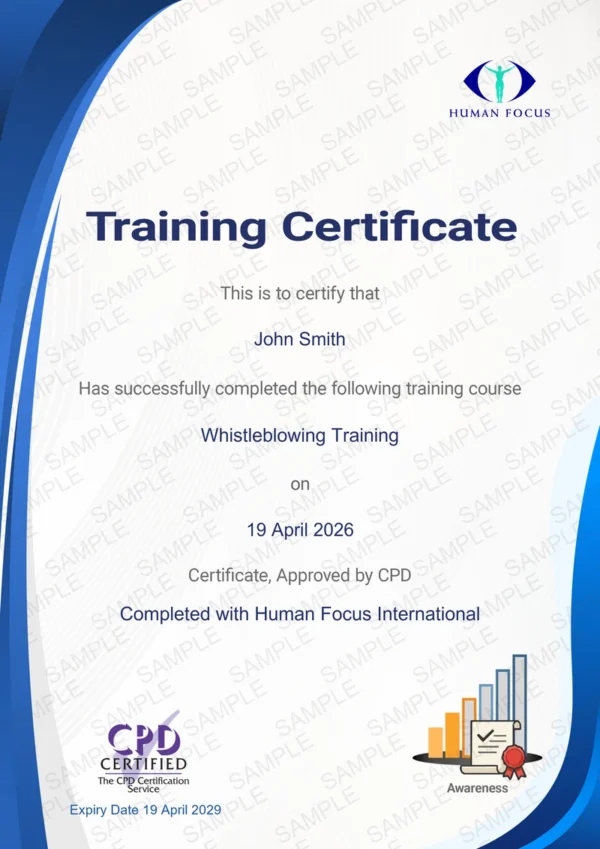
The course certificate includes:
User name
Company name
Course name
Completion date
Expiry date
Approval body
A CPD-certified course certificate will be available for download and printing instantly upon course completion.
Users must complete a final theory test before earning their certificate.
The end-of-course test is:
Fully online
Multiple choice
A score of 80% is required to pass.
Course attempts
Each licence includes one attempt at the final knowledge assessment.
If a trainee does not pass and wishes to try again, an additional licence is required. For their second attempt, the trainee can retake the assessment without repeating the course content.
Customer Feedback
Why Is Whistleblowing Training Important?
Whistleblowing is protected by law in the UK. Under the Employment Rights Act 1996, as amended by the Public Interest Disclosure Act 1998 (PIDA), employers cannot dismiss or mistreat a worker for raising a genuine concern in the public interest.
For most organisations, the risk is not refusing to act on a concern. It is mishandling a disclosure without realising it carries legal protection. When a manager misses a protected disclosure, shares a whistleblower’s identity, or allows them to be sidelined after speaking up, the organisation can face an employment tribunal claim. It also discourages others from reporting, which means serious wrongdoing can go unaddressed.
The Legal Duty to Protect Whistleblowers
Protection is wider than many managers assume:
It applies to “workers”, not only employees, including agency workers and some contractors
It begins on the first day of work and continues after the working relationship ends
It covers both unfair dismissal and detriment, such as being denied promotion, having hours cut or being excluded from activities
It applies even when a concern later turns out to be unfounded, as long as the worker reasonably believed the information was true and that disclosing it was in the public interest
Mistreatment by colleagues also counts as detriment. An organisation can be held liable for it unless it shows it took all reasonable steps to prevent it — which makes a clear policy and trained managers part of that defence.
Where Organisations Get It Wrong
Most whistleblowing failures are procedural rather than deliberate. Concerns are missed because they look like personal grievances, reviewed by someone with a conflict of interest, or closed without feedback to the person who raised them. Each of these can turn a manageable concern into a legal and reputational problem.
This whistleblowing training course helps staff and managers recognise these situations and respond appropriately, so disclosures are more likely to be handled correctly from the outset.
Core Objectives of This Training
This course is designed to help your organisation:
Distinguish a protected disclosure from a personal grievance
Raise and receive concerns through the correct internal and external routes
Maintain confidentiality and keep clear, defensible records
Respond to whistleblowers in a way that avoids creating detriment
Address wrongdoing early and demonstrate to stakeholders that concerns are managed responsibly
Frequently Asked Questions
Whistleblowing training courses teach employees and managers how to recognise, raise and handle disclosures about wrongdoing at work.
It explains what counts as a protected disclosure, how the law protects people who speak up, and the correct steps for reporting concerns and responding to them.
The aim is a workplace where staff feel safe to raise issues and managers know how to act on them without exposing the organisation to legal risk.
This Whistleblowing Training course is designed to help UK organisations handle whistleblowing correctly and consistently.
Staff learn to recognise a protected disclosure, distinguish it from a personal grievance, and raise concerns through the right internal and external routes.
Managers learn how to receive and respond to disclosures, maintain confidentiality and keep clear records — reducing the risk of mishandling a concern and the legal and reputational consequences that can follow.
A grievance is a personal complaint about your own employment; your pay, your treatment, or your working conditions, for example. Whistleblowing is a disclosure about wrongdoing that affects others or the wider public, such as safety risks, fraud, legal breaches or sexual harassment.
The deciding factor is the public interest: a concern that affects only you is usually a grievance, while one that goes beyond your own situation can qualify as a protected disclosure carrying specific legal protection against dismissal and detriment.
Some issues can engage both routes, so staff need to be able to tell them apart.
This course costs £25.00 +VAT per learner. Bulk discounts are available for organisations training multiple staff.