This CPD-certified Disciplinary and Grievance Training course helps employees understand how these procedures work and encourages them to help resolve issues quickly and easily.
Where appropriate, informal procedures are encouraged as the primary option. By understanding discipline and grievances, staff will be better equipped to work with employers if such procedures are required.
Understand what disciplinary and grievance procedures are, when each applies, and why resolving issues informally is usually the first and best option.
Learn what employers and employees are each responsible for during a case, including the employer’s duty to keep procedures confidential, fair, consistent, open and timely.
Recognise the difference between minor offences and gross misconduct, how minor issues may be addressed informally and why gross misconduct may proceed directly to a formal procedure.
Understand how an employee raises a concern and, where appropriate, seeks to resolve it informally — by talking directly, writing to those involved or using mediation — before filing a formal grievance.
See what happens when a case becomes formal, including how investigations gather evidence and how meetings and hearings are conducted fairly and impartially.
Understand the possible results of a case — a warning, suspension, demotion, dismissal, no action or upholding a grievance — and the employee’s right to appeal.
Disclaimer: This programme provides knowledge and supporting guidance. Completing it does not by itself make you competent, qualified or authorised for workplace tasks. Follow your employer’s procedures, risk assessments and supervision. Do not carry out inspections or testing unless your employer has confirmed you are competent and authorised for the equipment or task.
What You Will Learn
Why discipline and grievance procedures are necessary
Roles and responsibilities
Importance of seeking informal resolutions where applicable
How informal resolutions work
Steps to formal disciplinary procedures
Steps to formal grievance procedures
Possible outcomes of these types of procedures
Available in 20+ Languages
Course subtitles are available in multiple languages, including:
This course is certified by the Continuing Professional Development (CPD) Certification Service.
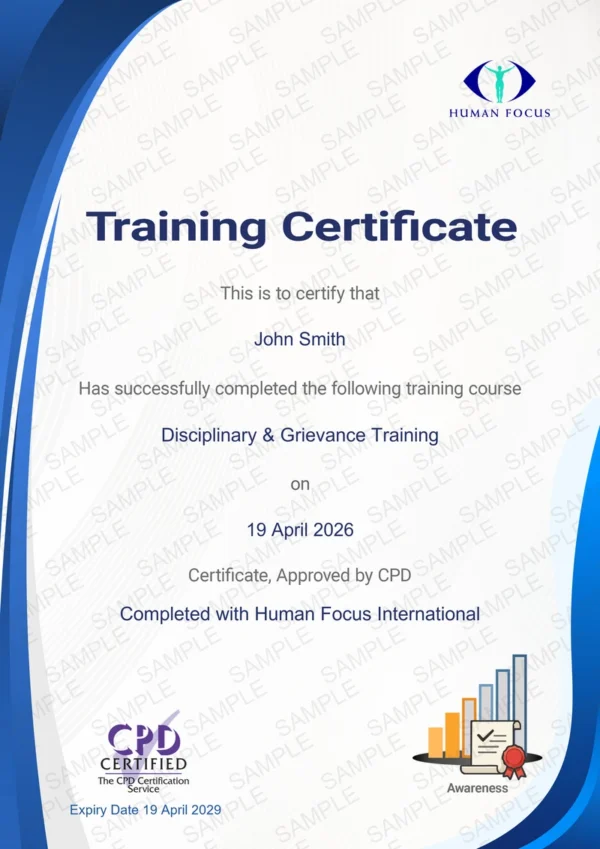
The course certificate includes:
User name
Company name
Course name
Completion date
Expiry date
Approval body
A CPD-certified certificate will be available for download and printing instantly upon course completion.
Users must complete an assessment before earning their certificate.
The end-of-course test is:
Fully online
Multiple choice
A score of 80% is required to pass.
Course attempts
Each licence includes one attempt at the final knowledge assessment.
If a trainee does not pass and wishes to try again, an additional licence is required. For their second attempt, the trainee can retake the assessment without repeating the course content.
Customer Feedback
Why Is Disciplinary and Grievance Training Important?
Conduct, performance and interpersonal issues are a normal part of working life. Handled early and informally where appropriate, many issues can be resolved quickly. Left unaddressed — or handled badly — they can escalate into formal disputes that damage working relationships, disrupt teams and take up significant management time.
For employees, the difference often comes down to understanding how these procedures work. Staff who know how to raise a concern, respond to one, or resolve an issue directly are better placed to address problems before they become formal.
Training helps employees understand their part in these procedures, so concerns are raised properly, handled fairly and resolved as early as possible.
How This Training Helps Your Organisation
This course helps your organisation:
Encourage employees to raise concerns early and seek informal resolution where suitable
Give staff across teams, shifts and sites a shared understanding of how procedures work
Help employees respond constructively when conduct or performance concerns are raised
Support appropriate participation in investigations and formal meetings
Reinforce confidentiality, fairness and professionalism during sensitive situations
Help reduce avoidable misunderstandings, unnecessary escalation and disruption
About Disciplinary and Grievance Training
This course helps employees understand how workplace disciplinary and grievance procedures work, why they exist, and what to expect if they are ever involved in one.
Employees learn the difference between a disciplinary matter — raised by an employer about conduct or performance — and a grievance raised by an employee. They also see the key stages of a fair process, from investigation and formal meetings through to decisions and appeals.
By completing the course, employees are better prepared to raise concerns appropriately, respond constructively when issues arise, and understand why fairness, confidentiality and respect matter at every stage.
Frequently Asked Questions
A disciplinary procedure is used when an employer addresses concerns about an employee’s conduct or performance. A grievance procedure is used when an employee raises a workplace concern, problem or complaint with their employer.
There is no fixed legal timescale. The procedure should be completed without unreasonable delay while allowing enough time to investigate the issue, hold any meetings, make a decision and consider an appeal. Employers should also follow any timescales set out in their own procedures.
A fair disciplinary procedure usually involves investigating the issue, notifying the employee in writing if there is a case to answer, holding a disciplinary meeting, confirming the decision in writing and allowing an appeal. Employees have the right to be accompanied at a disciplinary meeting that could result in a formal warning or other disciplinary action.
No specific law requires employers to provide this training. However, employers should handle disciplinary and grievance matters fairly and follow the Acas Code of Practice. Employee awareness training helps staff understand how procedures work, what is expected of them and how to participate appropriately if a concern arises.
This course costs £25.00 + VAT per trainee. Discounted rates are available for bulk purchases. Click on ‘Discount’ beneath the ‘Buy Now’ button for more details.
The certificate for this course is valid for three years. After this period, the course will need to be repeated to renew the certificate.
Yes. This course is certified by the CPD Certification Service.