From 1 May 2026, the Renters’ Rights Act 2025 changes how every assured tenancy in England must be managed, with no grace period. Teams that continue to follow pre-Act processes face enforcement exposure from day one, and civil penalties can reach £40,000 for serious or repeat breaches.
This CPD-certified Renters’ Rights Act Training for Property Managers gives property and portfolio management teams a practical procedure for the new rules. Staff learn to draft compliant periodic tenancy agreements, serve valid Section 8 notices, process Section 13 rent increases and screen applicants within the new legal boundaries — reducing the risk of errors that carry enforcement consequences.
This course is for letting, property management and portfolio landlord teams working with private rented sector tenancies in England — particularly those managing existing portfolios where processes and agreements have not yet been updated for the new framework.
It is suitable for:
Property and portfolio managers
Lettings branch and area managers
Heads of lettings and compliance directors
Operations managers in property firms
Course Content
The Renters’ Rights Act Training for Property Managers includes the following sections:
Understand why the Act was introduced and what the commencement timetable requires.
Learn how all assured tenancies now operate as periodic tenancies. Understand what written agreements must contain and how the 12-month protected period works.
Understand why Section 21 is abolished and how the transitional window for pre-May 2026 notices operates. Recognise what makes a valid Section 8 notice and why defective notices must be re-served in full.
Learn how to select the correct ground, calculate the notice period and distinguish mandatory grounds from discretionary ones. Understand how the grounds for anti-social behaviour (7A, 14), rent arrears (8, 10, 11) and landlord occupation (1, 1A) apply in practice, including the 12-month re-letting ban.
Understand why Section 13 is the only permitted route for rent increases, with a once-per-year limit. Learn how the new Tribunal reforms affect tenant challenges and why the Act is not rent control.
Recognise the ban on discrimination, the bidding prohibition and the cap on rent in advance. Understand how these rules reach superior leases, mortgages and insurance contracts.
Learn how to handle a pet request within 28 days and what counts as unreasonable refusal. Document decisions defensibly and understand how pet-related damage sits under the deposit framework.
Understand the current position on the Decent Homes Standard and Awaab’s Law, including what remains subject to secondary legislation. Recognise which HHSRS and Category 1 hazard powers are already in force for damp, mould and hazard complaints.
Learn how the PRS Database and PRS Landlord Ombudsman will work once commenced in Phase 2. Understand why an unregistered landlord cannot obtain a possession order and how the Ombudsman changes landlord accountability.
Recognise the civil penalty tiers of £7,000 and £40,000. Learn how Rent Repayment Orders now extend liability to superior landlords and company directors, covering up to 24 months’ rent. Understand the practical steps that reduce enforcement risk.
What Your Staff Will Learn
By completing this training, staff will be able to:
Identify when the Act takes effect and which tenancies it covers
Apply the periodic tenancy structure and draft compliant written agreements
Serve a valid Section 8 notice and select the correct ground for possession
Calculate notice periods and distinguish mandatory grounds from discretionary ones
Process rent increases through Section 13 and handle tenant challenges at the First-tier Tribunal
Recognise prohibited marketing practices, including rental bidding, discrimination and excess rent in advance
Handle pet requests within the 28-day statutory timeframe
Understand the current position on the Decent Homes Standard and Awaab’s Law, what remains subject to secondary legislation and which HHSRS and Category 1 hazard powers are already in force
Available in 20+ Languages
Course subtitles are available in multiple languages, including:
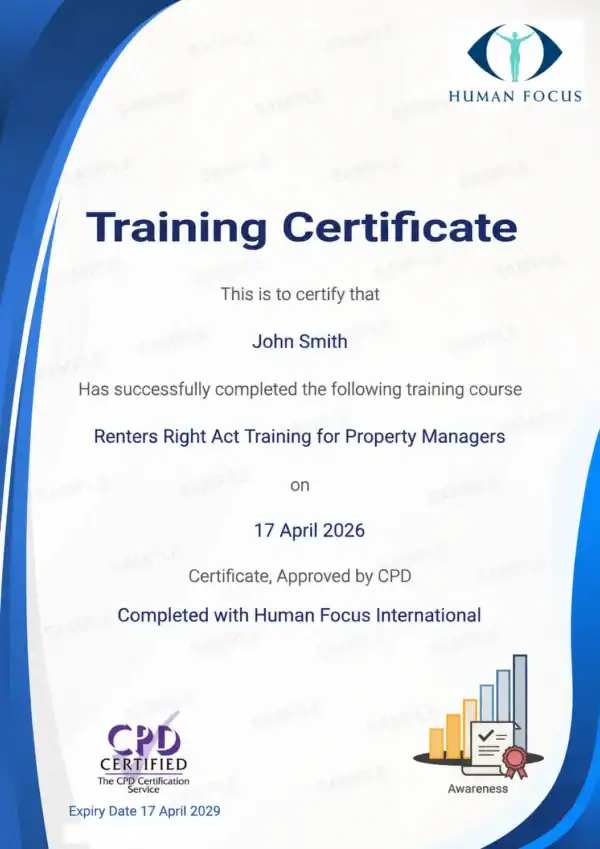
This course is certified by CPD – the Continuing Professional Development Certification Service.
The course certificate includes:
User name
Company name
Course name
Completion date
Expiry date
Approval body
A CPD-certified course certificate will be available for download and printing instantly upon course completion.
Users must complete a final theory test before earning their certificate.
The end-of-course test is:
Fully online
Multiple choice
A score of 80% is required to pass.
Course attempts
Each licence includes one attempt at the final knowledge assessment.
If a trainee does not pass and wishes to try again, an additional licence is required. For their second attempt, the trainee can retake the assessment without repeating the course content.
Customer Feedback
Why Renters’ Rights Act Training for Property Managers Is Important
From 1 May 2026, the Renters’ Rights Act changes the legal basis of every assured tenancy in England. There is no grace period and no transition window for teams that have not yet adjusted. The new rules apply from commencement, across new and existing tenancies, whether or not agreements and processes have been updated.
The risk for letting and property management businesses is not that staff are unaware of the Act. It is that routine tasks, including drafting agreements, serving notices, processing rent increases and responding to applicants, continue to be carried out in ways that were standard before May 2026 but are now either unlawful or procedurally invalid.
Errors of that kind are not visible until enforcement lands. By then, a defective notice must be re-served from scratch, an unenforceable rent increase must be withdrawn, or a civil penalty notice must have already been issued.
Liability under the Act does not stop at the letting agent or landlord. Rent Repayment Orders now extend to superior landlords and company directors, covering up to 24 months’ rent. For serious or repeat breaches, courts must impose the maximum award. The question for any business managing multiple tenancies is not whether one error is affordable. It is whether the team’s processes are consistent enough to prevent errors at scale.
This CPD-certified Renters’ Rights Act Training for Property Managers gives teams a shared working method for the new framework before the deadline arrives. It is a practical way to help teams prepare and reduce the risk of avoidable compliance failures.
How This Training Helps Your Organisation
This course helps letting, property management and landlord businesses:
Prepare staff to apply the new assured tenancy regime correctly from 1 May 2026
Reduce the risk of defective notices, unlawful marketing practices and invalid rent increases
Improve consistency of tenancy processes across branches, portfolios and teams
Build awareness of Phase 2 PRS Database and Ombudsman requirements ahead of commencement
Help reduce the risk of civil penalties and Rent Repayment Orders
Start Your Renters’ Rights Act Training for Property Managers Today
With Phase 1 in force from 1 May 2026, training staff now is a practical way to prepare. Give your teams a consistent working method for the new framework and reduce the risk of avoidable compliance failures across every tenancy you manage.