DSEAR Dust Explosion Risk Assessment Training for Duty Holders
schedule
Course Duration: Approximately 2 hours
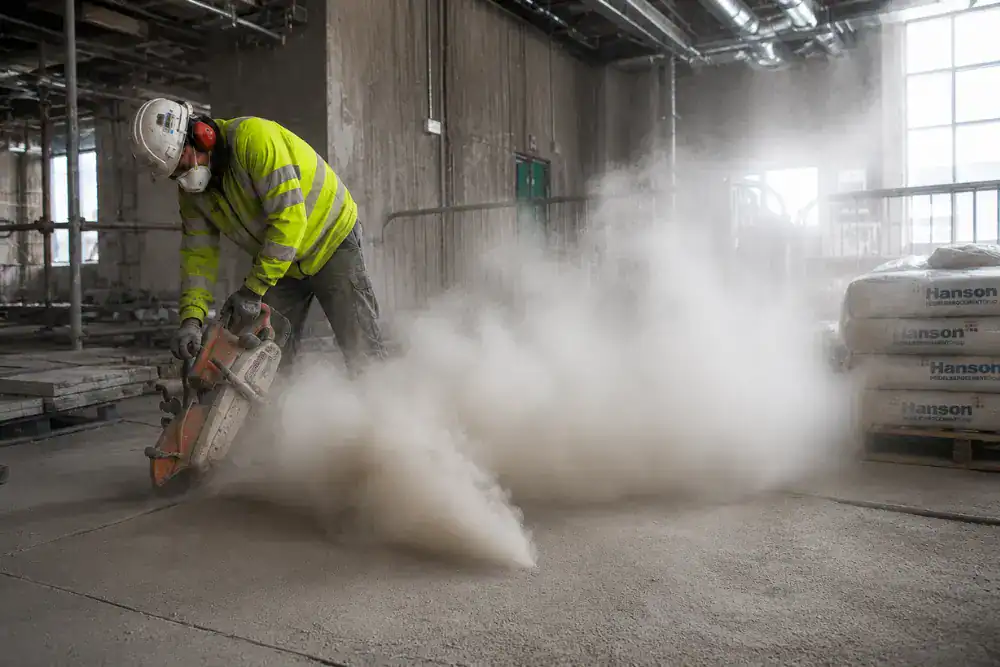
Combustible dust can ignite without warning. A primary explosion can trigger a secondary blast that causes even greater damage. Yet many DSEAR risk assessments still leave the gaps that make this possible.
This IIRSM-approved DSEAR Dust Explosion Risk Assessment Training for Duty Holders gives organisations a practical, consistent framework for assessing combustible dust risk. It helps duty holders understand what a robust assessment should cover, where critical decisions are often missed, and what suitable control measures look like in practice.
This DSEAR Risk Assessment Training is for anyone with legal or operational responsibility for managing combustible dust explosion risk under DSEAR — particularly in workplaces where dust-generating processes, hazardous area decisions and control measures create significant compliance and safety responsibilities.
It is suitable for:
Site managers and operations managers
Health and safety managers and advisers
Compliance officers and environmental managers
Facilities engineers and maintenance managers
Production managers in dust-generating industries
Anyone acting as a DSEAR duty holder or responsible person
Course Content
The DSEAR Dust Explosion Risk Assessment Training for Duty Holders contains the following modules:
Understand what DSEAR requires and how it fits within the wider UK health and safety framework for managing fire and explosion risk.
What is DSEAR?
DSEAR Structure & Guidance
UK Legislation
European Legal Background
Learn how combustible dust explosion hazards arise, what must be identified during an assessment and how risk should be evaluated in a structured way.
Purpose & Scope
The Incident at Imperial Sugar
Understanding Dust Explosion Science
Hazard Identification Process
Dangerous Substances Data
Risk Evaluation
Understand the hierarchy of control, how hazardous areas are classified and how suitable control measures and equipment decisions are determined.
Choosing Controls
Substitution
Engineering Controls
Administrative Controls
Hazardous Area Classification
Hazardous Area Classification in Practice
Equipment Categories & Selection Principles
Equipment Ratings & Labelling
Emergency Preparedness
Personal Protective Equipment (PPE)
Follow the full DSEAR dust risk assessment process through a practical workplace example, from hazard identification and risk evaluation to control selection and recording findings.
Hazard identification
Assessment of the Risks
Risk Controls
Reviewing & Revising
Recording Findings
Disclaimer: This programme provides knowledge and supporting guidance. Completing it does not by itself make you competent, qualified or authorised for workplace tasks. Follow your employer’s procedures, risk assessments and supervision. It does not appoint you to a dutyholder, responsible person or competent person role.
What Your Staff Will Learn
By completing this training, duty holders will be able to:
Understand DSEAR requirements where combustible dust creates a fire or explosion risk.
Recognise which routine processes, materials and workplace conditions are most likely to create explosive dust atmospheres.
Identify the dangerous substances, release points and ignition sources that must be considered in a robust dust risk assessment.
Use dust explosion data to judge hazard severity and support proportionate control decisions.
Apply the DSEAR hierarchy of control to combustible dust risk and identify which measures matter most in practice.
Carry out hazardous area classification, define dust zones correctly and match equipment selection to zone requirements.
Structure, evaluate and document a DSEAR risk assessment under Regulation 5 so that key decisions are clear and justifiable.
Follow the full dust explosion risk assessment process through a practical workplace example.
Available in 20+ Languages
Course subtitles are available in multiple languages, including:
This course is approved by IIRSM – the International Institute of Risk & Safety Management.
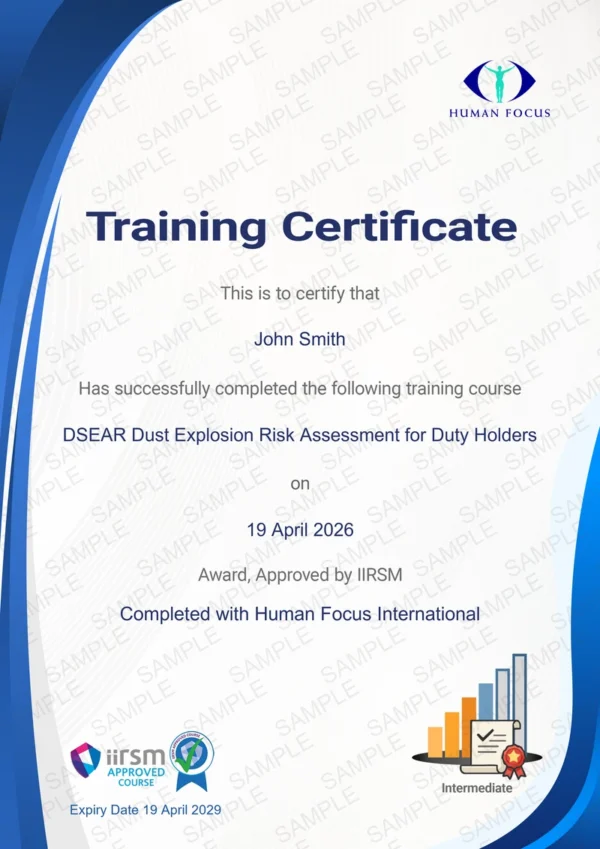
The course certificate includes:
User name
Company name
Course name
Completion date
Expiry date
Approval body
An IIRSM-approved course certificate will be available for download and printing instantly upon course completion.
Users must complete a final theory test before earning their certificate.
The end-of-course test is:
Fully online
Multiple choice
A score of 80% is required to pass.
Course attempts
Each licence includes one attempt at the final knowledge assessment.
If a trainee does not pass and wishes to try again, an additional licence is required. For their second attempt, the trainee can retake the assessment without repeating the course content.
Customer Feedback
Why DSEAR Dust Explosion Risk Assessment Training for Duty Holders Is Important
The risk of combustible dust explosions remains one of the most serious and easily underestimated hazards in many industrial workplaces.
Dust from materials such as wood, flour, sugar and metal can create explosive atmospheres during routine activities including conveying, milling, sanding, bagging and cleaning. Where these risks are not properly assessed and controlled, the consequences can be severe.
DSEAR requires duty holders to identify dangerous substances, assess the risk of fire and explosion, classify hazardous zones where required and put suitable controls in place. Employers must also record significant findings where required and ensure that risk assessment decisions can be clearly justified.
In practice, combustible dust risks often remain uncontrolled despite these duties. The most common failure points are:
Dust accumulations in less visible areas not being recognised as part of the explosion risk.
Ignition sources such as hot surfaces, static discharge or maintenance work not being fully considered.
Hazardous area classification decisions being missed, oversimplified or poorly documented.
Control measures being applied inconsistently or without clear justification.
Risk assessments identifying hazards in general terms without showing how decisions were reached in practice.
This IIRSM-approved Dust Explosion Risk Assessment training gives duty holders a shared, structured baseline for carrying out combustible dust risk assessments under DSEAR. It helps them understand what a defensible assessment should cover, which assessment decisions matter most and how to document suitable controls clearly in practice.
How DSEAR Dust Explosion Risk Assessment Training for Duty Holders Helps Your Organisation
Beyond individual duty holder competence, this training supports wider organisational control of combustible dust risk by:
Creating a consistent approach to identifying, assessing and documenting dust risks across teams
Helping the organisation justify hazardous area classification and control decisions with greater confidence
Supporting compliance with DSEAR, the Health and Safety at Work etc. Act 1974 and the Management of Health and Safety at Work Regulations 1999
Reducing the risk of inconsistent decisions in zoning, control measures and equipment selection
Providing training records that support audits, inspections and principal contractor requirements
Start DSEAR Dust Explosion Risk Assessment Training Today
Equip your team to carry out suitable and sufficient DSEAR dust explosion risk assessments and classify hazardous dust zones correctly. This training supports a more confident approach to compliance and helps reduce the risk of a serious dust explosion.