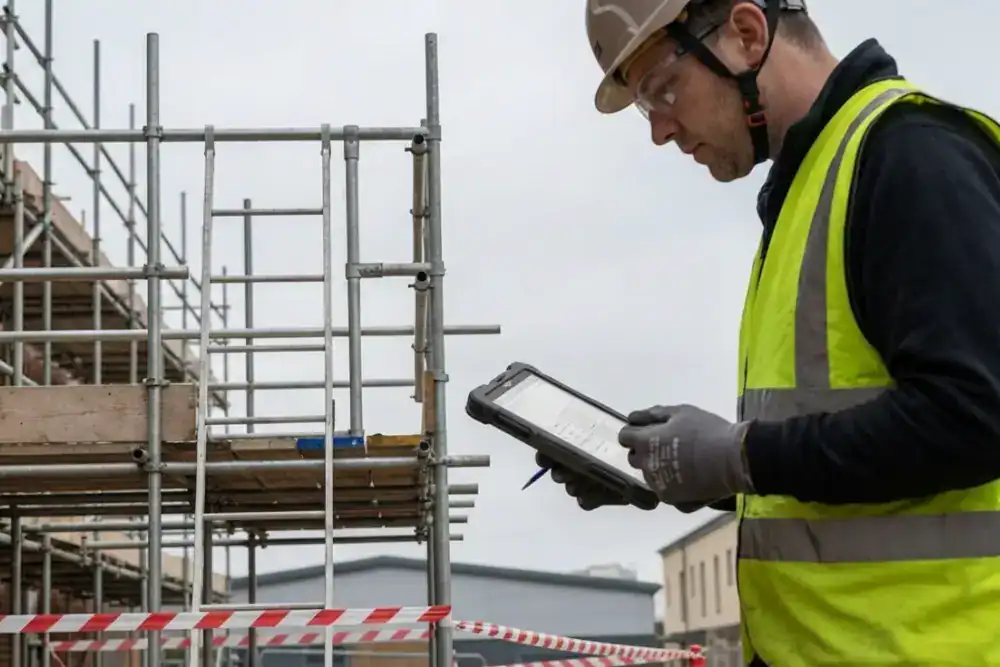
Most working at height incidents do not occur because organisations failed to complete a risk assessment. They occur because the conditions assumed during planning no longer match those workers face on the job.
Risk Assessment and Method Statements (RAMS) play an essential role. They define the intended controls, equipment, and sequence of work. But they are, by definition, static. They cannot anticipate every change in weather, access, sequencing, congestion, or task adaptation that emerges once work begins.
This is where checklists can help — but only if they are used to surface live risk, not simply to confirm that paperwork exists.
This article explains how a working-at-height checklist can be used to identify risks that arise during the job and how it should be applied as a context-sensitive prompt, not a compliance exercise.
Many checklists focus on confirming that controls were specified, rather than whether they are still effective.
Common limitations include:
confirming that edge protection was planned, without checking whether it remains intact
- confirming harness availability, without checking whether the connection is feasible in real work
- confirming access equipment selection, without checking whether it still suits the task sequence
- confirming training, without checking whether workers can apply it under current conditions
Research into safety monitoring and checklist use shows that risk is dynamic. Controls degrade, conditions change, and small adaptations accumulate over time. A checklist that does not account for this can provide false reassurance.
A useful checklist does not ask “Was this planned?”
It asks “Does this still work here, now?”
A well-designed checklist is not a universal solution. It is a structured way of prompting reflection on how the job is actually unfolding.
Its purpose is to help supervisors and teams:
- notice when conditions have changed
- identify where exposure has increased
- detect early signs of drift from the planned method
- intervene before those changes escalate into incidents
Crucially, any checklist must be adapted to the specific task, site, and organisation. What follows is not a definitive list. It is a starting framework that needs to be shaped to local context, work type, and risk profile.
Rather than listing prescriptive rules, an effective checklist focuses attention on areas where risk commonly emerges.
Working at height is highly sensitive to environmental change. A checklist should prompt consideration of whether conditions remain suitable, including:
- weather effects on stability, visibility, and surfaces
- lighting and glare
- noise and distraction
- congestion from other trades or activities
- changes in ground or platform condition
The question is not whether these were considered during planning, but whether they are still acceptable now.
Many falls occur during movement rather than during the main task.
A checklist should prompt teams to reflect on:
- whether access routes remain clear and appropriate
- whether ladders, platforms or MEWPs are still positioned as intended
- whether transitions between levels are stable and protected
- whether workers are being forced into awkward repositioning
Transitions are where exposure often increases silently.
As work progresses, the task often changes subtly.
A checklist can help surface:
- whether the work sequence has changed
- whether temporary fixes or improvisations have appeared
- whether tools or materials are altering balance or reach
- whether time pressure is influencing how the job is done
These are not signs of poor behaviour — they are normal adaptations that need to be recognised and managed.
Controls should be assessed as they are used in practice, not as they appear on paper.
This includes reflecting on:
- whether harness connection is feasible at all task stages
- whether anchor points remain suitable as work progresses
- whether collective protection is still intact
- whether PPE use is being compromised by task demands
The focus is on effectiveness, not compliance.
A checklist should also consider the human side of the task, including:
- whether workers understand where exposure increases
- whether new or less familiar personnel are involved
- whether fatigue, time pressure, or distraction is emerging
- whether the team feels able to raise concerns or pause work
These factors strongly influence how safely work is carried out in reality.
The most effective checklists are used with the workforce, not on them.
They work best when they:
- support short, focused conversations on site
- encourage workers to share where the job feels awkward or exposed
- create permission to adjust the plan when needed
- act as an early warning system, not a fault-finding exercise
This approach aligns with modern safety thinking: risk is managed best when organisations pay attention to work as it is actually done, not only how it was imagined.
Any working-at-height checklist should be treated as a living tool, not a fixed template.
Organisations should expect to:
- adapt questions to different tasks and environments
- refine prompts based on learning and near misses
- remove items that do not add value
- add prompts specific to their own work activities
The strength of a checklist lies in how well it reflects the local context.
A working at height checklist can be a powerful safety tool — but only if it is used to surface live risk, not to confirm that a document was completed earlier in the day.
When used thoughtfully, a checklist helps bridge the gap between planning and reality. It supports better judgement, earlier intervention, and safer decisions as work unfolds.
Human Focus supports organisations in developing and using context-aware checklists, alongside training and digital tools that help teams recognise change, manage drift, and maintain safe systems of work during real operations.
Managing work at height safely requires more than completing paperwork at the start of the job. It requires the ability to recognise change, check that controls still work in practice, and respond as conditions evolve.
Human Focus supports this through its online risk management system, helping organisations manage site inspections, risk assessments, method statements and on-site checks in one practical digital framework.
To support this approach, we’ve also developed a free working-at-height checklist focused on risks that can emerge during the job, not just those identified during planning. The checklist is available to download and can be adapted to suit different tasks and site conditions.