An online safety training system is only as effective as the support behind it. Getting the platform is the easy part. Getting it set up correctly, populated with the right content, configured for your organisation’s structure, and maintained as your needs evolve is where most organisations need help — and where most providers fall short.
What Does Effective Support for an Online Safety Training System Look Like?
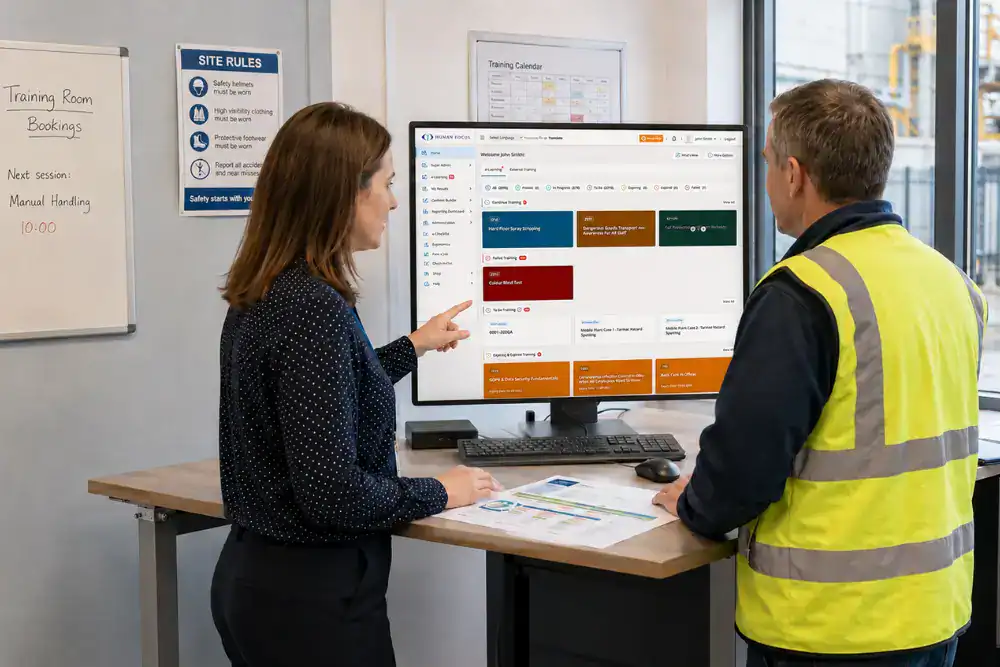
Online safety training systems have become significantly more capable in recent years. The platform technology is no longer the limiting factor. What determines whether an organisation actually builds an effective safety training programme — rather than simply purchasing access to one — is the quality of the online safety training support that surrounds it.
Support for a modern safety training system is no longer simply a helpdesk function. It requires a genuinely multi-faceted team: people who understand health and safety compliance, people who understand learning content design, people who understand how large organisations structure their training requirements, and people who can handle the technical complexities of integrating systems and resolving platform issues.
Most online safety training providers offer some version of support. Very few offer all of these dimensions. Understanding what comprehensive support looks like — and how to assess whether a provider is genuinely delivering it — is an important part of choosing the right system.
Why Online Safety Training Support Is More Than a Helpdesk
The gap between purchasing an online safety training system and actually having a functioning, effective safety training programme is significant. For most organisations, bridging that gap requires sustained, expert input across several dimensions that have nothing to do with platform functionality.
Consider what is involved in getting an online safety training system genuinely working for an organisation:
- Identifying which training is needed, for which roles, across which compliance areas
- Configuring the system to reflect the organisation’s structure — sites, business units, user roles, reporting hierarchies
- Converting existing internal documentation into effective online training content
- Identifying gaps in current provision and prioritising what to address first
- Managing the ongoing evolution of the training programme as roles, risks and regulations change
- Resolving technical issues and integrating the training system with other organisational systems
None of this is achieved by a support team that can only answer questions about how to use the platform. It requires people who understand the subject matter, know the organisation, and can provide proactive guidance rather than reactive troubleshooting.
When support falls short, the consequences are practical and immediate: training programmes stall during onboarding, internal documentation never gets converted, the system is configured incorrectly and becomes difficult to manage, and the organisation ends up with a platform it is not using effectively rather than a safety training programme that is genuinely working.
The Six Areas a Support Team Needs to Cover
Effective support for an online safety training system needs to cover six distinct areas. These go well beyond platform help and into the substantive expertise required to build a complete safety training programme.
1. Understanding Safety Training Needs and Gaps
Before any training can be configured or delivered, someone needs to help the organisation understand what training it actually needs. This requires the support team to understand health and safety compliance — the legislation, the regulatory framework, the common training gaps across different sectors and operational environments. It also requires the ability to map training needs across roles: from frontline workers through supervisors and managers to duty-holders and senior leaders. A support team that can only help with platform navigation cannot do this. A support team with genuine safety training expertise can.
Ask Your Current Provider:
- Can your support team help you identify which compliance areas apply to your organisation and what training requirements arise from them?
- Can they map training needs across different roles and responsibility levels — not just tell you which courses exist?
- Do they understand the difference between what a site operator needs and what a duty-holder needs?
2. Developing a Safety Training Menu
Once training needs have been identified, the support team should be able to help the organisation select suitable courses from the approved library and identify where gaps exist that cannot be filled by online training alone. Not all safety training can or should be delivered online. A good support team will help the organisation understand which elements require face-to-face delivery, which require internal bespoke content, and which are well-served by approved online courses. This requires honest advice rather than a sales pitch for more courses.
Ask Your Current Provider:
- Does your provider help you build a training menu that fits your actual needs — or do they simply sell you access to more content?
- Do they acknowledge when a training need is better met by face-to-face delivery or internal bespoke training rather than an online course?
- Can they provide a structured training plan rather than leaving you to navigate a catalogue?
3. Setting Up the Safety Training Management System
Configuring an online safety training system for a complex organisation is not straightforward.
Large organisations with multiple sites, business units and user roles need a system that reflects their structure: site managers who can run reports for their site but cannot see or affect other sites, organisation-wide compliance reporting for senior leaders, different course allocations for different role groups, and automated processes that manage renewals and alerts without manual intervention.
Getting this configuration right requires detailed understanding of the organisation’s structure and training requirements — and the ability to translate that understanding into system configuration. Getting it wrong creates a system that is confusing to use, produces unreliable reports and requires constant manual intervention to maintain.
Ask Your Current Provider:
- Does your support team take the time to understand your organisational structure before configuring the system?
- Can they set up role-based access, site-level reporting and organisation-wide compliance views?
- Is the configuration something they do with you — or something you are expected to work out for yourself?
4. Identifying and Developing Internal Task-Specific Training
As covered in the third guide in this series, approved online training cannot replace the internal, task-specific training that covers an organisation’s specific equipment, processes, permit systems and operational knowledge. A support team that genuinely understands safety training will help the organisation work through its internal documentation, identify what needs to be developed as training, and either support the organisation in doing that development itself or provide a done-for-you service to handle the conversion. This is a significant element of the support offering and one that many providers do not provide at all.
Ask Your Current Provider:
- Can your support team help you identify which internal documents need to be converted into training content?
- Do they provide guidance on how to prioritise internal training development — starting with the highest-risk content?
- Can they support or manage the conversion of internal documentation into effective online training?
5. Converting Internal Documentation into Training Content
Converting internal documentation — SOPs, RAMS, inductions, control of work procedures — into effective online training is a specialist skill. It requires understanding of learning design, content structure, assessment development and the technical requirements of the training platform.
For most organisations, particularly during the initial onboarding phase when large volumes of internal content need to be converted, this is the single most demanding element of the implementation.
A support team that can provide this capability — either by guiding internal stakeholders through the process or by taking documentation and converting it on the client’s behalf — makes the difference between an implementation that succeeds and one that stalls indefinitely.
Ask Your Current Provider:
- Does your provider offer support for converting internal documentation into online training — or do they provide a platform and leave you to populate it?
- Is there a done-for-you conversion service for organisations with large volumes of existing content?
- Do they have learning design expertise on the support team — not just platform administrators?
6. Handling IT and Integration Challenges
Most modern safety training systems are cloud-hosted and can be operational almost immediately. But as organisations mature in their use of training platforms, technical complexity increases. Organisations increasingly want their training system to connect with HR systems and other record-keeping platforms so that data flows automatically — removing the need to maintain records in multiple places.
Setting up HR system integration on a training platform requires API-enabled systems and technical expertise. Beyond integration, there are always platform-specific issues that require development capability to resolve.
Providers using third-party proprietary systems — platforms they have licensed rather than built — often cannot make these adjustments. Providers with their own platform and in-house development team can respond to specific client needs rather than waiting for a third-party product roadmap.
Ask Your Current Provider:
- Does your provider own and develop their own platform — or are they using a licensed third-party system they cannot modify?
- Can the system connect with your HR or other management systems through API integration?
- When technical issues arise, do they have in-house developers who can resolve them — or are you dependent on a third party?
What Good Support Logistics Look Like
The content of support matters. So does how that support is delivered. The following four qualities determine whether a support service is genuinely usable in practice.
“Jeremy and Lisa have been really helpful. I can honestly say that Human Focus are our very best supplier we have — their support is brilliant.”
Kirsty Clark, Compliance Manager, HSL Group
The Platform Question: When Something Needs Changing, Who Has the Power to Change It?
At some point in your use of an online safety training system, something will need to change. A feature does not behave as expected. An integration with your HR system does not work. A report is not producing reliable data. A configuration needs adjusting to reflect a change in your organisational structure.
The practical question is: who has the power to make that change? If your provider has built and maintains their own platform, the answer is straightforward — their development team can investigate and resolve it. If your provider has licensed a third-party platform, the answer is more complicated. They can raise the issue with the third party, but they cannot fix it themselves. The resolution depends on the third party’s priorities, roadmap and response times — over none of which your provider has control.
This is not a theoretical concern. It becomes a practical problem when an integration remains unresolved for months, when a reporting issue cannot be fixed because it requires a platform change, or when a feature the organisation needs simply does not exist and the provider has no ability to build it. These are not uncommon situations.
- When something needs changing, ask: can your provider fix it directly, or do they have to refer it to a third party? If the latter, what is the typical resolution time and who decides the priority?
- If the system needs integrating with another platform: does the provider have developers who can build and support that integration, or is this dependent on a third party?
- If you need a feature that does not currently exist: can the provider build it for you, or are you waiting for a product update that may or may not happen?
Does Your Current Provider Measure Up?
If you are using an online safety training system already, the following questions will help you assess whether the support you are receiving is adequate. If you are evaluating a new provider, use them to stress-test the support claims made during the sales process.
- Does your support team call or respond the same day? If not, what is the actual response time in practice — not the committed SLA, but what you experience?
- Does the person who responds actually understand health and safety, or just the platform? Can they answer questions about which training applies to a specific role, or do they only help with navigation and settings?
- Do you speak to the same person or team consistently? Or do you repeat your situation from scratch every time you make contact?
- Has your support team helped you understand your training needs — or have they only responded to specific requests? Proactive, ongoing compliance support that identifies gaps is more valuable than reactive support that responds to problems.
- Has your provider helped you convert internal documentation into training content? Or has the burden of populating the system fallen entirely on your team?
- Are there things you need the system to do that your provider cannot deliver? If the answer is yes, is that because the feature does not exist or because the provider cannot modify a third-party platform?
- Are you paying for support that should be included? If every request for help generates a proposal for additional charges, the support model may not be sustainable for your programme.
What to Do with Your Answers
If several of these questions expose gaps in your current support experience, it is worth considering whether those gaps are limiting the effectiveness of your safety training programme. A system that is configured incorrectly, under-populated with content, or producing unreliable compliance reports is not delivering the value it should — regardless of the quality of the platform itself.
What Poor Support Looks Like in Practice
Poor support rarely presents itself as an obvious failure. It tends to show up as a series of small, persistent frustrations that together prevent the safety training system from ever working as well as it should. These are the most common patterns.
- The system is live, but course allocations are inconsistent across sites. Different sites are running different course sets with no central logic, because the initial configuration was never done properly.
- Managers cannot get reliable compliance reports before audits. The reporting function was never set up to reflect the organisation’s structure, so outputs are incomplete or cover the wrong scope.
- Internal SOPs and inductions were meant to be converted into training, but the work never happened. The provider delivered the platform but provided no meaningful support for the content conversion process, leaving internal teams to manage it alone.
- The client has access to hundreds of courses but no structured training matrix. Nobody helped map the courses to roles and compliance needs, so workers are completing whatever seems relevant rather than what their role actually requires.
- Support responds quickly but cannot answer safety training or configuration questions. The support team is fast, but it only handles platform navigation. Every question about which training applies to a specific role or how to configure a report gets escalated and takes days.
- Integration with HR or user records remains manual months after launch. The provider cannot make the integration work because the platform is a third-party system they do not control, leaving the organisation managing two sets of records manually.
- The organisation is paying for a platform but still managing critical training evidence in spreadsheets. External certificates, renewal dates and offline training records were never integrated into the system because nobody helped set that up, leaving the compliance picture split between two places.
The Human Focus Support Service
Human Focus has built its online safety training support service around the understanding that an online safety training system is only as good as the expertise and commitment behind it. We do not believe in selling access to a platform and leaving clients to work out the rest.
Our support team covers all six of the areas described in this guide: safety compliance expertise, training menu development, system configuration, internal training identification, content conversion, and technical and integration support. Named contacts work with clients over time, providing ongoing compliance support and getting to know their organisation, their training programme and their evolving needs.
For new clients, we provide a structured onboarding service that bridges the gap between purchasing the system and having a functioning safety training programme — including, where needed, a done-for-you service for converting internal documentation into effective online training content.
The Human Focus system is built on our own platform and supported by our in-house development team. When a client needs something adjusted, integrated or developed, we can do it — without depending on a third-party product roadmap.
“The management system of the online training has been easy to use, really helpful. It sends out alerts if people are yet to undertake training. I can very easily set someone up in a group and reaching out to the team, they’ll always look to see if there’s any other courses that we want to add on there or future courses that can be developed.”
Kirsty Clark, Compliance Manager, HSL Group
Book a Demo That Focuses on Your Specific Needs
If you have worked through the diagnostic questions in this guide and identified gaps in your current support experience — or if you are evaluating providers and want to understand what genuinely comprehensive support looks like — book a free demo. Bring your specific questions about support, onboarding and content conversion. We will focus the conversation on whether we can solve your actual problems, not on showing you platform features.