In many organisations, confined space work looks controlled because the paperwork is complete. The permit is issued, isolations are listed, gas tests are recorded, and rescue arrangements are described. On paper, the job is safe. The problem is not that this paperwork is often treated as sufficient, even as conditions during the work begin to change.
Supervisors are usually surprised when something goes wrong, not because the paperwork was missing, but because the paperwork no longer matched the conditions under which the work was actually being carried out. The permit still reflected the situation as it was imagined at authorisation, while, for example, access points had shifted, ventilation effectiveness had degraded, isolations had been disturbed, or the job had overrun under pressure.
Under the Confined Spaces Regulations 1997, the entry supervisor controls whether entry is authorised. In practice, that control does not end when the permit is signed. Confined space risk is dynamic, and the supervisor’s role is to manage the work as it unfolds so that the conditions assumed on the permit remain true. Where organisations focus too heavily on issuing permits and fail to actively manage the work once entry has begun, misalignment between paperwork and reality can occur and result in serious harm.
This article sets out practical steps for maintaining alignment between what is paper safe — work as imagined and authorised — and what is genuinely safe as the work is carried out and conditions evolve.
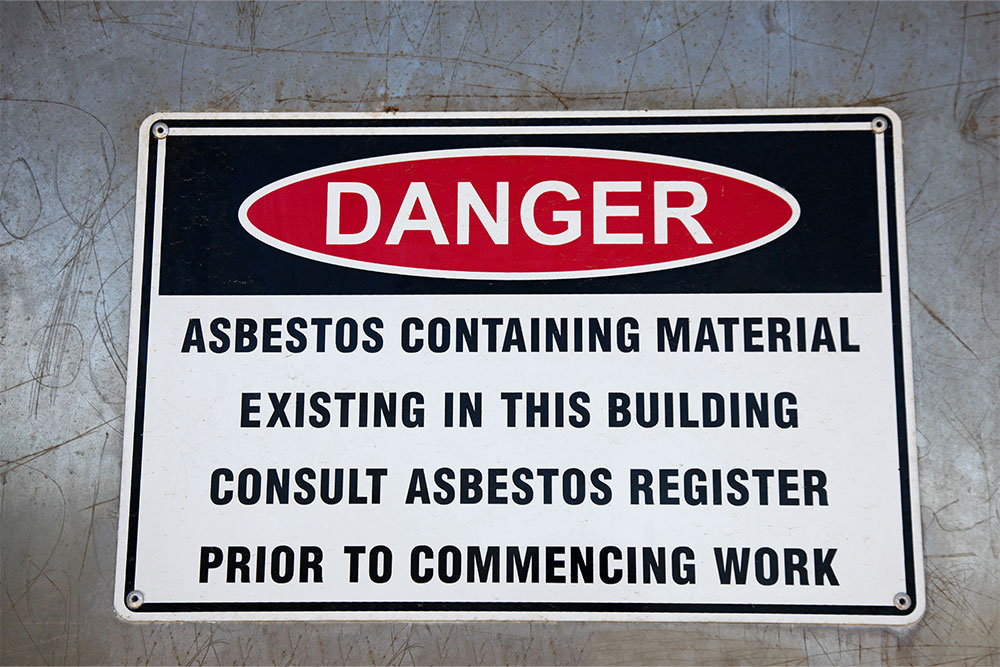
In practice, a confined space is less about physical size and more about how quickly conditions can become dangerous. If the work is enclosed and a serious hazard could reasonably develop, treating it as ‘just an awkward place to work’ is how sites lose control of the risk.
The definition in the Confined Spaces Regulations 1997 focuses on ‘specified risks’ because these failure modes can cause serious injury and can develop quickly, be unforgiving, and be difficult to detect from the outside. They include the following.
- Serious injury from fire or explosion
- Loss of consciousness from heat
- Loss of consciousness or asphyxiation from gas, fume, vapour or lack of oxygen
- Drowning from rising liquid
- Asphyxiation from a free-flowing solid or being unable to reach a respirable environment due to entrapment by a free-flowing solid
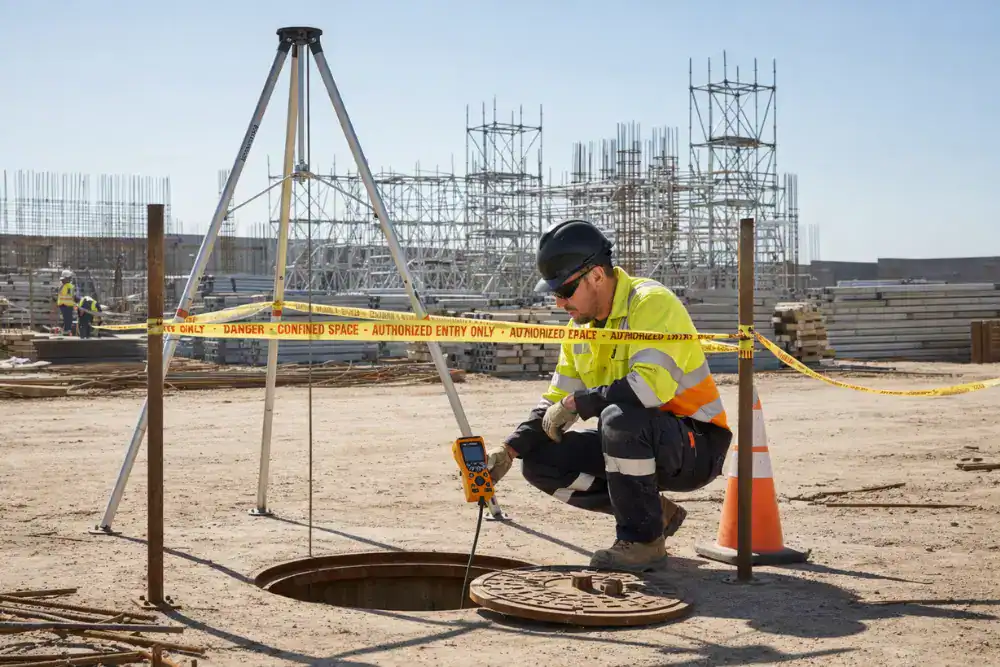
This is why confined spaces include many familiar locations in maintenance and operations. Tanks, vats, silos, pits, trenches, sewers, pipes, flues, wells and similar enclosed areas can all qualify, depending on what could reasonably happen during the work.
So the practical question is not the physical size of the space. It’s whether, for this job in these conditions, specified risks are realistically present, based on:
- The task method being used
- The isolation approach and verification
- The ventilation arrangement
- The atmospheric controls (testing, monitoring, re-test rules) that will actually be applied
A confined space permit-to-work system converts legal duties into a documented authorisation decision with defined conditions.
It is where the supervisor demonstrates that entry is justified, that the safe system of work is defined in operational terms and that emergency arrangements are ready before anyone goes inside.
Without verification and revalidation, the permit relies on planning assumptions, even though confined space risk can shift with small changes in method, isolation quality or site conditions.
Used well, the permit does two things that matter legally and operationally:
- It ensures the boundaries of the job are explicit
- It makes critical controls verifiable rather than assumed, particularly where multiple teams or contractors are involved
The supervisor can use the permit to capture and confirm:
- The agreed scope and entry point
- The isolations required and who verified them
- Atmospheric test results and when re-testing is required
- Ventilation and monitoring arrangements for the duration of the work
- Communications and the standby person’s role
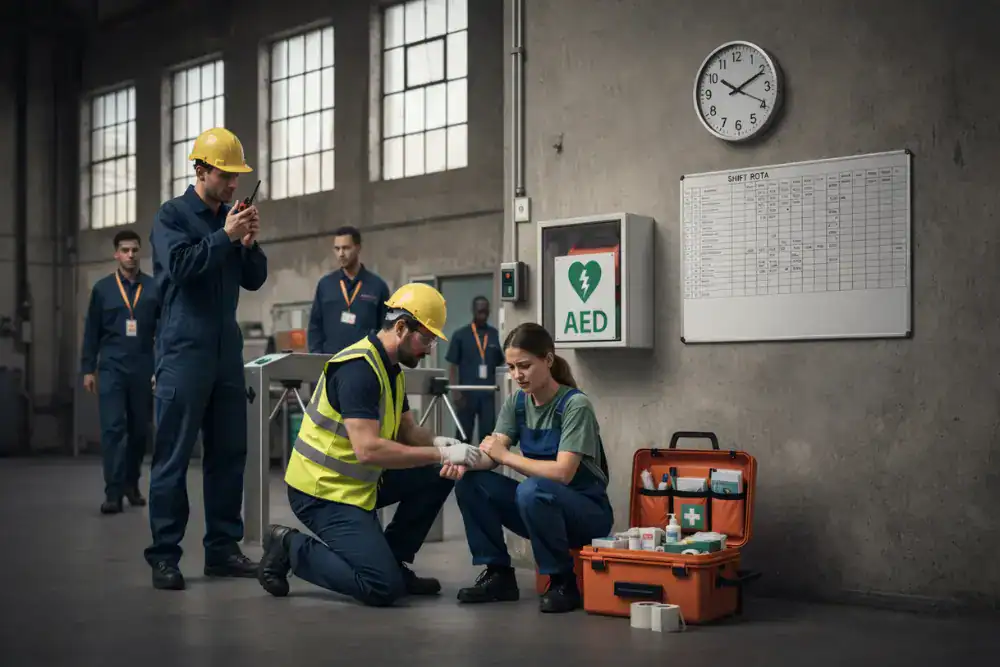
- Rescue arrangements that are in place, tested for this entry point and resourced with trained people
The permit is not the control by itself. Its value lies in defining what must remain true for work to continue, giving the supervisor a defensible basis to pause and re-authorise if conditions drift.
A permit isn’t a control; it’s a claim that controls are true. If you don’t re-check truth, you’re just filing beliefs.
Research on confined space work commonly identifies failures where entry permits are used to compensate for weak preparation, weak assurance, and unproven rescue readiness.
Confined space risk doesn’t usually ‘arrive’—it accumulates through small, locally rational deviations until the space becomes unforgiving. (Rasmussen, 1997)
Permit quality is set by the preparation that goes into it. The issuer has to turn a job request into a defined method, identify foreseeable failure modes in that space and specify the controls that must be in place.
Field research on confined space interventions reports that, where access or plant condition is uncertain, organisations may rely on in-the-moment judgment rather than structured pre-work planning. (Burlet-Vienney et al., 2015a)
Structured pre-work is replaced by judgment in the moment, which increases the risk of missed hazards and underestimated exposure.
Generic risk assessment is an attractive fiction in confined spaces because isolation, atmosphere, ventilation, and rescue are a single coupled system.
Research (Burlet-Vienney et al., 2015b) shows that generic risk assessments struggle with confined space work because hazards and controls interact. Isolation, atmosphere, ventilation and rescue feasibility are linked. If the assessment does not surface those dependencies, the permit can list controls that do not reliably match the risks created by the actual method in that specific space.
Selman et al. stress that rescue needs to be planned before entry and carried out by trained personnel. Where the permit assumes rescue will be worked out if needed, people default to improvised rescue attempts, which is where multiple fatalities occur. Burlet-Vienney, D. et al. also note that rescue procedures were often untested, reinforcing the same failure mode.
If your rescue plan depends on heroics, you don’t have a plan—you have a high likelihood of a rescuer becoming a casualty. (NIOSH, 1986)
Selman et al. list recurring contributors in fatalities, including failure to recognise confined space entry, weak risk assessment, procedures not followed, poor training, weak testing and ventilation, weak isolation and unplanned rescue. The key point is that these are not isolated mistakes. They cluster when risk assessment is weak and the risk management system is not applied consistently in live conditions.
Most confined space failures are not dramatic at the start. They happen when scope, isolations, atmosphere controls or rescue readiness quietly drift during the work. These steps are less about ‘following the permit’ and more about keeping control when the job shifts.
Supervision in confined space entry is not administration; it’s real-time management of performance variability under pressure.
As a supervisor, your first control decision is to treat entry as the exception, not the default. If the outcome can be achieved from outside, you remove most of the risk rather than trying to manage it later with paperwork.
The permit only works if the risk assessment and method statement describe this task, in this location, under these conditions. If they are generic or written for a different access point, plant state or duration, you are building the job on assumptions.
Supervisor checks:
- A clear work scope that describes the outcome, the method, the tools and the expected duration
- The correct space identification, entry point and any connected plant, pipework or shared services that could introduce energy or substances
- Risk assessment and method statement that match the job as it will actually be done, including current conditions and any foreseeable changes during the work
- Any linked permits that need to align, such as hot work, electrical isolation, line breaking or other concurrent activities that could change the risk picture
This step is where most confined space controls either become reliable or stay aspirational. The risk is not that isolations are forgotten. It is that they are assumed.
A valve is believed to be closed, a drive is believed to be off, a line is believed to be dead and the permit becomes a record of belief rather than a record of verified control.
Your job as supervisor is to make the space safe to enter and to make the isolations auditable, meaning someone could look at the permit later and see exactly what was isolated, how it was secured and who proved it.
Supervisor checks:
- Energy isolation for electrical, mechanical, hydraulic and pneumatic sources, including confirmation that stored energy is released or secured
- Process isolation for fluids, gases and solids, using the required standard for the job, such as blanks, spades or double block and bleed where relevant
- Lock-off and control, including tags, key control and isolation register details, with a clear record of who applied and who independently verified each isolation
- Safe access and egress, including ladders, lighting, trip hazards and removing covers or guards in a controlled way, so entry and exit remain safe if conditions change
A single pre-entry test only protects people when it is backed by defined re-test rules or continuous monitoring. Atmospheric hazards can change during the job, so testing only protects people if it is treated as an ongoing control, not a one-off prerequisite.
Before entry, test in line with site procedure and at the right points for the space and the work, then record results in a way that supports decisions later. If there is a credible route for conditions to change, plan for continuous monitoring or defined re-test intervals and triggers.
Ventilation also needs to be treated as a control with a clear airflow route, not just a piece of equipment running nearby. Do not authorise entry, and stop work if readings are outside site limits.
Supervisor checks:
- Gas monitor is the right type for the hazards, with bump test or calibration status confirmed
- Test sequence and results are recorded with time, test point and tester details, typically: oxygen first, then flammables, then toxic materials
- The monitoring plan is clear, including continuous monitoring where needed and re-test triggers such as breaks, overruns, method changes or alarms
- The ventilation method and its effectiveness are confirmed, including the locations of supply and extraction
- Personal protective equipment (PPE) and respiratory protective equipment (RPE) match the risks and the planned method
- PPE and RPE are not being used to compensate for missing controls
This is where the permit either becomes operational control or it becomes paperwork. It’s essential to ensure people share the same picture of the job boundaries, the controls that must stay in place and the conditions that trigger an immediate stop.
A short on-site briefing is how you align that understanding at the entry point, with the actual kit, isolations, monitoring and rescue arrangements in front of you.
Supervisor checks:
- Entrants are competent, briefed and named on the permit
- Standby duties are clear, communications are agreed and check-in frequency is set
- The rescue plan is practical for this entry, with equipment and trained rescuers in place before entry starts
- The entry log is started and maintained, including names, times in and out, gas test times and permit expiry times
- Only once roles, controls and stop rules are clear, and rescue arrangements are in place, do you sign and issue the permit
Stay in control of the work. Check conditions through the job. Re-test as stated on the permit and any time something changes. Stop work if controls fail, alarms sound or the job changes. If the job stops for a break or shift change, suspend the permit. Re-authorise only after checks are repeated. When work ends, close the permit and confirm that the space is left safe.
Supervisor checks:
- Re-test and record results at set times
- Confirm continuous monitoring stays active where required
- Suspend and hand over permits using a clear sign-off process
- Close the permit only after all persons are out, tools are removed and isolations are managed under site rules
A confined space permit remains valid only while the specified conditions remain true and within the permit’s time and scope limits.
If conditions change, the permit may no longer match the risk. The supervisor must stop the job, control the space and only allow re-entry after checks are repeated and recorded.
Suspend the permit and stop work if any of these happen:
- Gas monitor alarms or readings move outside limits
- Ventilation stops or airflow drops
- Isolation is disturbed, removed or cannot be confirmed
- The job scope changes (task, tools, substances, duration)
- A break, shift change or change of entrants or the standby person
- Communications fail or the standby person leaves the entry point
- Weather, flooding risk or external factors affect the space
After suspension, the supervisor should get everyone out, make the area safe, re-test the atmosphere, re-check isolations and controls, re-brief the team and only then revalidate or reissue the permit.
For shift changes, handover must happen at the entry point. The new supervisor takes control by briefing the team, checking controls and signing the permit. If this cannot be done, cancel the permit and start again.
The permit is treated as proof that controls exist, even as drift and substitution creep in during the job. Equipment gets moved, ventilation performance changes, isolations are disturbed or people work outside the agreed limits to ‘keep progress moving.’ The paperwork still looks complete, but the control reality has changed.
Paper compliance is easy to audit; operational control is harder—so organisations drift toward what’s easy to evidence rather than what’s true.
To prevent false assurance, the permit must operate as part of a management loop, not as a form. That loop requires clear ownership by the supervisor, active monitoring while the job is live, verification that controls remain effective and defined review triggers that force a stop and reset when conditions change.
Training alone does not prevent confined space failures on its own. Control is maintained through active supervision, verification, and the authority to stop work when conditions change. Training should support that loop by reinforcing what keeps a permit valid as conditions change during the work, and how permits are monitored, suspended, and reauthorised when assumptions no longer hold.
Human Focus Permit to Work Training focuses on how permit systems support safe systems of work in practice — including how supervisors and teams recognise drift, manage change, and act decisively when the conditions assumed on the permit no longer match the job.