8 Benefits of Learning Management Systems for Health and Safety Training

Benefits of Learning Management Systems

Most organisations can confirm that health and safety training has taken place. Far fewer can confirm who received which training, to what standard and how often, in a form that stands up when an enforcement officer asks to see it.

Under the Health and Safety at Work etc. Act (HSWA) 1974, employers must provide adequate instruction, training, and supervision to ensure the health and safety of workers (HMSO, 1974). Meeting that duty is straightforward enough in principle. Where organisations often struggle is in proving compliance across a workforce of shifting roles, changing risks and multiple locations.

That is where the core benefits of Learning Management Systems (LMS) for health and safety lie. They give organisations a central system to assign, deliver, record, and analyse training, with enough visibility to identify gaps before they are revealed by an incident or an audit.

This article sets out what an LMS delivers in practice and where each capability still depends on management decisions the platform cannot make for you.


Key Takeaways

  • The real compliance failure is usually not missed training, but being unable to show who is competent to do the work when that judgement is scrutinised.
  • An LMS can assign, deliver and record training, but it cannot by itself establish competence to carry out the task.
  • LMS arrangements rarely fail because of the platform itself; they fail when management treats completion data as evidence that the risk is controlled.
  • E-learning only stands up as a control when it is built around task-critical decisions and tested against what happens in practice, rather than used as a more efficient way to distribute content.

What Makes Health and Safety Training Hard to Manage

The HSWA 1974 sets general duties for training, but associated regulations set additional and more specific requirements.

Under the Management of Health and Safety at Work Regulations 1999, employers must take employees’ capabilities into account when assigning tasks. They must also provide health and safety training when employees are recruited, and repeat or adapt that training whenever employees face new or increased risks through changes in role, equipment, technology, or systems of work (HMSO, 1999).

Other regulations have their own requirements where they apply. For instance, PUWER 1998 requires documented training for equipment users and operators, and COSHH 2002 requires instruction and training for employees exposed to identified hazards (HMSO, 1998; HMSO, 2002).

Manual management of these overlapping requirements breaks down at scale, such as in organisations with shift patterns, high turnover, diverse role types and a large number of contractors. This is usually not because the people maintaining it aren’t capable, but because the system isn’t built for it.

The training may well have taken place. What catches organisations out, especially after an incident, is whether it was delivered to the right standard, to the right people and at the right intervals, with outcomes that can be verified.

Spreadsheets maintained by one person cannot reliably identify gaps in competence, even if they are kept up to date with what is happening in practice. Other workarounds, such as sending annual reminders to line managers and relying on inductions alone to ensure worker competence, do not show training adapting to changing risks.

An LMS doesn’t fix all of this. It doesn’t establish competence, and it doesn’t replace the wider management decisions involved in training. But it does provide an infrastructure for training compliance management that manual systems cannot match.

8 Benefits of Learning Management Systems for UK

A Learning Management System gives organisations a more reliable way to deliver, track, and document health and safety training. For UK employers, its value lies in making training easier to manage at scale while improving consistency, visibility, and compliance.

The benefits below show where an LMS can strengthen both training delivery and training oversight.

1. Consistency and Standardisation

One of the most significant benefits of Learning Management Systems is the ability to deliver identical training content to every learner, regardless of location, shift pattern, or instructor availability.

In traditional classroom training, content can drift over time. Different trainers emphasise different points, skip sections, or interpret guidance in their own way. The HSE’s guidance on health and safety training stresses that effective training must deliver safety-critical information consistently (HSE, 2012). An LMS removes instructor variability from the equation — every employee receives the same content, in the same order, to the same standard.

For organisations operating across multiple sites or with high staff turnover, this consistency is not optional; it is essential for compliance.

2. Traceability and Audit Readiness

If you can’t prove training happened, it may as well not have happened — at least from a regulatory standpoint.

Under ISO 45001:2018 (Clauses 7.2 and 7.5), organisations must maintain documented evidence of worker competence and training (ISO, 2018). The HSE’s management framework HSG65 reinforces this, expecting employers to keep accessible records as part of their Plan-Do-Check-Act cycle (HSE, 2013).

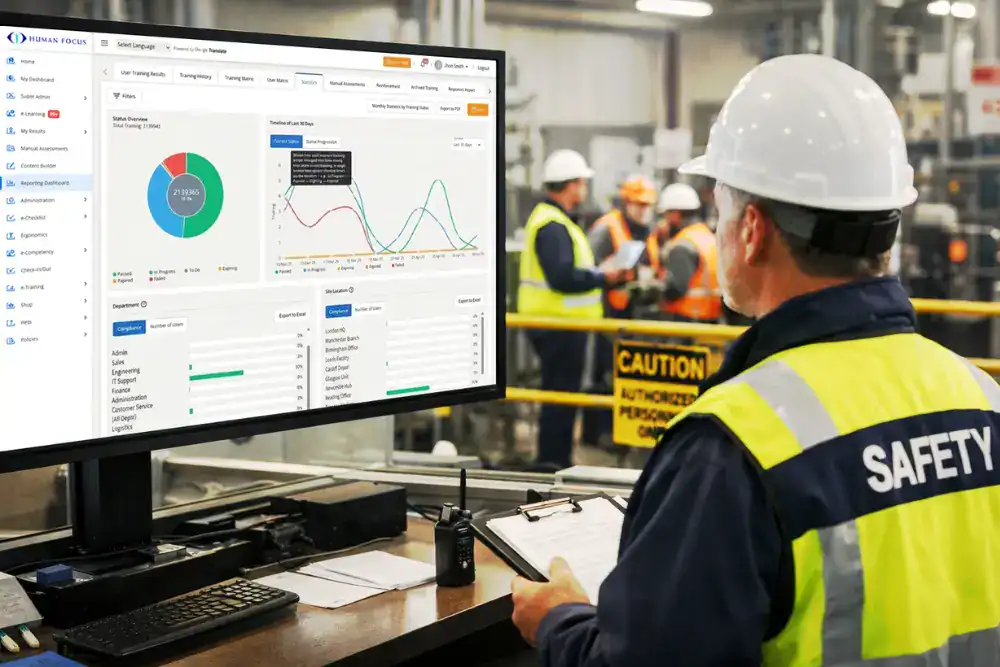
An LMS automates this entirely. Completion dates, assessment scores, certificate expiry dates, and individual learning histories are logged in real time. When an auditor, inspector, or insurer asks for evidence, it takes seconds — not days — to produce it. This level of audit readiness is one of the strongest practical benefits of Learning Management Systems in regulated industries.

3. As Effective as Traditional Training

A common concern about moving training online is whether people actually learn anything. The evidence is reassuring — with an important caveat.

A large-scale meta-analysis published in JAMA found that internet-based learning was equivalent to, and in some cases slightly more effective than, traditional instruction (Cook et al., 2010). However, further research showed that outcomes depend heavily on instructional design — specifically, the quality of interactivity, feedback mechanisms, and learner engagement built into the course (Sitzmann et al., 2006).

In short, an LMS doesn’t automatically make training effective. But a well-designed LMS with well-designed courses delivers results that match or exceed the classroom — with far greater flexibility and reach.

4. Scalable Training Without Proportional Cost Increase

Classroom training scales linearly: more people mean more sessions, more venues, more instructor days, and more cost. Digital training doesn’t follow the same curve.

As the European Agency for Safety and Health at Work highlights, e-learning tools significantly reduce the marginal cost of each additional learner (EU-OSHA, n.d.). Once a course is built and loaded onto an LMS, it can be delivered to ten people or ten thousand without additional production cost.

This is particularly valuable for distributed workforces for sectors such as logistics, construction, retail and facilities management, where gathering employees for face-to-face training is expensive and disruptive.

5. Spaced and Repeated Learning Improves Retention

People forget most of what they learn in a single session. This isn’t a flaw in the training — it’s how memory works.

Research published in Psychological Bulletin confirmed that distributing learning over time — known as spaced practice — significantly improves long-term retention compared with massed, one-off sessions (Cepeda et al., 2006).

An LMS makes spaced learning practical. Automated refresher courses, periodic knowledge checks, and scheduled re-certification reminders ensure that critical safety information isn’t just delivered once and forgotten. It’s reinforced at intervals that support genuine retention, which is one of the more underappreciated benefits of Learning Management Systems.

6. Supports Risk-Based Decision Making

Most organisations collect training data. Far fewer use it to inform decisions.

ISO 45001 promotes the monitoring, measurement, and evaluation of competence as part of a functioning occupational health and safety management system (ISO, 2018). An LMS generates precisely this kind of data: completion rates by team, assessment pass rates by topic, overdue training by department, and trends over time.

This isn’t just an administrative matter. If assessment scores on manual handling are consistently low in one division, that’s a signal — possibly pointing to inadequate supervision, procedural issues, or higher-risk conditions that need attention. The analytics capability of an LMS turns training data into actionable risk intelligence.

7. Minimises Operational Disruption During Training

Training records document that a worker received instruction at a point in time. They do not show whether the trained behaviour is observable today, at the point of work, under current site conditions, with this crew and this equipment.

A worker trained for confined space entry six months ago, on a different site, with different equipment, carries that qualification into conditions where none of it applies. The gap is not in the training. It is in the assumption that training transfers reliably across contexts without task-specific briefing to bridge it.

Trained behaviour degrades under predictable conditions. Crew changeovers dilute site-specific knowledge. Equipment substitutions change the physical procedure without a corresponding briefing. Programme pressure makes the shortcut the faster and apparently cost-free choice. The working environment determines whether the trained method is the easiest available. If it is not, deviation follows regardless of what the training record shows.

A site induction that covers fire evacuation, PPE policy, and reporting procedures produces a documentation record. What determines behaviour on site is more specific: does the worker know the hazards of this task, in this location, under conditions that exist today? Can they name what should make them stop? Task-level briefing by someone with direct knowledge of the controls in place, at the start of the activity, is what answers those questions (HSE, 2013).

8. Blended Learning Works Better in Practice

The most effective training programmes do not rely on one delivery method alone. Online learning works well for core knowledge, compliance topics, and refresher training. Face-to-face training is better for discussion, practice, and higher-risk tasks where people need to see the task done properly and apply it themselves.

An LMS does not replace face-to-face training; rather, it supports it. It gives organisations one place to assign learning, record completion, and keep training records up to date, while practical training can still take place where demonstration, coaching, and supervision matter most.

See These Benefits in Practice

For those responsible for managing health and safety training across an organisation, the Human Focus LMS provides a platform to assign training by role, track completion and certification status across all sites, and produce audit-ready records from a single system.

The platform supports e-learning delivery alongside the recording of externally certified training, providing a unified competency view regardless of how training was delivered. A library of over 300 health and safety e-learning courses is available through the platform. Book a demo to see how it works for your organisation.

About the author(s)

Human Focus Editorial Staff comprises a dedicated collective of workplace safety specialists and content contributors. The team shares practical guidance on human factors, risk, and compliance to support safer, more effective workplaces.

Share with others
You might also like

Popular Courses

GDPR Awareness Training Course
GDPR Training
View Course Details
LOTOTO online training course
Safe Isolation – Lock Out, Tag Out, Try Out (LOTOTO) Training
View Course Details
IOSH Managing Safely
IOSH Approved Managing Safely e-Learning
View Course Details
spill kit training
Spill Kit Hazardous Substances Training
View Course Details
Legionella-Risk-Assessment-Training
Legionella Risk Management Principles for Responsible Persons
View Course Details

Recent Articles

Course Announcement Introduction to ISO 45001 Training
Course Announcement: Introduction to ISO 45001
forklift struck by risk
Forklift Struck-By Risks: The System Controls That Reduce Collisions and Falling Loads in Warehouses
contractor safety
Assuring Contractor Safety: Testing What Happens on Site
fire risk assessment mistakes
Common Fire Risk Assessment Failures: What Responsible Persons Get Wrong and How to Avoid Enforcement Action
harness inspection records UK
Harness and Lanyard Inspection Records Explained

Current Offers

near miss reporting for effective learning
Managing Near Miss Reporting for Effective Learning

Original price was: £895.00.Current price is: £595.00. +VAT

Sustainability and Environmental Management Training
Sustainability & Environmental Management Training

Original price was: £895.00.Current price is: £595.00. +VAT

Icon-PNG
Home Working Bundle Pack (4 in 1)

Original price was: £100.00.Current price is: £49.00. +VAT

driving for work
Driver Training Pack (5 in 1)

Original price was: £100.00.Current price is: £60.00. +VAT

driving for work
Highway Code Updates Awareness Training

Original price was: £25.00.Current price is: £15.00. +VAT