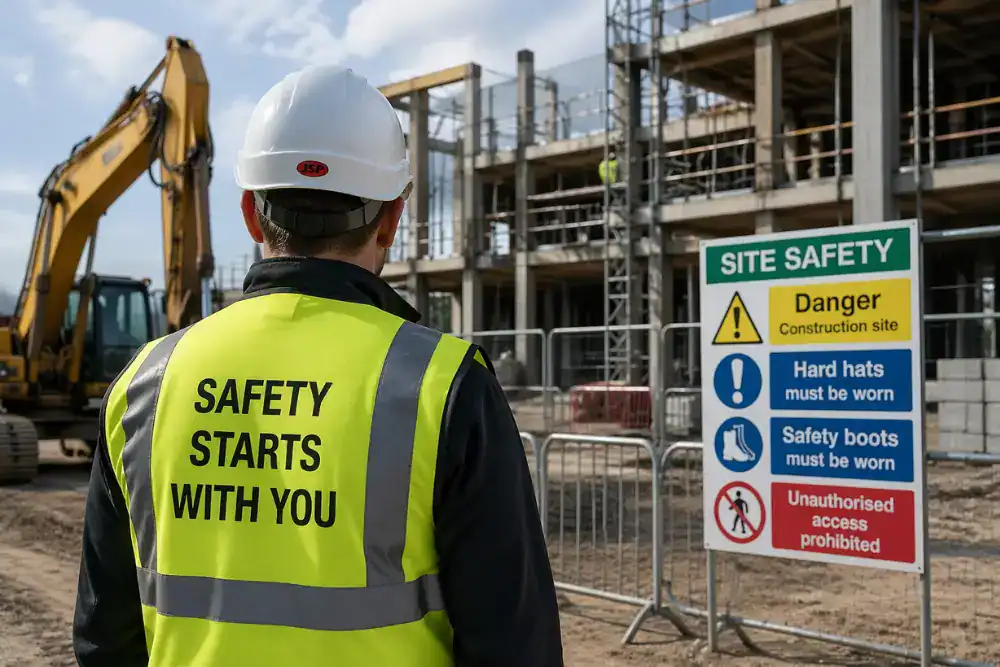
Most organisations that have investigated a serious incident on a construction site can account for what happened. Few can explain why the training they had recorded as complete did not prevent it.
Construction safety training is now a standard line item in most principal contractor and subcontractor compliance programmes. Courses are assigned against job roles, completion rates are tracked on a dashboard, and site managers are told that workers have been trained. Then, a worker falls from height, unknowingly disturbs an asbestos-containing material, or develops a back injury, the training was designed to prevent.
The post-incident review finds that workers who completed the modules cannot recall the content, and made exactly the decisions the training was meant to stop. This is not a regulatory gap. It is a content and programme design problem — and the organisations most surprised by it are usually the ones whose completion dashboards had shown full compliance.
This article sets out what the five most in-demand construction safety courses must cover to close that gap, where each one most commonly fails in practice, and what distinguishes a course that changes how workers behave on site from one that satisfies an audit requirement and nothing else.
Each of the five courses below addresses a hazard category that continues to produce fatalities and serious injuries in a sector where, by any measure, training provision is not the problem.
Falls from a height are the leading cause of fatal injury to workers in Great Britain, a pattern that has remained consistent over time.
According to HSE data, falls from a height accounted for 35 deaths in 2024/25 — the single largest category of fatal accident — against a five-year average (2020/21–2024/25) of 38 deaths per year (HSE, 2025a).
Under the Working at Height Regulations 2005, employers must ensure work at height is properly planned, supervised and carried out by competent people (UK Government, 2005a). ‘Competent’ is not satisfied by course completion alone.
Competence requires that workers and supervisors can apply the regulatory hierarchy – avoid, prevent, minimise – under the conditions they actually face on site, including under time pressure and with the equipment available to them.
A Working at Height course should address the decisions workers make in practice:
- Whether a task is genuinely short duration and low risk
- Whether an alternative means of access is available
- When a risk assessment requires escalation rather than improvisation
It should cover the full hierarchy of control under the Working at Height Regulations 2005 – not just the theory, but how to apply it under the conditions workers actually face on site.
Asbestos is the single largest cause of work-related deaths in Great Britain — and construction workers carry a disproportionate share of that burden.
According to HSE’s Construction Statistics in Great Britain, 2025, around 5,400 cancer registrations per year were attributed to past work in the construction industry. Of the approximately 3,500 construction-related occupational cancer deaths estimated for 2005, around 70 per cent were caused by past exposure to asbestos – primarily lung cancer and mesothelioma.
Mesothelioma is a cancer of the lining of the lungs and chest wall caused almost exclusively by asbestos exposure. The same report notes that approximately 46 per cent of currently occurring mesotheliomas among men born in the 1940s are associated with the construction industry — including carpenters, plumbers, and electricians (HSE, 2025b).
Under the Control of Asbestos Regulations 2012, anyone likely to encounter asbestos during their work must receive appropriate information, instruction and training before they start (UK Government, 2012). For construction workers in refurbishment, maintenance or demolition roles, this is a legal requirement, not an optional addition.
The most common failure is workers who understand that asbestos is dangerous but cannot identify the materials most likely to contain it in the buildings they work in. Pre-2000 construction used asbestos extensively in textured coatings, pipe lagging, floor tiles and ceiling panels.
A course that covers the hazards in theoretical terms only, without grounding it in the practical reality of a refurbishment site, leaves workers at risk in exactly the situations the training was designed to address.
An effective asbestos awareness course should ground workers in the practical reality of the materials they are likely to encounter. It should cover the types of asbestos-containing materials common in pre-2000 buildings – including textured coatings, insulation board, floor tiles and pipe lagging – and equip workers to recognise them visually rather than only in theory.
The course should also explain why disturbance is the critical risk, how fibres are released and what the health consequences of even brief exposure can be over time. Workers should leave understanding not just that asbestos is dangerous, but what to do and stop doing when they suspect they have encountered it on site.
Musculoskeletal disorders are the most prevalent form of work-related ill health in the construction sector. According to HSE’s Construction Statistics in Great Britain, 2025, an estimated 41,000 construction workers are suffering from work-related musculoskeletal disorders – representing 53 per cent of all work-related ill health in the sector. Construction workers develop musculoskeletal disorders at a substantially higher rate than the all-industry average (HSE, 2025b).
Under the Manual Handling Operations Regulations 1992, employers must avoid hazardous manual handling where reasonably practicable, assess the risk where it cannot be avoided and reduce the risk of injury (UK Government, 1992a). Training is one part of that reduction — but only one part.
Construction manual handling is not the same as office or warehouse manual handling. The loads are heavier and more irregular. The terrain is uneven. Workers frequently handle materials in confined spaces, at awkward heights or under time pressure that discourages correct technique. Musculoskeletal disorder develops gradually, rarely producing a single reportable incident, which means the gap between training records and actual risk can remain invisible until a pattern of absences or a serious injury makes it visible.
An effective manual handling course for construction workers should address the specific physical demands of the sector rather than generic load-handling principles.
It should cover the postural risks associated with common construction tasks — block laying, pipe handling, rebar positioning, and working at low or awkward heights — and explain how the build-up of physical strain over time contributes to musculoskeletal injury even in the absence of a single acute incident.
Workers should understand how to apply the avoid, assess, reduce hierarchy under the Regulations in the context of real site conditions and know when a task requires reassessment rather than improvisation.
Personal protective equipment is the last line of defence, not the first. Most experienced safety professionals know this. Most construction workforces behave as though it is the primary control. That disconnect – between treating PPE as a last resort and treating it as the primary control – is where many PPE-related injuries occur.
Under the Personal Protective Equipment at Work Regulations 1992, employers must provide appropriate PPE where risks cannot be adequately controlled by other means and must ensure workers are trained in its correct use, storage and maintenance (UK Government, 1992b).
That obligation is routinely underestimated. Providing PPE and issuing a completion certificate for a generic awareness course does not satisfy it if workers cannot demonstrate correct selection, fitting and use in practice.
Construction generates significant quantities of fine dust particles small enough to be breathed deep into the lungs — including silica dust from cutting and grinding — subject to specific control limits under the Control of Substances Hazardous to Health Regulations 2002 (UK Government, 2002).
According to HSE’s Construction Statistics in Great Britain, 2025, an estimated 5,000 construction workers are suffering from work-related breathing or lung problems, at a rate substantially higher than the all-industry average (HSE, 2025b).
An effective PPE course for construction workers should cover the hierarchy of controls and the position of PPE within it — ensuring workers understand why PPE is a last resort rather than a first response.
It should address correct selection for specific hazard types encountered on construction sites, including respiratory protection, eye and face protection and skin protection against dust and chemical exposure.
Workers should be able to demonstrate correct fitting and understand the limitations of each type of equipment. The course should also cover maintenance, storage and the worker’s own legal responsibilities under the Regulations.
Construction sites present fire risks that permanent workplaces do not. Temporary structures, incomplete fire-resistant separation between different parts of the building, stored flammable materials, activities involving heat or sparks – such as welding, cutting and grinding – and high workforce turnover all compound the risk.
Under the Regulatory Reform (Fire Safety) Order 2005, the responsible person on a construction site must carry out a suitable fire risk assessment and ensure workers receive adequate fire safety information and instruction (UK Government, 2005b).
Fire safety training completion rates on construction sites are typically high. Fire safety competence on site is often lower in practice than completion records indicate.
Workers complete a fire awareness module during induction, the record is filed, and no site-specific briefing follows. When an incident occurs, the investigation typically finds the same gaps:
- Workers knew the generic principles but not the specific evacuation assembly point
- They had not been briefed on the permit-to-work system for activities involving heat or sparks
- Workers were unaware that the temporary escape route had changed since their induction. Induction completion is not the same as site-specific fire safety competence.
An effective fire safety course for construction workers should go beyond generic fire triangle theory and address the specific risk profile of a working construction site. It should cover the causes and spread of fire in environments with incomplete fire-resistant separation, stored materials and active welding, cutting or grinding operations.
Workers should understand the permit-to-work system for activities involving heat or sparks, their responsibilities under it and the consequences of non-compliance.
The course should address emergency procedures in a way that reflects the variability of construction site layouts. This means covering temporary escape routes, assembly points that change across a project’s lifecycle and the absence of fixed firefighting infrastructure present in a permanent workplace.
Human Focus offers all five construction safety courses covered in this article, and more. Every course is approved by a named awarding body, mapped to relevant UK legislation and designed to be deployed and tracked at scale across multi-site operations.
If your workforce has role-specific training needs that a standard catalogue does not cover, the Human Focus bespoke training solution lets you convert your own site procedures, risk assessments and method statements into structured, trackable eLearning. Completion is recorded automatically. Managers can conduct on-site competency sign-offs directly through the platform.