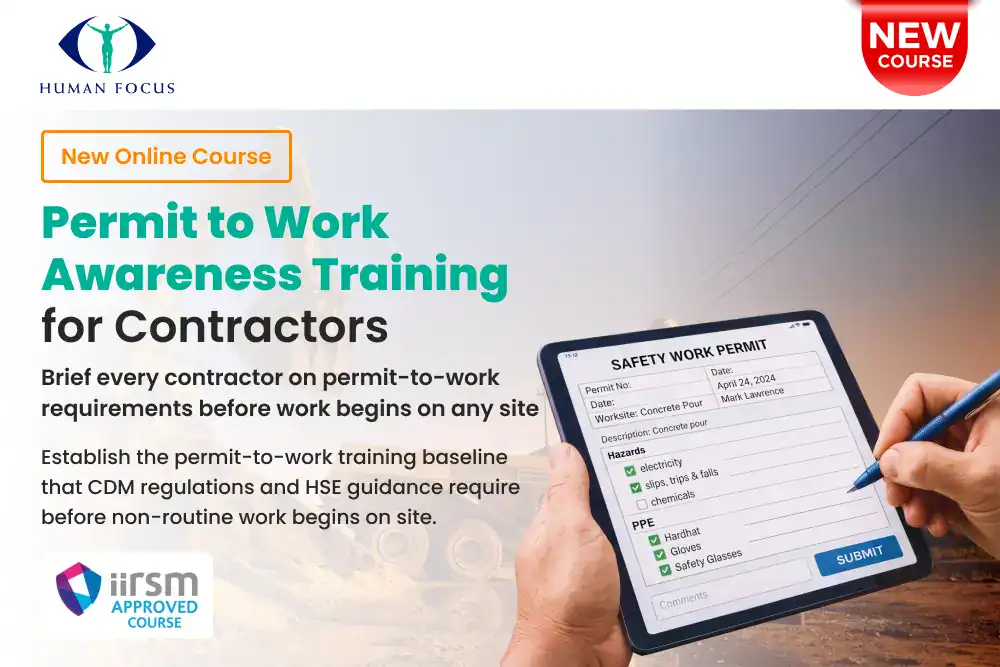
We’re pleased to introduce our fully online course: Permit to Work Awareness Training for Contractors.
Permit-to-work systems exist to control some of the most dangerous tasks carried out in any workplace — hot work, confined space entry, electrical isolation, excavation and work involving hazardous substances. When these systems are followed correctly, they provide a structured way to manage risk before, during and after non-routine work. When they are not, there is no automatic safeguard. A common gap lies in whether contractors fully understand what the permit requires in practice. Contractors arrive from different organisations with different levels of prior training, and that variation in understanding is where permit systems most commonly break down.
This IIRSM-approved Permit to Work Awareness Training for Contractors course helps organisations ensure that contractors understand when permits apply, what each stage requires, and how failures occur in practice. Using a realistic confined space scenario, it follows each stage of the permit process from planning and coordination through to acceptance, working under permit, managing changes and formal closure. Designed for contractors, supervisors and site managers, the course provides a consistent foundation for applying permit-to-work systems correctly across sites, teams and tasks.
Permit-to-work failures can contribute to serious and fatal accidents during non-routine work. The Health and Safety at Work etc. Act 1974, the Management of Health and Safety at Work Regulations 1999, and HSE guidance HSG250 all support the need for properly planned, communicated and controlled permit-to-work arrangements. On construction projects, CDM 2015 adds further planning and management duties. Those requirements are only met where contractors understand what permit compliance demands of them at each stage. Without that understanding, organisations face a compliance gap that deploying a permit system alone cannot close.
This course builds that understanding before high-risk work begins. It covers the purpose of permit-to-work systems, which tasks and site conditions require a permit, the responsibilities of each role in the process, and how the permit lifecycle works from initial planning through to formal closure. It also addresses the recurring failures that cause permit systems to break down in practice — and why those failures create serious legal and operational risk.
By ensuring contractors are trained before site access, organisations can:
- Reduce variation in how permit conditions are applied across teams, sites and shifts
- Strengthen compliance with HSE guidance and legal duties under UK regulations
- Improve contractor readiness before high-risk work begins
- Provide documented training records to support audits, inspections and enforcement reviews
This training is ideal for:
- External Contractors and Subcontractors
- Contractor Supervisors
- Site Managers
- Individual Workers and Technicians
- Maintenance and Engineering Operatives
It is particularly relevant for contractors working in high-risk environments, including confined spaces, electrical installations and areas involving hazardous substances.
By the end of this course, trainees will be equipped to:
- Understand when a permit-to-work is required and the risks of working without one
- Apply permit conditions correctly and work safely within defined limits
- Recognise high-risk activities that require permits, including hot work, confined space entry and electrical isolation
- Carry out their responsibilities as issuer, receiver or worker at each stage of the permit process
- Identify common permit failures before they create risk — and know what actions to take
- Coordinate effectively with permit issuers and site supervisors throughout the work
For more details about this course, please contact us.