Human Focus AI Ergonomics Module makes ergonomics risk assessment and task-specific training practical at scale by replacing specialist-led assessment methods, manual posture scoring, and generic training content.
The AI Ergonomic Video Analyser operates in two main modes, both driven directly from short workplace video clips:
- Ergonomics and manual handling risk assessment
- Task-specific training and coaching
In risk assessment mode, users can capture short videos of real work tasks and automatically analyse postural ergonomics and manual handling risk. This makes ergonomics assessments easier to carry out, more consistent, and more accurate, leading directly to better task design, improved controls, and clearer evidence for change.
In training mode, the same analysed video content is used to create task-specific training. Video clips are overlaid with ergonomics graphics and risk indicators and published through the Human Focus system so workers receive guidance based on the exact tasks they perform. This makes task-specific health and safety ergonomics and manual handling training viable for the first time, rather than relying on generic courses that are disconnected from real work.
This is a significant step forward. Research shows that health and safety ergonomics and manual handling risk assessment training is most effective when it is task-specific and involves employee participation. By using real task video footage and built-in ergonomics analysis, the Human Focus AI Ergonomics Module enables this approach without the manual effort that has previously made it impractical.
Together, these two modes provide a powerful way of addressing musculoskeletal risks — still one of the largest causes of lost working days, workplace injuries, and compensation claims — by improving both how risks are assessed and how training is delivered.
Ergonomics and manual handling risk assessment has traditionally required specialist knowledge and a lot of manual effort.
From a risk assessment perspective, this has meant observing tasks in person or repeatedly reviewing ergonomics video analysis, manually applying tools such as RULA (McAtamney & Corlett, 1993), REBA (Hignett & McAtamney, 2000), or the NIOSH 2 Lifting Equation (NIOSH, 1991), and producing written reports after the assessment has been completed.
From a training perspective, this has resulted in widespread reliance on generic ergonomics and manual handling courses, because producing task-specific training has required too much time, expertise, and manual effort to be viable.
As a result, many tasks are assessed infrequently, improvements to task design are slow to implement, and training is often disconnected from the real risks present in the work.
The Human Focus AI Ergonomics Module removes this manual burden in both modes. Anyone who can capture short video clips using a mobile phone and engage frontline colleagues in walk-through, talk-through discussions of tasks can now undertake detailed ergonomics assessments and generate task-specific training that would previously have required significant specialist input.
In risk assessment mode, the Human Focus AI Ergonomics Module uses integrated mobile applications that run on any Apple or Android device.
The tool uses integrated mobile apps – that run on any Apple or Android device – which enables capture of short video clips in the workplace, either in the risk assessment or training mode.
Users capture short video clips of real work tasks in the workplace. These clips are automatically uploaded into the Human Focus learning and competency management system, where they are analysed using AI ergonomics tools.
Risk assessment functionality splits into two main areas: postural ergonomics analysis and manual handling analysis.
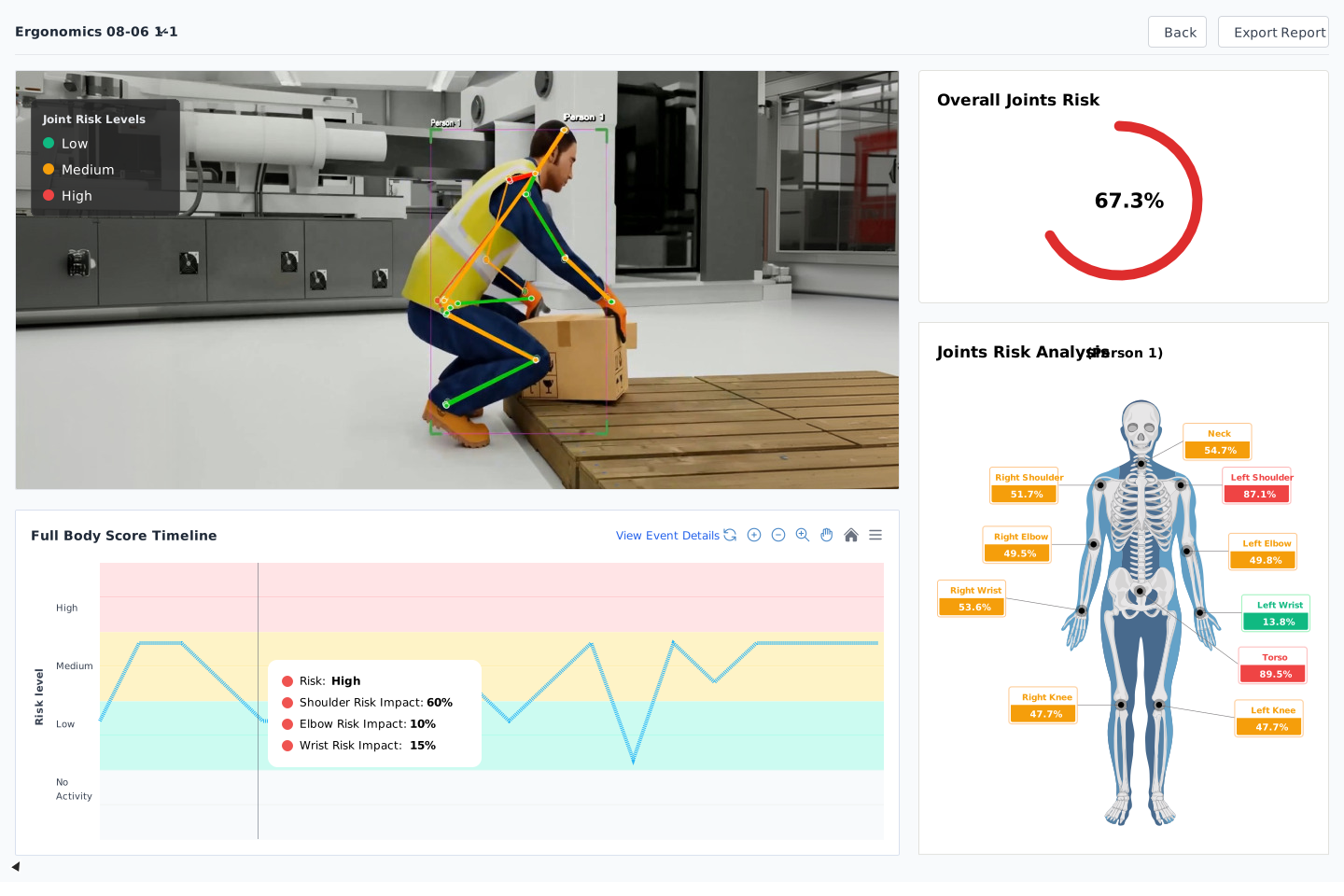
Postural ergonomics video analysis covers both whole-body and upper-limb assessment. The system applies established tools such as REBA for whole-body posture and RULA for upper-limb and neck posture. Analysed videos are overlaid with 3-D musculoskeletal skeletons that highlight posture, joint angles, and intuitive postural pinch points, making risk visible without specialist interpretation.
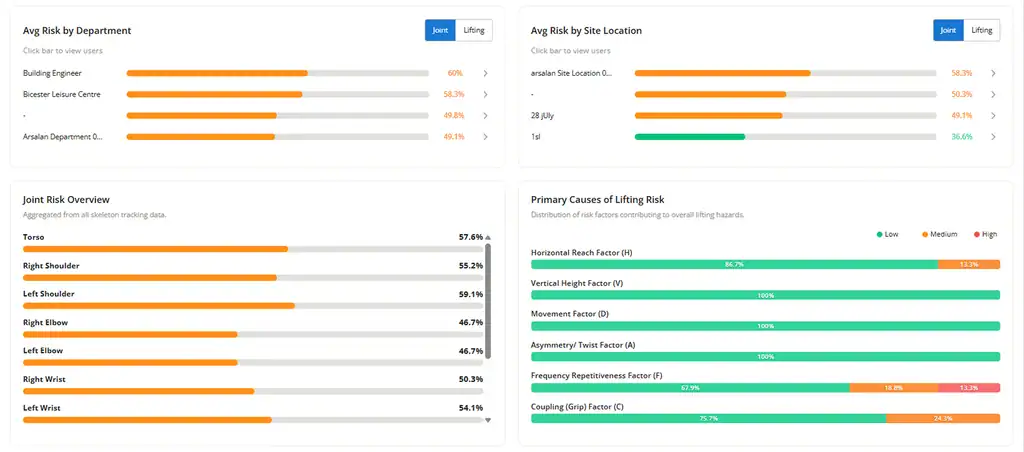
Manual handling analysis uses the NIOSH 2 Lifting Equation to assess lifting risk. This supports identification of risk factors and provides evidence to inform improvements in task design, equipment selection, and handling technique.
Risk assessment outputs are directly linked to the analysed video.
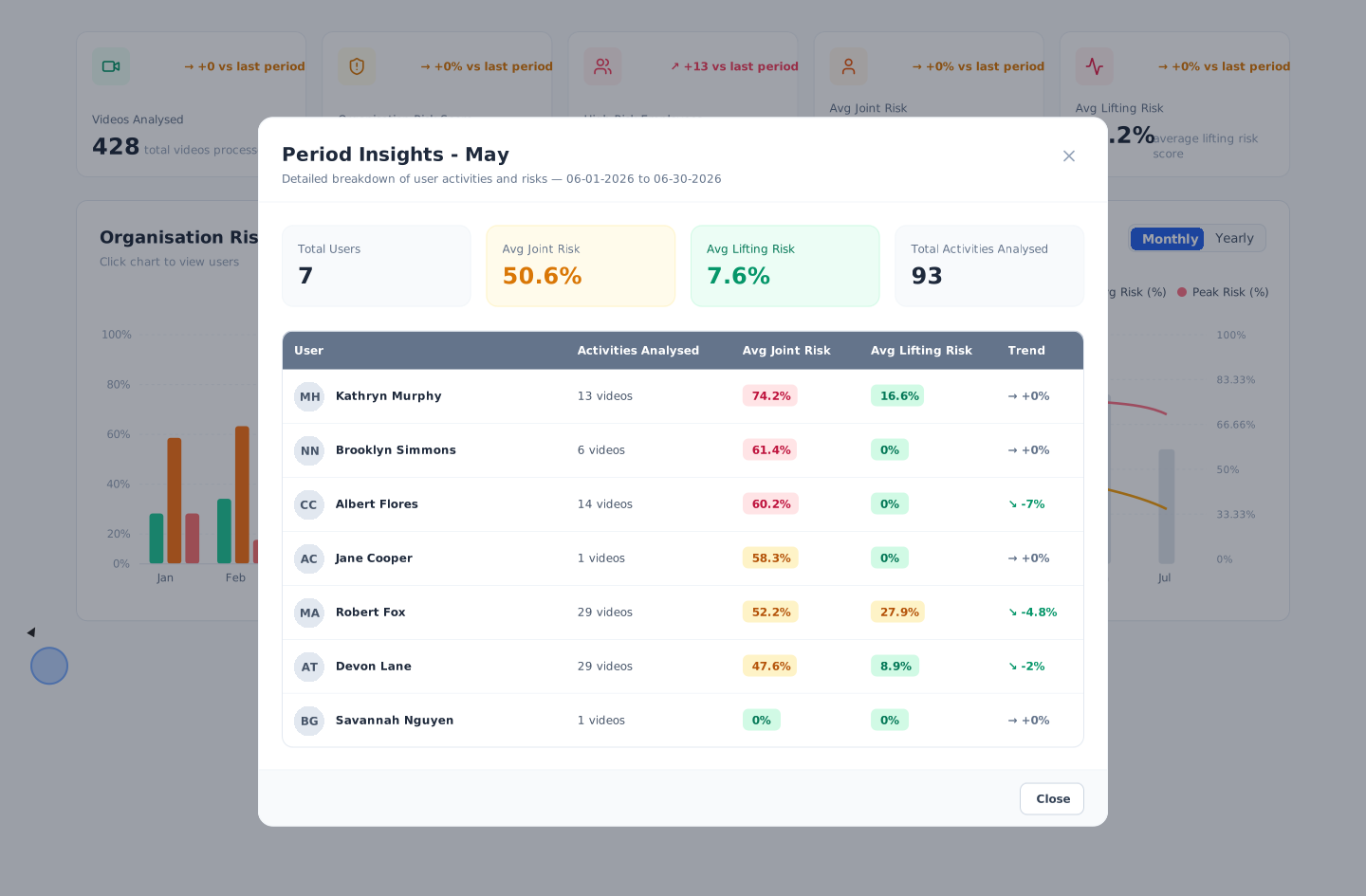
Graphs show how ergonomic risk changes over time and are synchronised with the footage. Selecting a point on a graph plays the corresponding moment in the video, removing the need for manual cross-referencing or annotation.
Text-based reports analyse the risks identified and make suggestions for improvement. Risk assessment reports can be downloaded as PDFs, including screen grabs from videos, posture overlays, graphs, and written analysis, removing the need to produce separate documentation after the assessment.
In training mode, the same analysed video content is reused to create task-specific ergonomics and manual handling training.
Video clips with overlaid ergonomics graphics and risk indicators can be published through the Human Focus content tools, allowing organisations to create training that reflects the exact tasks being performed.
This enables the creation of large volumes of bespoke, task-specific training that incorporates built-in ergonomics analysis. Employers can now create hundreds or thousands of individual task-specific training courses covering posture, ergonomics, and manual handling across their organisation.
Training mode also supports individual coaching and reinforcement.
The same mobile application can be used to capture videos of individual trainees performing tasks. These videos are automatically uploaded, analysed, and converted into a short e-learning experience for the individual.
Trainees watch themselves performing the task with automated AI ergonomics feedback highlighting performance and suggesting improvements. Training performance can be tracked over time, supporting reinforcement without additional manual effort.
Manual handling:
- Tasks can be analysed to inform improvements in task design and equipment.
- The same analysis is used to deliver task-specific manual handling training and reinforcement.
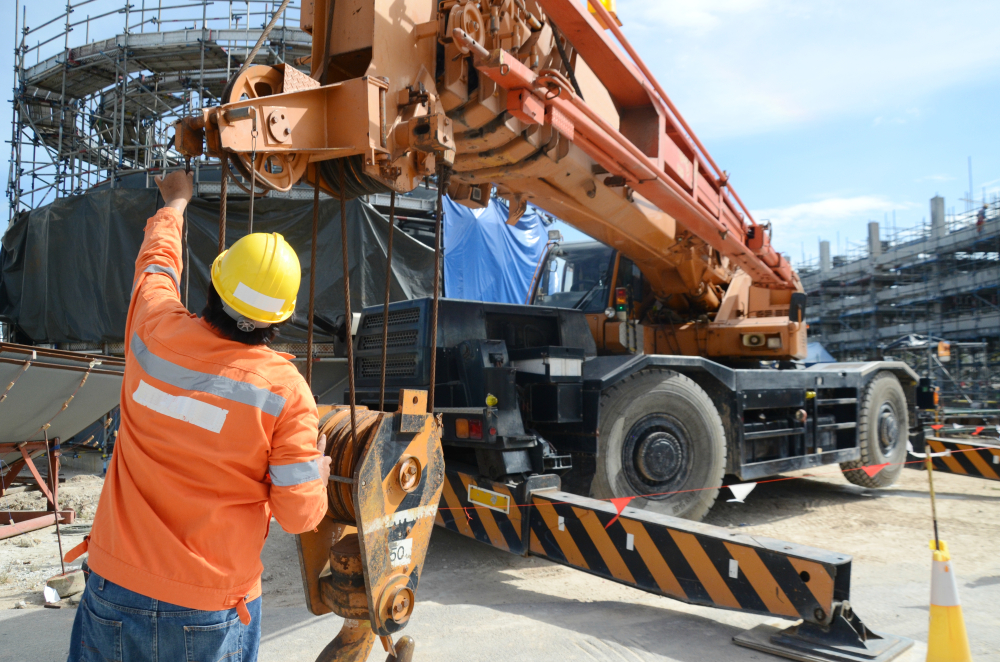
- Applicable across construction, manufacturing, utilities, warehousing, and distribution.
Industrial ergonomics:
- Tasks involving bending, twisting, reaching, or sustained awkward postures.
- Analysis can cover both whole-body and upper-limb risk.
- Improvements are embedded directly into bespoke training and coaching.
Display screen equipment work:
Short video clips are used to improve the consistency and accuracy of assessments.
- Supports UK display screen equipment risk assessment requirements.
- Enables ongoing coaching through repeat video capture and AI ergonomics feedback following workstation improvements.
The Human Focus AI Ergonomics Module is designed to act as a co-pilot, not the pilot, for ergonomics risk assessment and training.
It does not replace professional judgement, nor does it automatically redesign tasks or workplaces. Decisions about task design, controls, and safe systems of work still sit with people who understand the work being done.
What the module does is remove the manual, specialist-dependent effort that has traditionally limited ergonomics risk management. By automating ergonomics assessment via AI automated video analysis, posture scoring, reporting, and the creation of training-ready content, it takes the friction out of producing risk assessments and task-specific, bespoke ergonomics training that would otherwise be impractical to create and maintain.
Human Focus supports this capability with a range of advanced online training courses in posture and manual handling, recognised by the International Institute of Risk and Safety Management (IIRSM). These courses develop the professional knowledge needed to interpret assessments properly, apply judgement, and use the outputs of the Human Focus AI Ergonomics Module effectively.
This solution, providing both individual competence and expertise through the AI intelligence process, delivers genuine safety performance improvement.