Whole Body Vibration Awareness Training for Operators
schedule
Course Duration: 30+ minutes
This IIRSM-approved Whole Body Vibration Awareness Training for Operators helps plant and vehicle operators understand how vibration exposure builds up during everyday work and how their operating decisions affect the dose they receive.
Whole body vibration is a common hazard for mobile plant and vehicle operators. Exposure accumulates across a shift and can lead to long-term musculoskeletal problems, particularly affecting the lower back. This training explains how vibration occurs in real work situations and the practical steps operators can take to reduce their exposure and report symptoms early.
This course is designed for workers operating machinery or vehicles where whole body vibration exposure is a routine part of the job, including:
Plant and mobile equipment operators
Excavator, dumper, forklift truck and roller drivers
Construction, civil engineering and groundworkers
Agricultural, forestry and utilities workers
Site supervisors responsible for plant-intensive operations
Anyone exposed to vibration through vehicle seats or operating platforms
Course Content
The Whole Body Vibration Awareness Training for Operators course includes the following sections:
Understand how vibration enters the body when operating plant and vehicles, which equipment generates the highest vibration levels and how personal factors such as posture and cold conditions can affect exposure.
Learn how long-term vibration exposure can lead to lower back pain, musculoskeletal disorders and balance problems, and why early symptoms may appear mild before becoming permanent if exposure continues.
Understand employer and operator responsibilities under the Control of Vibration at Work Regulations 2005, including the exposure action value (EAV) and exposure limit value (ELV).
See how vibration risk assessments estimate operator exposure, how daily dose values are calculated and how tools such as the HSE WBV calculator help assess exposure across real shifts.
Recognise how factors such as speed, terrain, seat condition, posture and task duration influence cumulative vibration dose during plant operation.
Learn the hierarchy of vibration controls and how management measures, equipment maintenance and work planning help reduce exposure.
Understand the practical steps operators can take each shift, including adjusting posture, checking seat condition, managing exposure time and reporting symptoms early.
What Your Staff Will Learn
By completing this training, operators will understand:
How whole body vibration exposure builds across a shift
Which types of plant, terrain and working conditions increase vibration dose
How WBV-related health problems develop gradually over time
The legal exposure thresholds that apply to vibration risk
How daily exposure can increase when operators switch between machines or tasks
The controls that reduce vibration dose during routine work
How to recognise early symptoms and report concerns promptly
Available in 20+ Languages
Course subtitles are available in multiple languages, including:
This course is approved by IIRSM – the International Institute of Risk & Safety Management.
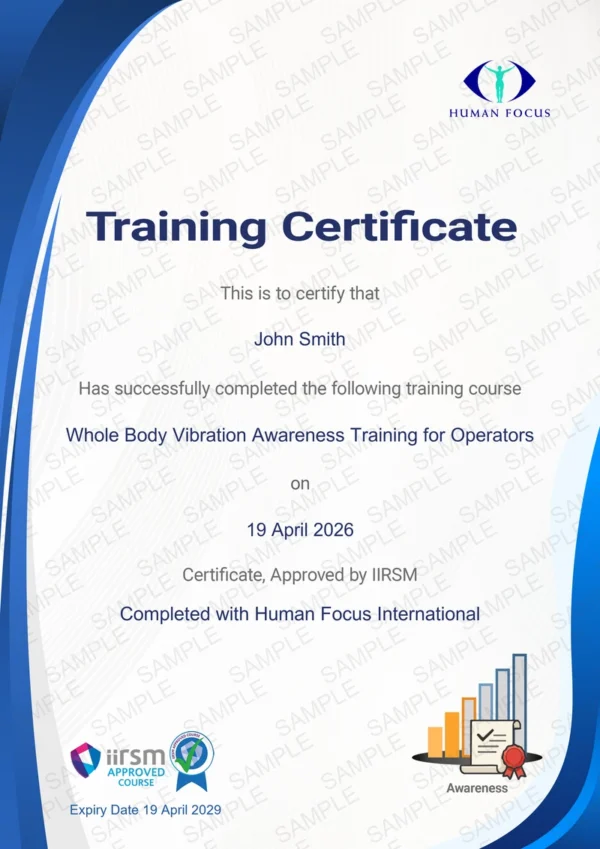
The course certificate includes:
User name
Company name
Course name
Completion date
Expiry date
Approval body
An IIRSM-approved course certificate will be available for download and printing instantly upon course completion.
Users must complete a final theory test before earning their certificate.
The end-of-course test is:
Fully online
Multiple choice
A score of 80% is required to pass.
Course attempts
Each licence includes one attempt at the final knowledge assessment.
If a trainee does not pass and wishes to try again, an additional licence is required. For their second attempt, the trainee can retake the assessment without repeating the course content.
Customer Feedback
Why Whole Body Vibration Training Is Important
Whole body vibration is a significant cause of long-term musculoskeletal problems among plant and vehicle operators. The effects usually develop gradually, often after years of repeated exposure, and early symptoms may be easy to overlook.
Under the Control of Vibration at Work Regulations 2005, employers must assess vibration risks, reduce exposure so far as reasonably practicable and provide workers with appropriate information and training.
In practice, operators may not always see how their daily decisions affect exposure. Changing speed, travelling over rough ground or switching between machines can significantly increase vibration dose across a shift. Because these decisions appear routine, early symptoms are often ignored rather than reported.
Training helps operators understand how exposure accumulates during normal work and how their own operating choices influence risk.
How This Training Helps Your Organisation
This course helps organisations:
Improve operator awareness of whole body vibration risks
Support compliance with the Control of Vibration at Work Regulations
Reinforce vibration risk assessments and exposure limits
Encourage early reporting of vibration-related symptoms
Promote practical controls that reduce exposure during everyday work
By improving operator understanding of how vibration exposure occurs, the training supports more consistent management of WBV risk across plant-intensive operations.
Give plant and vehicle operators the knowledge they need to understand how vibration exposure builds during everyday work and how their operating decisions affect risk. This training helps strengthen vibration control measures and supports safer plant operations.