Temporary Works Coordinator Training

Temporary Works Coordinator Training

schedule

Course Duration: Approximately 2 hours

Temporary Works Coordinator Training helps organisations understand why temporary works failures are rarely caused by a single mistake. Problems can arise when designs are used before approval, inspections are missed, or site changes are made without proper review and sign-off.

Within a formal temporary works procedure, the TWC coordinates the Temporary Works Register and Design Brief and checks that current RAMS and any required permits are in place and aligned with the approved design. Without this level of control, unsafe decisions can pass into live construction work.

This IIRSM-approved course helps organisations prepare TWCs to understand temporary works management in the context of CDM 2015, BS 5975-1:2024 and BS 5975-2:2024. It explains where coordination failures can occur, which decisions carry the greatest responsibility and what effective control looks like in practice.

live_tv
100% online training
volume_up
Full audio voiceover
repeat_on
Fully online assessment
account_balance_wallet
Discounts when you buy in bulk
important_devices
Access on any device
app_shortcut
App available for iOS & Android
Training You Can Trust

Approved by IIRSM

Aligned with UK Legislation

Certificate on completion

Developed by health and safety professionals

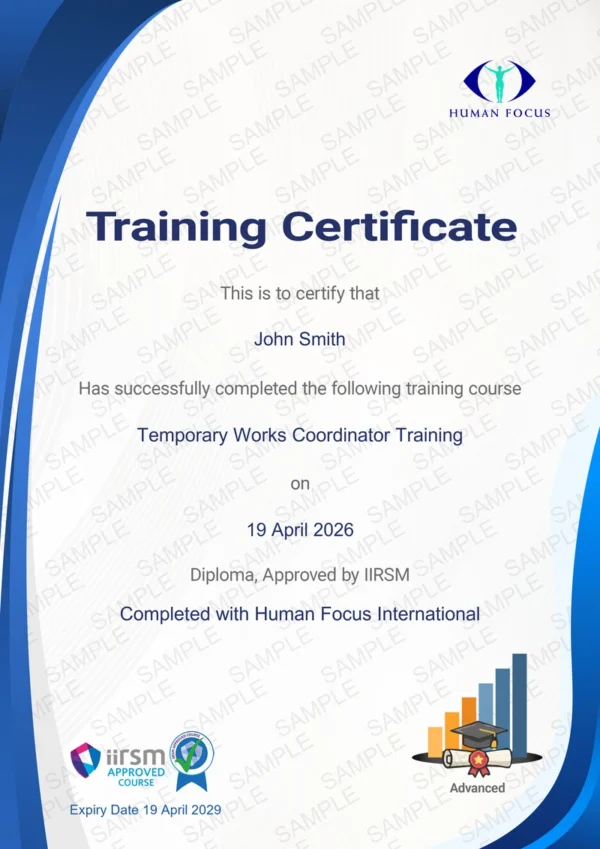
Temporary Works Coordinator Training Course Certificate
Temporary Works Coordinator Training
IIRSM-logo-for-website-131224
£195.00 +VAT

Discounts  for bulk purchases

Need Help?

£195.00 +VAT

Course Preview

Course Details

Course Duration Approximately 2 hours
Approval body IIRSM
Format Fully online
Assessment Multiple choice
Certification Same-day digital certificate
Certificate Valid For 3 years

Suitable For

This online Temporary Works Coordinator course is designed for those involved in managing, coordinating or working alongside temporary works on construction and engineering projects.

It is suitable for:

Newly appointed TWCs

Prospective TWCs

Temporary Works Supervisors

Site and project managers

Engineers and foremen

Temporary Works Designers and Designated Individuals

The course is particularly relevant to construction, civil engineering, infrastructure, refurbishment, demolition and utilities projects that use a formal temporary works procedure based on BS 5975-1:2024.

Course Content

The Temporary Works Coordinator Training course includes the following modules:

Understand what temporary works are, what the law requires and the key roles and management procedures described in BS 5975-1:2024, with an introduction to the relevant falsework guidance in BS 5975-2:2024.

  • Temporary Works Overview
  • What Can Go Wrong?
  • Legal Background & Standards
  • Hazards
  • The 4 C’s
  • Key Roles in Temporary Works
  • The Role of the Temporary Works Coordinator

Learn how to use the core documents the TWC relies on and how to plan, manage and control temporary works in practice.

  • Temporary Works Register
  • Design Brief
  • RAMS
  • Permits in Temporary Works
  • Planning Temporary Works
  • Managing Temporary Works
  • Managing Risk
  • Managing Alterations

Disclaimer: This programme provides knowledge and supporting guidance. Completing it does not by itself make you competent, qualified or authorised for workplace tasks. Follow your employer’s procedures, risk assessments and supervision. It does not appoint you to a dutyholder, responsible person or competent person role.

What Your Staff Will Learn

By completing this training, TWCs will:

Understand how temporary works failures occur and the consequences for workers and organisations

Understand how relevant CDM 2015 duties and the recommendations in BS 5975-1:2024 and BS 5975-2:2024 relate to project decisions and responsibilities

Understand their role across planning, coordination, inspection and removal of temporary works

Learn how to use and maintain a Temporary Works Register accurately throughout a project

Know how to brief designers, manage design checks by category and control design changes formally

Understand how to apply risk classifications and design check categories to determine the correct level of oversight

Understand how permits to load, unload or dismantle are checked, authorised, issued and closed under the project procedure

Available in 20+ Languages

Course subtitles are available in multiple languages, including:

French

Dutch

German

Italian

Spanish

Polish

Course Approval Body

IIRSM-logo-for-website-131224

Approved by IIRSM

This course is approved by IIRSM – the International Institute of Risk & Safety Management.

The course certificate includes:

  • User name
  • Company name
  • Course name
  • Completion date
  • Expiry date
  • Approval body

An IIRSM-approved course certificate will be available for download and printing instantly upon course completion.

Users must complete a final theory test before earning their certificate.

The end-of-course test is:

  • Fully online
  • Multiple choice

A score of 80% is required to pass.

Temporary Works Coordinator Training Course Certificate

Course attempts
Each licence includes one attempt at the final knowledge assessment.

If a trainee does not pass and wishes to try again, an additional licence is required. For their second attempt, the trainee can retake the assessment without repeating the course content.

Customer Feedback

Why Temporary Works Coordinator Training Is Important

This training gives prospective and appointed coordinators a practical framework for understanding how temporary works should be controlled from the first design requirement through to installation, use, alteration and removal. Temporary works may only remain in place for part of a project, but the consequences of poor control can be serious. A missed design check, an unapproved change or a permit issued at the wrong stage can expose workers, the public and the programme to avoidable risk.

Effective temporary works management is therefore about more than producing paperwork. It creates a controlled route for identifying temporary works, defining what must be designed, checking that the design is suitable, confirming that site conditions match the assumptions made and recording when work can safely move to the next stage.

HSE does not prescribe one mandatory management system or require every project to use the title Temporary Works Coordinator (TWC). However, it recognises the appointment of a TWC as an effective way to coordinate suitable designs, checks and correct installation. BS 5975-1:2024 sets out recognised good-practice procedures for managing temporary works, while BS 5975-2:2024 deals with the design and implementation of falsework.

Temporary Works Coordinator Responsibilities

The TWC coordinates the temporary works process rather than acting as the designer for every solution. The role involves making sure the right people, information and controls come together at the right time. Depending on the project and the organisation’s procedure, this can include maintaining the temporary works register, ensuring a suitable design brief is prepared, coordinating design checks, confirming that inspections have been completed and controlling permits before loading, use or dismantling.

A temporary works register provides a live record of the temporary works identified on a project and their status. It helps the team see what requires design, checking, approval or further action. The design brief then gives the designer the information needed to develop the solution, including relevant site conditions, loads, interfaces, sequence and constraints.

The TWC also needs to understand how the temporary works process connects with the project risk assessment, method statements and site activities. Designs can be technically sound but still be compromised if assumptions are not communicated, materials are changed, adjacent work affects stability or installation does not follow the agreed sequence. Changes should therefore be controlled and referred back through the appropriate design and checking process rather than accepted informally on site.

On some projects, a Temporary Works Supervisor (TWS) may support the TWC by overseeing specific temporary works activities. The exact division of duties should be clear. A TWS does not remove the need for overall coordination, and neither title by itself proves competence. Organisations still need to consider the person’s training, knowledge, skills, experience and authority for the work they are expected to control.

How This Training Helps Your Organisation

A temporary works coordinator training course can help organisations build a more consistent understanding of the controls expected around temporary works. For learners, the value is in seeing how the different parts of the process fit together rather than treating registers, permits and inspections as separate administrative tasks.

The course explains the purpose of the temporary works register, the information required in a design brief, the role of design checks and the importance of recording decisions. It also helps learners understand when work should stop because information is missing, a change has not been approved or the required inspection or permit has not been completed.

For employers, online temporary works coordinator training can support a wider competence-development process by giving prospective or appointed TWCs a common foundation before they take on live coordination duties. It can also help site teams use the same terminology and follow a more consistent process across projects.

Training alone does not make someone competent to act as a TWC. Employers should still assess the individual against the demands of the project, formally define their role and give them sufficient authority, time and support. An online temporary works coordinator course is most useful when it sits alongside the organisation’s own procedures, practical experience, supervision and project-specific instruction.

Start Your Temporary Works Coordinator Training Today

Build a stronger understanding of BS 5975, temporary works management and the decisions that keep temporary works under control. This TWC course is designed to help prospective and appointed coordinators understand how registers, design briefs, risk information, design checks, inspections and permits work together throughout the temporary works process.

Give your team a clearer foundation for coordinating temporary works safely and consistently. Enrol online to begin the course and support your organisation’s wider approach to competence, appointment and effective site control.


Frequently Asked Questions

A Temporary Works Coordinator (TWC) is the person appointed to coordinate the organisation’s temporary works procedure on a project. The role typically involves overseeing the temporary works register, coordinating design briefs and design checks, and making sure required inspections and permits are completed at the correct stage.

The TWC does not personally design or inspect every item of temporary works. Their responsibility is to help ensure that the agreed management process is followed, information reaches the right people and temporary works do not progress without the required controls.

The course is suitable for prospective and newly appointed TWCs who need to understand how temporary works are managed and controlled. It can also be useful for Temporary Works Supervisors (TWS), project and site managers, engineers, foremen, temporary works designers and others who work closely with the coordination process.

Training should form part of a wider competence process. Completing the course alone does not appoint or automatically qualify someone to act as a TWC.

The Human Focus course takes approximately two hours to complete. It is delivered as online e-learning, so learners can work through the material without attending a scheduled classroom session.

Course duration varies considerably between providers and course types. In particular, this two-hour course should not be confused with the separate CITB Temporary Works Co-ordinator Training Course, which has a substantially longer delivery and assessment requirement.

A TWC course can help you understand how the different parts of temporary works management connect in practice. That includes the temporary works register, design brief, risk information, design checks, inspections, alterations and permits.

This knowledge can make it easier to identify what should happen before temporary works move from one stage to another. It also helps clarify when information is missing, when a change needs further approval and when work should not proceed until the relevant control has been completed.

The course provides supporting knowledge. Your employer must still decide whether you have the competence, experience and authority needed for the responsibilities assigned to you.

It can support safer temporary works management, but training by itself cannot prevent accidents.

Temporary works depend on suitable designs, effective communication, competent people and controls being applied correctly on site. Understanding when design checks, inspections or permits are required can help TWCs recognise gaps before work progresses. The same applies when site conditions change or the installed works no longer match the approved design.

The practical benefit is stronger coordination. That can contribute to reducing the likelihood of temporary works being installed, altered, loaded or dismantled without the necessary checks.

The Human Focus course certificate is valid for three years. A digital certificate is available after successful completion of the course assessment.

Certificate validity should not be treated as proof that someone remains competent for every TWC role throughout that period. Employers should continue to consider experience, current knowledge, project complexity and the individual’s ability to carry out the responsibilities assigned to them.

There are no formal entry requirements for the Human Focus course. It is designed for prospective and appointed TWCs as well as other construction professionals who need a better understanding of the temporary works process.

However, learners are likely to get more from the course if they already have some familiarity with construction projects, site risk management or temporary works activities. Employers should also provide any project-specific procedures and practical instruction needed for the learner’s role.

No. The Human Focus course is not the CITB Temporary Works Co-ordinator Training Course (TWCTC).

The Human Focus course is an IIRSM-approved, fully online e-learning course that takes approximately two hours. It provides supporting knowledge on BS 5975, the TWC role and the documents and controls used to manage temporary works.

These are different training products and should not be treated as interchangeable. The Human Focus course is intended for organisations and learners seeking flexible online learning to support their understanding of temporary works coordination and wider TWC competence development.

Related Courses