Psychological Safety at Work for Managers helps managers understand why people in their teams stay silent when problems arise — and what they can do about it. Workers often judge that staying quiet is safer than speaking up. This IIRSM-approved course shows managers how their own behaviour shapes that judgement, what drives silence in teams, and how to create the conditions for concerns to surface before they become incidents.
Psychological Safety at Work for Managers
schedule
Course Duration: Approximately 2 hours
live_tv
100% online training
volume_up
Full audio voiceover
repeat_on
Fully online assessment
account_balance_wallet
Discounts when you buy in bulk
important_devices
Access on any device
app_shortcut
App available for iOS & Android
Training You Can Trust


Course Preview
Course Details
| Course Duration | Approximately 2 hours |
|---|---|
| Approval body | IIRSM |
| Format | Fully online |
| Assessment | Multiple choice |
| Certification | Same-day digital certificate |
| Certificate Valid For | 3 years |
Who This Course Is For
This course is for anyone with people-management responsibility — particularly those leading teams where open reporting of problems, near misses and safety concerns cannot be assumed.
It is suitable for:
Course Content
This course includes the following modules:
Understand what psychological safety is and why it plays a central role in whether teams learn from everyday work. See how serious incidents develop when people notice problems but feel unable to speak up, or when concerns are raised but not listened to.
- What is Psychological Safety?
- How Psychological Safety Affects Learning
- How a Fear of Speaking Up Kills
- How Failing to Listen Kills
Recognise the mental models, power and skill gradients and trust dynamics that drive silence in everyday working life. Understand how a person’s position, experience level and relationship with their manager shape what they feel able to say.
- Mental Models
- Power & Skill Gradients
- Trust
Learn how civility directly affects team performance, decision-making and safety. Understand why even moderate rudeness damages attention and information sharing, and apply practical actions — including a humble inquiry approach — that improve civility, trust and openness within a team.
- Civility Saves Lives
- Simple Things to Improve Civility
- Humble Enquiry
What Your Staff Will Learn
By completing this training, managers will be able to:



Available in 20+ Languages
Course Approval Body
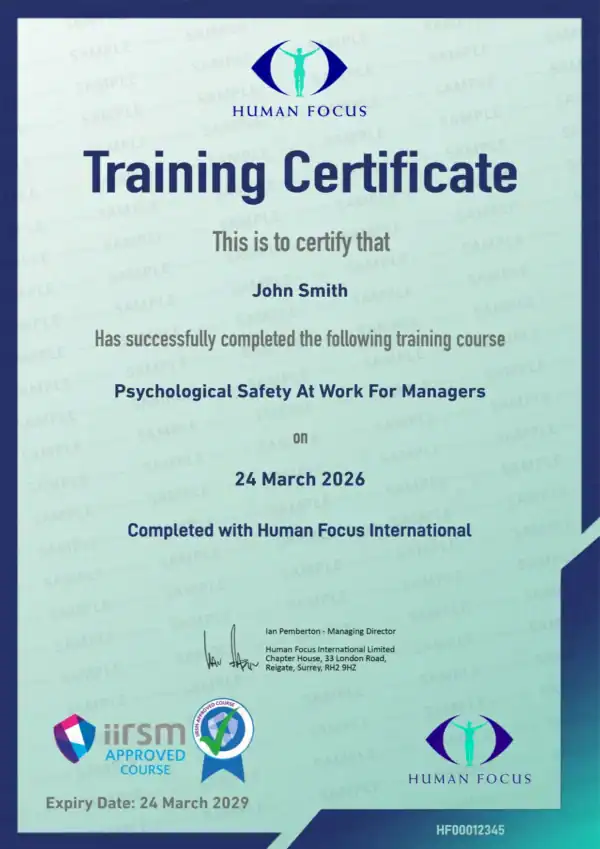
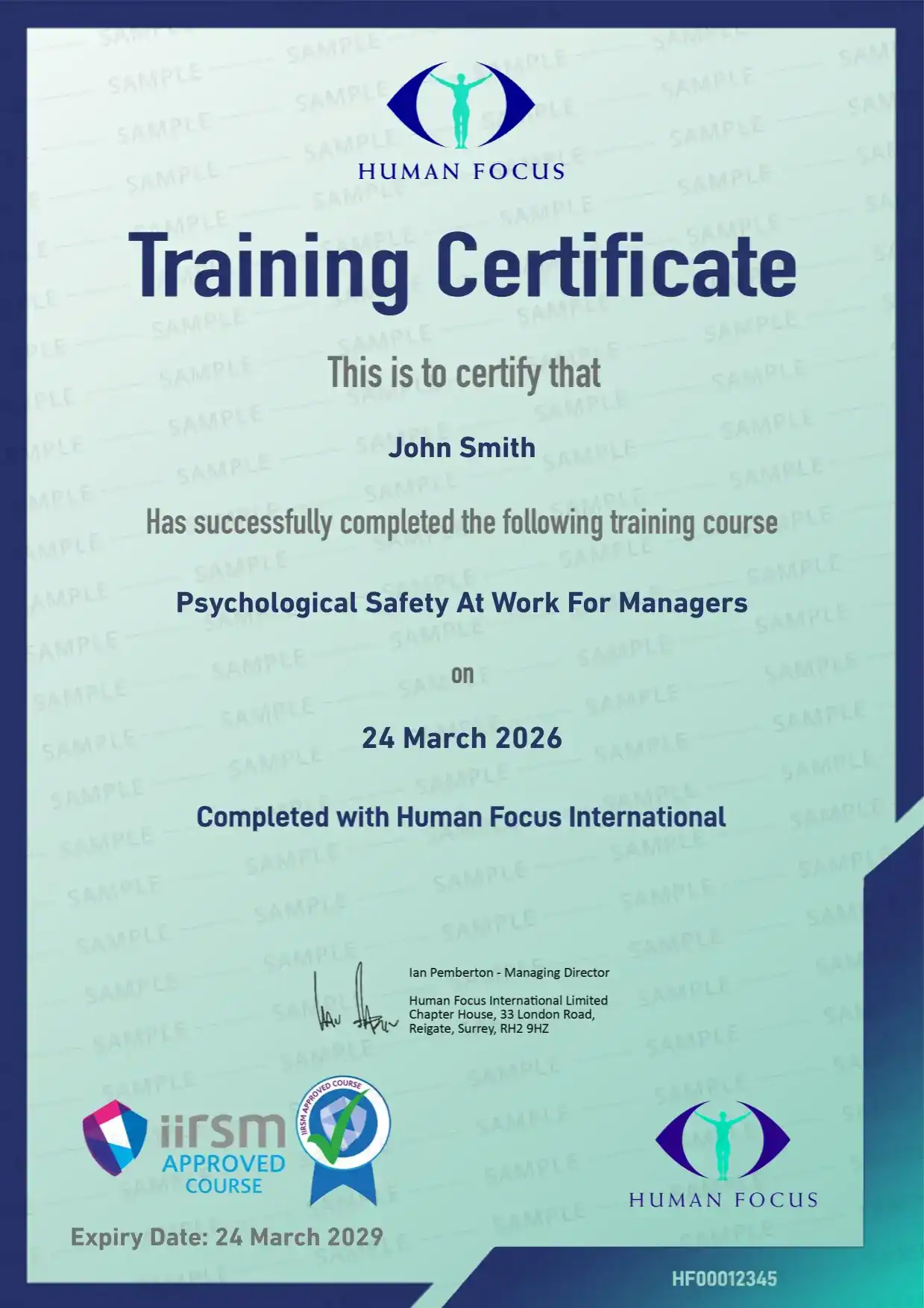
The course certificate includes:
- User name
- Company name
- Course name
- Completion date
- Expiry date
- Approval body
An IIRSM-approved certificate will be available for download and printing instantly upon course completion.
Users must complete an assessment before earning their certificate.
The end-of-course test is:
- Fully online
- Multiple choice
A score of 80% is required to pass.
Customer Feedback
Why This Training Is Important
Most workplace problems build quietly when people spot an issue, sense that something is wrong and say nothing. For many workers, the calculation is simple: speaking up feels personally risky, while the benefit is delayed and felt mainly by the organisation.
Managers shape whether that calculation ends in silence or early reporting through the way they respond to concerns, the tone they set and the signals they send about whether speaking up is safe.
When managers shut down challenge, dismiss concerns or tolerate incivility, important information stays hidden. Mistakes are repeated, near misses go unexplored and teams lose the chance to deal with problems early.
Under the Health and Safety at Work etc. Act, employers must protect employee health, including mental health. HSE guidance on work-related stress, Acas guidance on workplace relationships, ISO 45003 and the principles of ISO 45001 all reinforce the importance of management behaviour, support and communication.
This IIRSM-approved course gives organisations a structured way to address that, helping managers recognise what drives silence and build the conditions for earlier, more open reporting.
How This Training Helps Your Organisation
This course helps organisations:
- Help managers understand how their own behaviour affects whether people report problems and raise concerns
- Strengthen the quality and frequency of open conversations about risk, near misses and everyday work issues
- Support compliance with health and safety duties, HSE stress management guidance and Acas good practice
- Reduce the risk of incidents caused by unreported problems, hidden errors and closed feedback loops
- Build more consistent, trust-based management practices across teams, shifts and sites
Start Your Psychological Safety at Work for Managers Training Today
Give your managers the tools and confidence to build teams where people feel safe to speak up, report problems and contribute to stronger risk control. This training turns everyday management behaviour into a foundation for open communication, early problem reporting and consistent safety practices across your organisation.