Warning signs of a weak safety culture include serious concerns losing urgency before reaching decision-makers, work continuing despite unreliable safety controls and the same faults returning after corrective actions are closed. These patterns can persist even when organisations hold regular safety meetings, complete training and maintain detailed action records.
Safety culture reflects the shared expectations and practices that shape decisions about risk at work. Leaders need to establish whether reported concerns lead to changes in working arrangements and whether corrective actions have actually controlled the risks. One unresolved defect does not establish a weak culture, but repeated failures to act on known risks warrant investigation.
In the months before 11 December 2005, a tank-level gauge at a Hertfordshire fuel depot kept sticking. Site management and maintenance contractors had not responded effectively to its unreliability. Tank-filling arrangements had been independently audited, yet investigators later found them deficient and not properly followed.
During overnight filling, the gauge stuck and an independent high-level switch, intended to stop filling automatically, was inoperable. Petrol overflowed from the tank. A vapour cloud formed and ignited, causing an explosion and a fire that lasted five days.
The investigation also identified increasing throughput and insufficient engineering support. These pressures contributed to a culture in which keeping operations running took priority over process safety (Competent Authority, 2011).
Warnings, audits and protective equipment were present. How could a dangerous condition still be allowed to persist?
The Health and Safety Executive (HSE) identifies management commitment and communication among the influences on safety culture. Its guidance directs attention to management priorities alongside workers’ behaviour (HSE, n.d.-c).
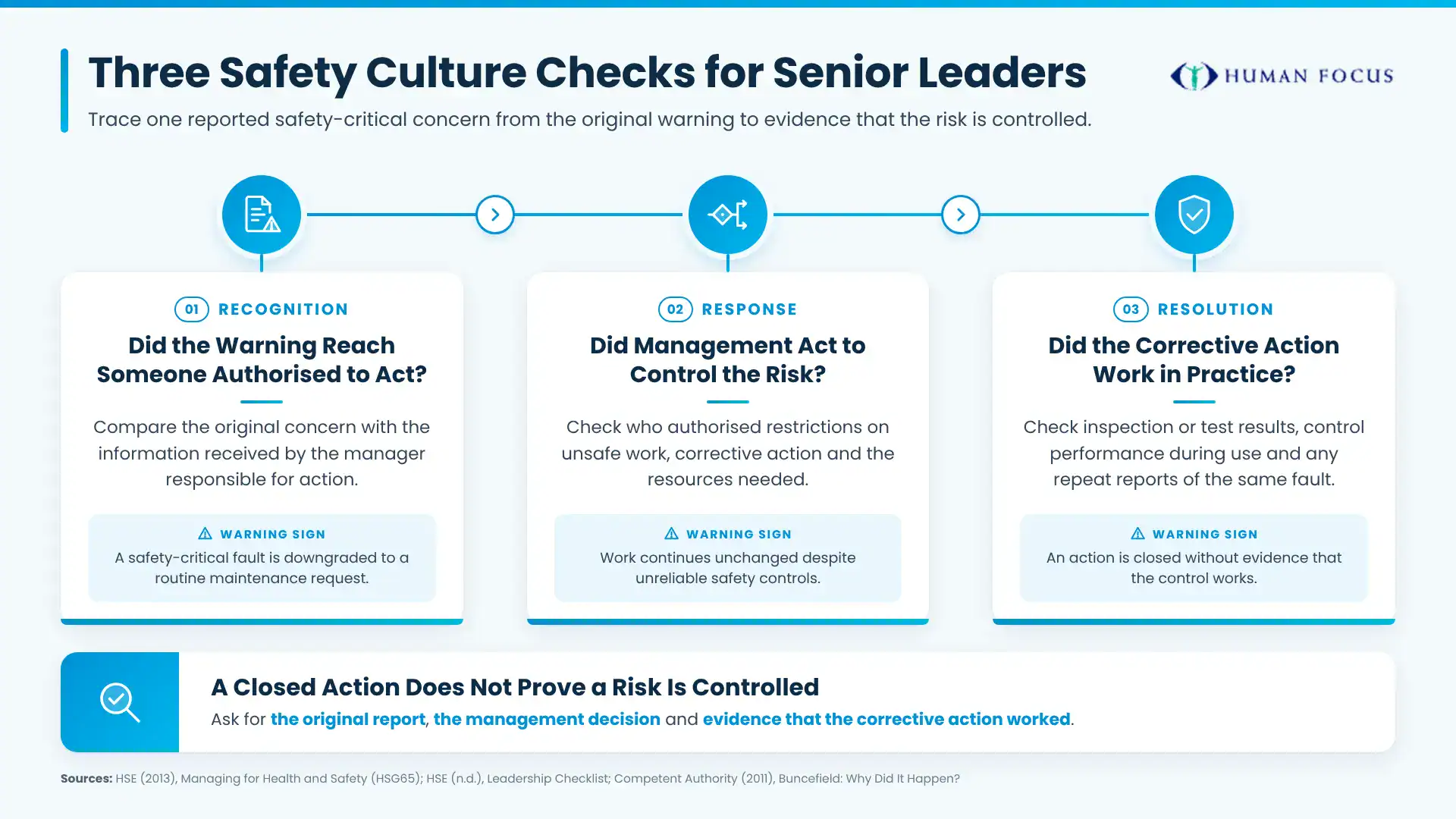
Leaders need to examine three connected stages. Recognition concerns whether emerging risks are identified and communicated accurately. Response concerns the operational decisions and resources that follow. Resolution concerns whether the organisation can demonstrate that corrective action has worked.
These weaknesses can reinforce one another. A warning stripped of urgency may receive only temporary attention. If an action then closes without an effective correction, the concern can leave the list of outstanding actions while the condition remains. Continued production can make the arrangement appear accepted, leaving the next team to work around the same difficulty.
The eight signs follow that sequence from recognition through management response to resolution. They are prompts for investigation, not a validated assessment or an HSE-approved checklist. The depot findings support specific failings described above; the signs below are broader questions for leaders to investigate in their own organisations.
Low reporting may reflect safer work or reduced activity. It may also reflect difficulty reporting or doubt that anything will change. When leaders accept low totals as conclusive, they may stop looking for concerns that remain outside the figures.
Researchers studying 38 construction companies at a US site compared formal injury logs with medical claims, finding eligible injuries missing from the logs. Underreporting was greater among companies with poorer safety climate. The association does not establish causation or a UK benchmark (Probst et al., 2008).
Compare totals with activity, defects and worker accounts, alongside access to the system and confidence in near-miss reporting.
A concern can enter the system accurately and lose its significance during a handover. A warning about an unreliable safety control may reach a decision-maker as an ordinary maintenance request. Without the original explanation, someone may allocate priority without understanding what continued work involves.
HSE’s leadership checklist asks whether workers’ concerns reach the appropriate level, including the board where necessary (HSE, n.d.-b).
Tracing one significant concern from the worker’s account to the authorised response can expose where detail disappeared. The concern is then the handling of information already raised, rather than workers’ willingness to report.
An injury can bring forward decisions that earlier warnings did not secure. Where senior attention depends on harm occurring, known deterioration may remain unresolved while the organisation waits for a more compelling reason to act.
Occupational health makes this particularly important. Repeated concerns about poorly performing dust extraction need investigation even when injury figures remain low. Waiting for diagnosed illness leaves the earlier equipment warnings unanswered.
Review records and worker accounts should show what leaders learned about deteriorating controls and what changed before harm occurred. Visible activity after an incident cannot answer those earlier questions.
At the fuel depot, increased throughput and insufficient engineering support added pressure while weaknesses persisted. In another workplace, a supervisor may report that staffing or equipment cannot support planned work safely, yet the output target remains unchanged.
Leaders can change the operation or provide the resources needed to maintain required controls. Requiring unchanged output without those controls allows the unreliable condition to continue.
HSE’s inspection guidance identifies decisions that consistently favour production or cost over safety as a possible cultural warning sign (HSE, n.d.-a). Recent scheduling and resource decisions provide evidence of which priority prevailed.
A procedure may depend on equipment, space or staffing that is no longer available. If managers continue accepting the output without reconciling those changes, workers can be left to develop informal workarounds.
Repeated completion without an injury can make a workaround appear acceptable. It does not demonstrate that the method controls the risk. The original discrepancy may become harder to see as the adjustment becomes routine.
Workers and supervisors can identify where instructions become impractical. Comparing the procedure with the task allows competent review of the method, resources and supervision. The discrepancy needs a safe resolution before the workaround becomes an accepted operating arrangement.
An investigation that ends with a reminder to follow instructions can leave the conditions behind an error unchanged. HSE recommends examining underlying management and organisational factors alongside immediate causes (HSE, 2013).
If equipment, workload or supervision contributed, repeating the instruction alone leaves those influences in place. Another person may then encounter the same difficulty. An investigation can be recorded as complete while its opportunity to prevent recurrence has been missed.
Individual decisions still require fair examination. The investigation should also explain which conditions contributed and what will change. The resulting actions should address causes supported by evidence.
A training record establishes completion of the recorded learning activity. It cannot, on its own, demonstrate practical capability or compensate for unsuitable equipment. HSE describes competence through skills, knowledge and experience, with consolidation and practical experience after training (HSE, 2013).
For a maintenance worker responsible for isolation, competence evidence needs to cover the actual task and appropriate supervision afterwards.
Where retraining follows a concern, the intended change needs to be specific. Someone may already understand the method but lack the time or equipment to apply it. Repeating the course leaves that constraint unresolved.
A completed action can remove a fault from an outstanding list without demonstrating that the control performs as intended. For example, resetting a faulty component may restore operation temporarily while leaving the cause of the fault unresolved.
When closure depends mainly on recording that work was done, leaders can receive reassurance while workers encounter the same failure again. The closure status then gives leaders an incomplete picture of the condition workers face.
Repair evidence and subsequent performance should support closure. A repeat event may have a different cause, so recurrence warrants investigation rather than an automatic conclusion that the previous repair failed. Either way, the repeated warning needs a management decision.
To measure safety culture, combine worker feedback with workplace observation and relevant records. Compare what people say management prioritises with what operational decisions show. Differences between accounts need investigation, including differences across shifts, roles and locations.
Safety climate concerns current perceptions of how safety is prioritised. Safety culture includes the broader expectations and practices behind those perceptions. HSE’s Safety Climate Tool measures an element of safety culture through workers’ attitudes and perceptions (HSE, n.d.-d).
An appropriately designed survey can reveal concerns about management priorities and support. Compare groups where responses support meaningful analysis and protect confidentiality, especially in small teams. Survey findings need interpreting alongside what happens to real concerns.
Address immediate risks promptly. To improve safety culture, identify where recognition, response or resolution is failing, then give an owner the authority and resources to change the arrangements. A significant recurring concern provides a practical starting point.
- What was originally reported? Recover the risk described by the worker or supervisor and compare it with the wording that reached the decision-maker.
- What management decision followed? Identify any restriction or change to the work, who authorised the response and what resources were provided.
- What evidence supports closure? Examine the correction, its effectiveness under operating conditions and whether the same failure has returned.
Agree priorities with workers and competent advisers, set completion dates and explain the outcome to affected teams. Bring a small selection of significant concerns into existing management meetings at a frequency proportionate to risk. Effective health and safety management arrangements should make this follow-through part of ordinary management.
The gauge faults at the Hertfordshire depot existed before petrol overflowed. The practical lesson for other workplaces is that repeated warnings require an effective response. Not every recurring fault leads to a major accident. Repeated faults still warrant investigation into why the condition persists.
Leaders should be able to show what changed when a concern was raised, who authorised the response and how the relevant controls were shown to work. A positive safety culture depends on decisions that provide adequate resources and safe working conditions. Judge reporting and action closure against that outcome.
If the review identifies a need to develop executive knowledge, Human Focus’s IOSH Safety for Executives and Directors covers responsibilities, resources, communication and performance monitoring. Leaders need to apply that knowledge when reviewing decisions and working conditions.
HSE advises that culture change can take several years (HSE, n.d.-c). Specific improvements can begin immediately, such as funding a repair or resolving an overdue concern. Check whether better decisions persist over time and under pressure before concluding that change has become established.
There is no universal requirement to use this checklist, conduct a particular culture survey or achieve a culture score. HSE’s inspection guidance distinguishes culture itself from management failures that may require enforcement (HSE, n.d.-a). Employers still need to meet the health and safety duties applying to their work. This review supports investigation and does not establish legal compliance.