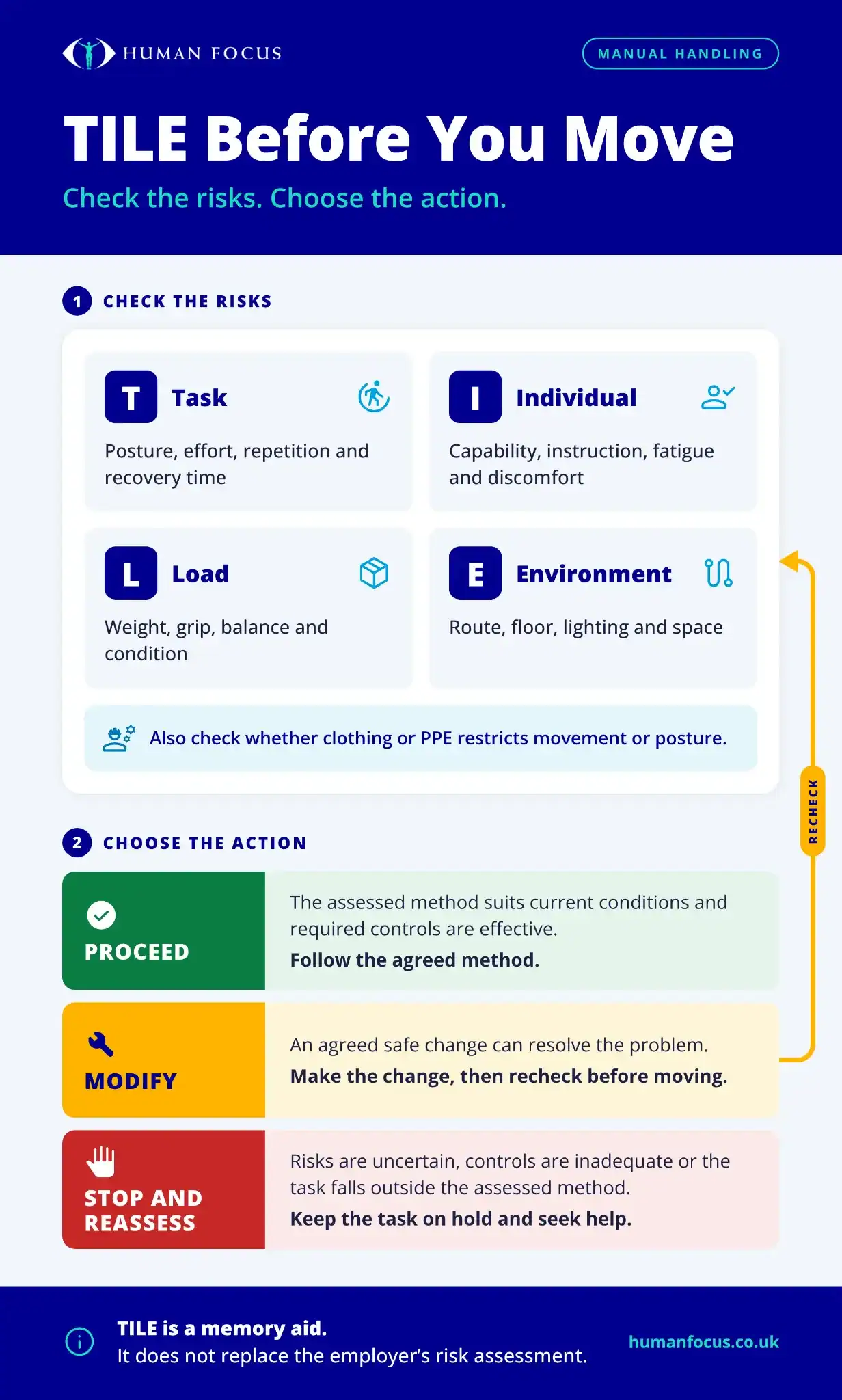
TILE is a memory aid used to assess manual handling tasks. It prompts you to consider the task, the person doing it, the load and the surrounding conditions before lifting, carrying, pushing or pulling.
This blog explains how to use TILE to spot risks before work starts and decide whether to proceed, change the planned method or stop for further assessment.
TILE stands for Task, Individual, Load and Environment. The four prompts map to the four factors specified in Schedule 1 of the Manual Handling Operations Regulations 1992:
The schedule describes these as “Factors to which the employer must have regard and questions he must consider when making an assessment of manual handling operations.”
It also includes “Other factors”, specifically whether personal protective equipment (PPE) or clothing hinders movement or posture. Employers must therefore consider more than the four TILE factors. TILE is a memory aid for those four specified factors, not a complete list of everything an assessment must address.
Use TILE before unfamiliar or potentially hazardous handling and whenever relevant conditions change. A manual handling pre-assessment should check whether the planned method still fits the job in front of the worker.
Reasons to pause include a different delivery, an unavailable handling aid, a changed route or discomfort that could affect handling. Routine work also needs attention when its normal controls are missing.
Under the Manual Handling Operations Regulations 1992, employers must avoid hazardous manual handling so far as reasonably practicable. Where this is not reasonably practicable, they must assess the risks and reduce them to the lowest level reasonably practicable.
A worker’s TILE check helps confirm that the assessed method and controls suit current conditions. It does not replace the employer’s assessment. Report problems and resolve them before starting.
Look at the whole movement, including picking up, transporting and putting down the load. Ask:
- Will it require stooping, reaching, twisting or holding the load away from the body?
- Is there room to move the feet and maintain a stable posture?
- Could handling distances, repetition, work pace or limited recovery time increase the strain?
- Will pushing or pulling require substantial effort to start, steer or stop?
- If people work together, can they coordinate the movement and set-down?
A short lift may still be demanding if it must be repeated throughout a shift. A trolley may reduce carrying but introduce difficult manoeuvring.
If the planned movement forces awkward postures, review the layout or method before starting. HSE’s guidance on reducing handling risks includes changing storage heights, shortening carrying distances and using suitable mechanical help.
Consider the worker’s actual capabilities, training and current condition. Experience with one handling task does not establish that someone can safely perform another.
Check for fatigue, pain, recent injury or other limitations. Also consider Schedule 1’s “Other factors”: whether clothing or
PPE restricts movement or posture. Keep required protection in place while the task or equipment is reviewed.
Decisions should reflect individual needs and job demands, rather than assumptions based on appearance, age or sex.
Discuss concerns with the worker and arrange suitable adjustments or assistance. Where pregnancy is relevant, follow the employer’s individual risk assessment arrangements.
Workers also need to understand the planned method and when to seek help. Human Focus’s Online Manual Handling Training covers pre-task assessment, handling techniques, pushing and pulling, and team lifting. It can support awareness alongside task-specific instruction and practical training. Completing an online course alone does not demonstrate competence for every handling operation.
Weight is only part of the check. Examine the load’s size, shape and condition, including:
- Poor handholds or packaging that could fail
- Uneven weight distribution or contents that can shift
- Sharp, hot, slippery or contaminated surfaces
- A bulky shape that prevents a secure hold or blocks the route ahead from view
Check available weight information and handling instructions. If the weight, balance or condition is uncertain, resolve that uncertainty before committing to the lift.
There is no universal legal weight limit that makes a load safe. HSE’s handling overview confirms that the law does not prescribe specific limits. A lighter load may still require changes because of its grip, position or handling frequency.
Check the starting point, destination and route between them. A clear space beside the load is insufficient if the route includes a tight doorway or slippery ramp.
Look for uneven floors, loose materials, steps, poor lighting, congestion and inadequate turning space. Consider heat, cold, rain, wind and other conditions that may affect grip, stability or control.
Check that the destination has enough space to put the load down without trapping fingers or adopting an awkward posture. If conditions differ from those covered by the planned method, pause and resolve the problem.
These factors often combine. The guide to Common Manual Handling Hazards and How to Avoid Them explains how changes in working conditions can undermine existing controls.
Use the findings to choose an action. The prompts below are a practical communication aid, not an HSE scoring system or proof that a task is safe.
One unresolved significant risk can be enough to stop the task. Several favourable factors do not cancel it out.
Changes might include smaller loads, different storage heights, a suitable mechanical aid or a revised route. Check their wider effects: smaller loads can increase repetition, while a trolley needs suitable floors and turning space.
Additional people should only form part of a planned method. HSE’s team-handling guidance emphasises space, grip, communication and coordination.
Once the task can proceed under suitable controls, apply the relevant safe lifting techniques and workplace instructions.
These illustrative scenarios show how the same four factors can lead to different decisions.
A worker needs to transfer a labelled carton from an accessible shelf to a trolley.
The task is a short transfer without reaching or twisting. The individual understands the method and reports no current difficulty. The load matches the assessed weight and packaging specification. The environment provides a clear route and a suitable set-down point.
Decision: proceed with the assessed method and required controls in place. If packaging is damaged or the specified trolley is missing, stop and review the plan.
A desktop printer needs moving to another room. Its load characteristics include uncertain weight and no obvious carrying handles. The task involves reaching behind a desk. The individual has no experience of moving this model. The environment includes trailing cables and a narrow exit.
Decision: stop and reassess. Check the manufacturer’s handling instructions and arrange a suitable method. Prepare the route and consider appropriate equipment or a planned team move. Asking a colleague to grab the other side does not resolve the other risks.
A site team plans to carry large boards from storage to the work area. The task involves repeated trips. The individuals know the normal method, but one reports fatigue. The load is bulky and vulnerable to wind. The environment has changed after rain, with slippery ground and restricted access.
Decision: stop and reassess. Review the weather, route, workload and handling method. Consider delivering materials closer to where they are needed or using suitable handling equipment. The original plan should not continue simply because it worked in dry conditions.
A stockroom trolley must travel along an established level route. The task and load match the assessed arrangement. The individual knows how to use the trolley, whose wheels and brakes are in working order. However, the environment has changed because empty packaging obstructs the route.
Decision: modify. Arrange for the obstruction to be removed safely, then recheck the route before moving. If a wheel jams or unusually high force is needed, stop and report it. HSE’s pushing and pulling guidance identifies wheel condition, slopes and manoeuvring space as relevant risks.
Seek further assessment where risks are unclear, conditions fall outside the assessed method or controls are inadequate. Repeated discomfort, difficult team handling, variable loads and substantial pushing or pulling forces need closer examination.
HSE’s manual handling risk filters help identify tasks needing more detailed assessment. Their guideline figures are not guaranteed safe limits.
Further assessment may involve:
A competent assessor should consult the workers involved. Seek specialist ergonomic or occupational health advice where risks or individual needs remain unresolved.
The law does not require the TILE acronym. Employers assessing hazardous manual handling must consider Schedule 1’s factors and questions. TILE helps recall four of those factors; it does not cover every assessment requirement.
TILE provides four headings for examining a task. A suitable and sufficient risk assessment evaluates risks and identifies necessary controls. A quick TILE check alone does not establish that this assessment is complete.
Yes, if the task, load, worker, equipment or surroundings change. Follow the agreed method and report changes affecting its suitability. Familiarity with a task does not mean it remains safe.
Check whether the planned controls address it. If controls are missing, conditions have changed, or the worker is unsure, pause and seek help. Resume after the problem has been addressed and the task rechecked.
Yes. Consider the effort needed to start, steer and stop, the worker, the load and the route. Wheels can reduce carrying while leaving risks from poor surfaces, slopes, defective equipment or restricted space.