Struck-by incidents in lifting rarely come down to one bad decision at the critical moment. They arise from predictable exposure: people are permitted to share space with a moving or suspended load, and the system relies on vigilance as the job progresses.
Safe lifting is therefore about designing the lift so people are always out of the load’s credible path — and making that design hold under real site pressure — rather than simply reminding people to take care.
‘Struck by a moving object’ remains one of the leading causes of fatal accidents in Great Britain. In 2024/25, 18 workers died as a result, according to the Health and Safety Executive (HSE, 2025). This article addresses three areas within a duty holder’s direct control: planning the lift, clarifying roles, and establishing and enforcing exclusion zones.
Struck-by incidents are rarely random. When lifting is tightly coupled and dynamic, predictable pressures and gaps create predictable exposure.
A systematic review across high-risk industries shows how production pressure can erode safety performance through recognisable mechanisms: time pressure, goal conflict, resource constraints, and the gradual normalisation of shortcuts (Lam et al., 2024). Where work is tightly coupled and dynamic — as lifting operations typically are — that drift can accelerate. The consequences of a misstep are immediate and severe, and there is often little slack in the system to absorb them.
Construction-specific research adds another layer. Routine violations within crews can become socially normalised: where shortcuts are perceived as standard practice, others are more likely to follow suit (Memarian et al., 2025). The site culture shapes behaviour as much as the method statement does. What looks like a poor individual decision in the aftermath is often the predictable output of a working environment that was already pushing people in that direction.
Safe work method statements and lift plans describe how the job is intended to be done. They rarely reflect work as it is actually performed under real constraints. Research on safe work method statements makes this gap explicit: documents may not account for how the job is executed under time pressure, with a reduced crew, or alongside other trades (Borys, 2012).
Research on job safety analysis in construction shows a related weakness: written controls can be used to compensate for weak physical barriers rather than to supplement strong ones (Albrechtsen et al., 2019). The result is a paper control — a document that records the intended safe system of work while doing little to constrain the work. When a plan fails to anticipate how conditions develop on the day, compliance with that plan becomes fragile. And when the response to a weak physical barrier is a more detailed document rather than a more robust constraint, the gap between the two widens.
Peer-reviewed research into construction safety finds that safety role ambiguity, role conflict, and interpersonal safety conflict are each associated with worse safety compliance and safety participation, with effects partly explained by reduced self-efficacy and increased ego depletion (Li et al., 2021). When people are unsure of their authority, they are less likely to act on it — particularly under pressure.
A systematic review of struck-by fatality research makes the same point at the role-design level. Spotter, banksman, and slinger-signaller functions are consistently under-examined relative to operator and managerial roles, which means the evidence base is still thin (Kudlinski & Ryu, 2026). An exclusion zone that depends on a slinger-signaller who is simultaneously managing the hook, fielding queries from other trades, and keeping non-essential people back is not a zone with a competent owner. It is a zone operating on optimism rather than design.
Sustained attention degrades reliably over time. This is a well-established finding in human performance research — the vigilance decrement — and applies consistently regardless of training level or motivation (Warm et al., 2008). It is not a moral failing. It is a known, repeatable feature of human performance that affects every person managing a zone boundary under real working conditions.
Research by the National Institute for Occupational Safety and Health (NIOSH) reinforces this. Large blind areas exist around lifting and mobile plant equipment even under controlled conditions (NIOSH, n.d.). A control that depends on someone noticing an intrusion is weak. It assumes sustained vigilance across an entire shift, often in equipment with significant blind spots — a performance assumption the evidence does not support. ‘Stay alert’ is an inherently weak primary barrier, irrespective of who is asked to sustain it.
The implication is consistent: planning, roles, and exclusion zones only work when they reduce exposure without depending on constant human perfection.
In practice, lift plans can meet that requirement on paper whilst failing to address the question that matters most: where could a person be when something goes wrong?
The most common shortfall is planning the route from A to B rather than the realistic movement envelope. A plan must account for swing, drift, snagging, or release — not just the intended load path.
HSE is direct on this point. Positioning and layout decisions have a significant effect on the risks. It is important to take practical steps to avoid people being struck. HSE expects equipment to be positioned to minimise lifting over people, with measures in place to reduce load drift and unintended release (HSE, n.d.a).
A second weakness is treating snagging and drift as edge cases rather than foreseeable failure modes. HSE’s ports and docks guidance identifies snagging as a foreseeable source of significant momentary forces (HSE, n.d.e). The same logic applies on construction and industrial sites. Loads snag, edges catch, and an optimistic assessment of the rigging arrangement can lead to shock-loading. A plan that does not account for this is not a safe plan; it is an incomplete one.
A third weakness is treating lifting over an occupied area as a briefing point rather than a design problem. If the planned route passes over a walkway, welfare route, or active work face, the appropriate response is to redesign the sequence — not to issue a warning and proceed.
Effective lift planning starts with the physical layout and sequence of work, not with the paperwork. The Lifting Operations and Lifting Equipment Regulations 1998 (LOLER) Approved Code of Practice and Guidance provides a simple plan example for routine lifting that addresses whether the anticipated path is clear and whether tag lines may be needed to control load swing (HSE, n.d.d). That is the right approach even for everyday lifts — movement must be planned, not just weight.
A lift plan focused on reducing struck-by risk addresses three things concretely:
- The load envelope, not just the route: This means the space the load could realistically occupy if it swings, spins, or snags — not merely the intended path from A to B.
- Lifting over occupied areas as a layout problem: If the route crosses a walkway or active work face, that is a design question to resolve before the lift begins. HSE’s construction guidance prompts duty holders to ask directly: will the route lift over an occupied area? (HSE, n.d.b)
- Drift and snagging as foreseeable, not exceptional: Tag line requirements, rigging clearances, and snag potential should be assessed as standard. If snagging is possible, the plan should address it.
Planning does not need to be elaborate for every lift. It must be proportionate to risk and unambiguous about who does what. It is whether the plan removes people from the load’s potential path before the lift begins.
The LOLER framework defines the roles clearly. The planner owns the lift design. The supervisor owns execution against the method statement. The slinger or signaller controls the load and directs movement. Someone must actively manage the exclusion boundary.
The difficulty is not awareness of the framework. It is that the framework assumes a level of operational clarity that multi-contractor sites routinely erode.
The failure point is usually at the interfaces. The operator cannot see the landing; the slinger is managing the hook and the boundary; supervision may be covering multiple tasks. Unless boundary control is explicitly owned, everyone assumes someone else is managing the space.
On a site running concurrent operations, the competent person may have signed off the plan but be elsewhere during execution. The supervisor may be covering more than one lift simultaneously. The exclusion-zone control role — the last line of defence between a moving load and a pedestrian — may never have been explicitly assigned. Each contractor assumes an adjacent trade is managing its own people. The result is a system where responsibility exists on paper but nobody owns it on the ground.
This is a procurement and sequencing failure as much as a safety one. The responsibility for resolving it lies with whoever is coordinating the site.
The real test is whether every person present can name, without hesitation, who owns each function — and whether the person whose job it is to stop the lift has clear authority to do so.
Exclusion-zone ownership must be assigned by name. It must be communicated to all trades working in the area. It must be reconfirmed whenever the lift plan or site conditions change. The question ‘who keeps people out?’ should have an unambiguous answer before the first sling is attached. If it does not, treat that ownership as unassigned — because in practice, it is.
Authority to stop the lift must be explicit, tested in practice, and visibly backed by supervision and management — not simply written into the method statement. Without that backing, a stop rule tends to hold in low-pressure situations and weaken in the high-pressure ones where it matters most.
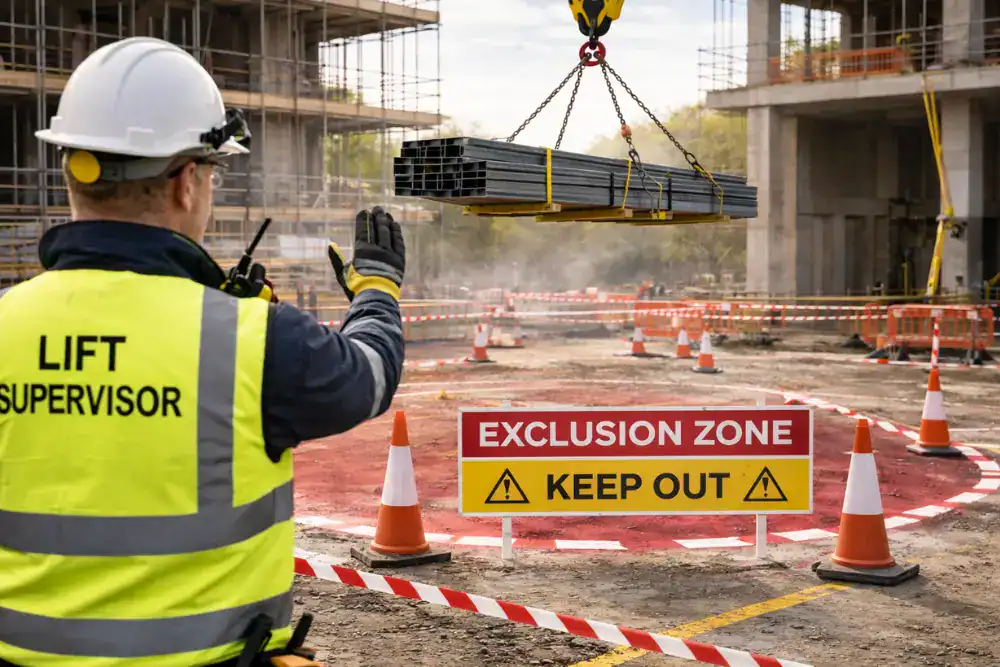
HSE’s planning guidance is clear. Where practicable, loads should be kept away from occupied areas. Where loads are suspended for significant periods, the area below should be treated as a danger zone with restricted access. The LOLER Approved Code of Practice goes further: where other measures may not be fully effective, a system must exclude people from the danger zone, and barriers and warning signs may be required (HSE, n.d.a; HSE, n.d.d).
The persistent weakness is design: zones are often set to satisfy a planning requirement rather than to hold under real site conditions.
A barrier placed across a route that people regularly use is likely to be moved. A zone boundary that cuts through an active walkway tends to be treated as temporary. A perimeter that forces an operative to walk much further to reach welfare facilities is likely to be ignored over time. Controls that create inconvenience tend to erode once production pressure builds. These outcomes are foreseeable — and should be identified at the planning stage.
The weakness with stop rules is different but equally predictable. Guidance from both the Construction Plant-hire Association (CPA) and HSE is clear on blind lifting: one nominated signaller, an agreed radio protocol, and a rule that the lift stops if communications fail (CPA, 2022; HSE, n.d.d). The difficulty is not that operatives are unaware of the rule. It is that they may lack the authority to invoke it.
On a site where the programme is under pressure, stopping the lift creates commercial pressure. The signaller has no authority to resolve it. The person closest to the risk may know exactly what the guidance requires and still hesitate if the organisational backing for their decision is unclear. The CPA documents how poor radio discipline — a product of competing demands, not a lack of training — can lead to lifting before hands are clear and lowering before people are clear of the landing area (CPA, 2022). These are predictable outcomes of how the work is organised under pressure.
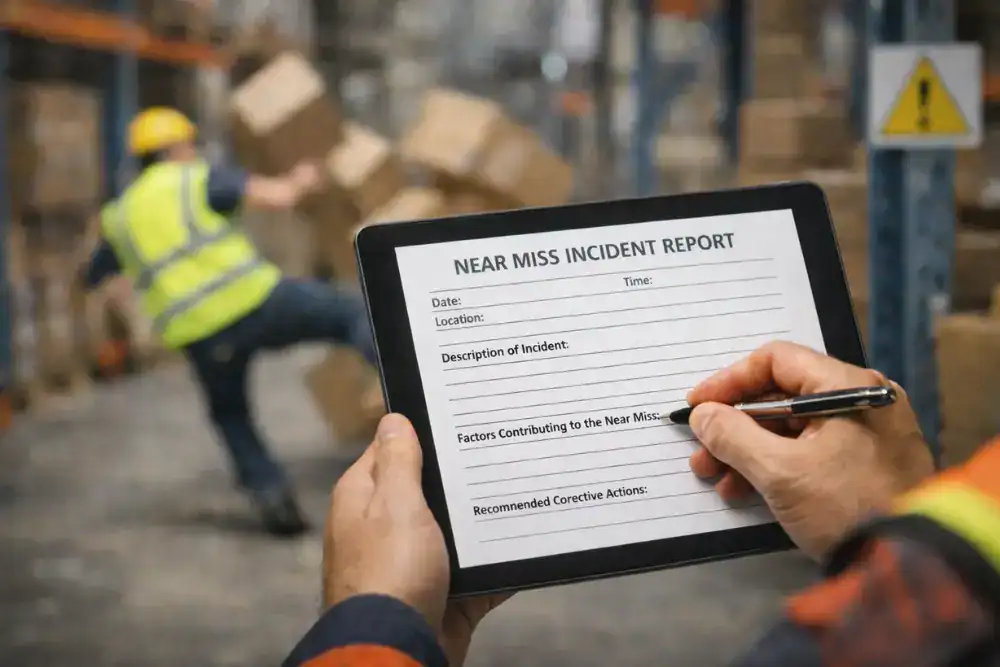
When a zone fails, post-incident review often focuses on the individual who walked through or the operative who left the barrier open. Both responses may misidentify the underlying failure. The more useful question is: why was the zone positioned so that leaving it open became the path of least resistance?
Exclusion zones must be designed around how people actually move, not around how they are expected to move. HSE guidance does not specify a universal minimum clearance distance. A defensible approach defines the zone around the credible movement and drop envelope:
- Potential swing, snag, and release dynamics
- The landing area and any overshoot
- Equipment slew and jib movement
- Any adjacent operations that could funnel people into the area
The aim is straightforward. People not involved in the lift should have no reason to enter the space and no easy way in. HSE’s workplace transport guidance states the principle plainly: no one should be in the loading or unloading area if they are not needed (HSE, n.d.f). Segregation beats awareness.
Controls hold better when enforcement is structural, not procedural:
- Physical barriers where practicable (not cones or tape in high-footfall areas).
- Defined access points, so entry requires a deliberate act rather than a casual step through.
- Sequencing the lift for when the area can genuinely be controlled, not at peak interface times.
- Explicit authority to stop the lift, with supervisory backing that is demonstrated, not merely written into the method statement
The CPA has published a fatality alert that illustrates what can happen when the load envelope is not adequately controlled. A load snagged during the initial stage of a lift. The sling overloaded and failed. The load fell onto the slinger and signaller. This is as much a planning and exclusion-zone failure as a rigging one — a foreseeable snag, a person within reach of a falling load, and a system that did not prevent the two from meeting (CPA, n.d.).
A planned load route reduces exposure before the lift starts. Clearly defined roles ensure someone always has authority over the move. The exclusion zone must be treated as a managed site condition, not an advisory boundary.
Training is most effective when it reinforces that structure. It should be targeted at the moments where lifts actually tend to go wrong. It works best as a support to physical controls — not a substitute for them. For those looking to build or refresh that underpinning knowledge, Lifting Operations Training covers the core principles relevant to planning, roles, and load control.