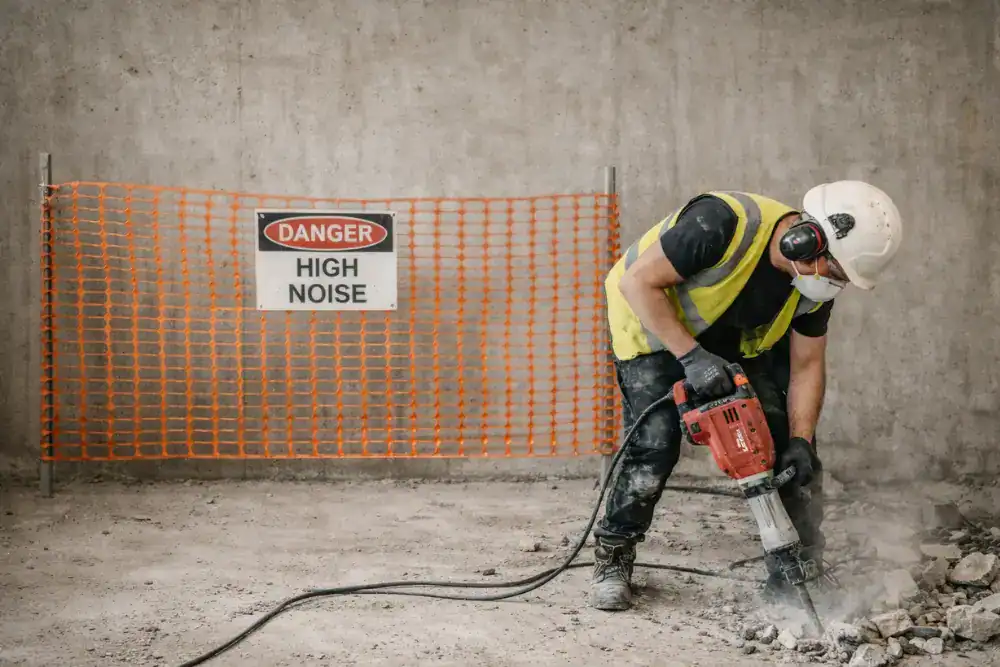
Noise risk assessments on small construction projects rarely fail because the forms are missing. They fail because small projects do not stay stable long enough for paper controls to hold. Scope shifts, resequencing and trade overlap mean exposure is shaped hour to hour by who is present, what is running nearby and whether yesterday’s controls still apply.
The conditions that make this hard are structural, not incidental. Small projects are shorter, more changeable and more subcontracted than the assessment assumes. Exposure is determined less by job titles and written tasks than by proximity, co-activity and how often short-duration jobs fragment unpredictably across the day.
The assessment is written at a point in time. By the time trades overlap, sequencing shifts or a subcontractor introduces unplanned noisy work nearby, it is describing a job that no longer exists. The exposure continues. The controls do not move with it.
This article explains why noise controls break down under change rather than on paper, and what keeps them functional when the plan no longer reflects the work.
Under the Control of Noise at Work Regulations 2005, as explained in HSE guidance L108 (HSE, 2005), a noise risk assessment must link three variables: how loud the noise is, how long exposure lasts, and who is exposed, including exposure to peak sound pressure.
The key thresholds are:
- Lower exposure action values:
80 dB(A) daily or weekly exposure; peak sound pressure of 135 dB(C)
- Upper exposure action values:
85 dB(A); peak sound pressure of 137 dB(C)
- Exposure limit values:
87 dB(A); peak sound pressure of 140 dB(C)
A detail that frequently undermines small-site noise management is that hearing protection must not be used to discount exposure when determining whether the lower or upper exposure action values have been reached. Hearing protection may only be taken into account when assessing compliance with the exposure limit value (HSE, 2005).
On small projects, this distinction is often lost when noise management collapses into a “PPE-first” approach. A plan that relies primarily on issuing ear defenders is not a noise control programme; it is a reliance on consistent wearing behaviour under pressure. Human factors and occupational health research shows that the reliability of personal protective equipment (PPE) is affected by comfort, compatibility with other PPE, intermittent use during short tasks and variable supervision — particularly on short-duration or multi-employer sites (Jones et al., 2013).
HSE guidance also recognises that construction noise exposure can vary markedly from day to day, and that weekly averaging may be appropriate in limited circumstances. Used without a clear rationale, however, averaging can obscure short-term exposure spikes rather than control them (HSE, 2005). HSE’s noise exposure calculators and ready-reckoners make the underlying logic transparent and straightforward to revisit when work conditions change (HSE, n.d.).
On paper, smaller jobs appear easier to assess: fewer people, fewer tasks, shorter duration. In practice, several organisational conditions make effective noise control less reliable.
Research into occupational safety and health (OSH) management in small and medium-sized enterprises (SMEs) shows that many formal systems assume stable conditions: time to plan, access to competent advice, continuity of supervision and repeatable work (Jones et al., 2013). Small contractors often rely on experience-led judgement because it fits the way the work is organised.
How this tends to fail in practice:
When work changes daily, judgment becomes difficult to validate. Noise assessments default to generic assumptions because there is limited time to map tasks realistically or to seek competent advice for higher-risk activities. Controls then gravitate toward what is easiest to specify — typically PPE — rather than what is most reliable under change.
On small projects, health risks such as noise exposure are frequently treated as secondary to immediate safety hazards, particularly under cost and programme pressure. UK construction research highlights knowledge gaps, misunderstanding of requirements and heavy reliance on PPE in SME contexts (Sunindijo, 2015). It also identifies a practical complication that dominates small works: a significant proportion of exposure is generated by other trades.
How this tends to fail in practice:
Noise assessments are written as if exposure is contained within one employer’s tasks, when in reality, exposure is mobile, shared and driven by co-activity.
Small sites often involve layered subcontracting, short-notice changes and rapid turnover. This weakens the translation between the assessment and the daily decisions that determine exposure — sequencing, proximity, time-on-task and who is present (Sunindijo, 2015).
How this tends to fail in practice:
The assessment exists, but it is not actively used to coordinate the work. Instruction to “wear hearing protection” becomes a stand-in for managing overlap.
ACAS guidance notes that employers with fewer than five employees are not required to record the significant findings of risk assessments, even though the duty to assess remains (ACAS, nd). On short-cycle construction work, this reduces the opportunity for learning between projects.
How this tends to fail in practice:
Each small job is treated as new. Noise management does not improve over time because the learning artefact does not exist.
From a work-design perspective, the purpose of a noise risk assessment on a small project is not precise exposure modelling. It is to produce controls that remain usable when the plan changes and triggers that survive trade overlap (Jones et al., 2013).
Job titles such as “carpenter” or “labourer” provide little insight into noise exposure. Exposure is driven by tasks such as cutting, drilling, breaking, grinding and impact fixing — and by who is within range at the time.
A more defensible assessment maps:
- Noisy tasks that are expected and those that commonly appear late
- Who is likely to be nearby when they occur
- Realistic durations and frequency, including repeated short bursts
- Potential for peak or impulsive noise
Failure mode to design for: assuming the job will run as planned. On small projects, it frequently does not.
Simple indicators, such as raised voices at approximately two metres, can help screen where better evidence is needed (HSE, 2005). Measurement or competent advice becomes particularly valuable where exposure may approach action values, peak noise is plausible, or multiple trades overlap.
Weekly averaging can be appropriate where exposure varies markedly, but only where it does not increase risk (HSE, 2005).
Noise control follows the hierarchy, but on small projects, the hierarchy has to work under space constraints, time pressure and a workforce that changes week to week. The controls below cover the full range relevant to small sites, from source reduction and distance through to health surveillance.
The most reliable control is one that does not depend on behaviour. Battery-powered and brushless tools, hydraulic rather than percussive breaking, and rubber-lined skips and chutes reduce source noise without requiring the operative to do anything differently. In practice, this breaks down when procurement is disconnected from planning. Tools are hired on cost and availability; quieter alternatives are not specified at the order stage, and by the time the job starts, the substitution opportunity has gone.
Distance is an underused control on small sites because it feels impractical when space is limited. The inverse-square law means that doubling the distance between the operator and the source reduces exposure by approximately 6 dB.
Remote-controlled demolition robots and long-reach attachments keep operators away from high-noise equipment entirely and are increasingly viable on confined urban sites where proximity risk is highest.
Where remote operation is not feasible, locating the noisy plant at the furthest workable point from occupied areas and positioning operators on the low-noise side of the equipment are controls that require planning rather than budget.
Published tool noise data frequently underrepresents real-world conditions. Dosimeters worn by operatives capture cumulative daily exposure and identify where the hierarchy is not controlling the action values, which tools noise tables cannot do.
On short-duration projects, a single monitoring exercise across a representative day is often enough to identify which tasks and trade combinations are driving exposure and to prioritise controls proportionately.
Some principal contractors on small commercial fit-out projects now use app-based sound level monitoring as a trigger for supervisory intervention when ambient levels exceed agreed thresholds, giving supervisors a real-time prompt rather than a retrospective finding.
Poorly maintained equipment is louder. Worn blades, loose fixings, failed anti-vibration mounts and unlubricated moving parts all increase noise output above the tool’s rated level. On short jobs, maintenance responsibility is often unclear: the tool is hired, the operative is subcontracted, and no one has explicit ownership. A pre-use check confirming blade condition, mount integrity and guard fitting adds minutes and removes a predictable noise escalation route. Some principal contractors include equipment condition in the site induction sign-off to create a named checkpoint.
Acoustic barriers and hoarding reduce noise reaching adjacent work areas and neighbouring premises. On small sites, temporary hoarding with acoustic-rated panels is increasingly common on street-level demolition and refurbishment work. Sequencing noisy and quiet tasks to separate trades by time rather than space is the more common control where physical separation is not possible. Both controls collapse under production pressure when sequencing decisions are made informally on the day. Sequencing that affects noise exposure needs to be written into the programme and supervised, not left to trade coordination on the morning.
Hearing protection is the last line of defence, not the first. Where it is required, the selection needs to be matched to the noise level. The Single Number Rating indicates the attenuation the device provides under test conditions, but real-world protection is consistently lower. HSE guidance applies a derating factor: for a device with SNR 30, assumed real-world protection is closer to 15 dB. That derating is routinely ignored when sites issue generic disposable earplugs as a default. For tasks at or above 100 dB(A), combined ear muffs and a half mask, or custom-moulded protection, is likely to be required.
Fit, storage and condition are where protection fails in practice. Poorly fitted earplugs, flattened ear cushions on reusable muffs, and ear defenders stored loose in site boxes deliver a fraction of their rated attenuation.
Reusable devices that are not cleaned regularly accumulate debris that degrades the seal and reduces effective attenuation further. A simple issue and inspection regime with clean, labelled storage, a defined cleaning schedule and a replacement interval for reusable devices removes most of that degradation without significant cost.
General noise awareness training changes attitudes; it does not reliably change exposure. Training that works on small sites is task-specific and covers:
- Which tools on this project require hearing protection
- What the daily exposure action values mean in practice
- How to fit and check the protection being issued
- Who to tell when noise levels change
Linking training to tool induction and the site-specific noise risk assessment gives operatives a decision framework rather than a generic instruction.
Where operatives are regularly exposed at or above the upper exposure action value of 85 dB(A) LEP,d, health surveillance is a legal requirement under the Control of Noise at Work Regulations 2005.
On small projects, it is frequently absent: either because the employer has not assessed whether the threshold is met, or because short contract durations create ambiguity about who carries the responsibility.
Audiometric records should travel with the operative, not sit with a single employer. Early threshold shift is detectable before it becomes a significant loss — but only if the testing happens, and only if results are tracked over time rather than filed and forgotten.
One of the most consistent weaknesses on small construction projects is the absence of a learning loop. Where jobs are short and documentation is minimal, controls do not improve across projects.
Capturing which tasks drove exposure, which controls held or collapsed, and why, is one of the few ways to make future assessments more realistic.
On small construction projects, noise risk assessment is tested not when the plan runs smoothly, but when sequencing changes, another trade arrives early, and short tasks fragment across the day. Where controls depend on a stable plan, exposure is left to chance, proximity and PPE use in the moment.
This pattern persists because there is an accepted substitute that feels proportionate to short-duration work: generic assumptions, a hearing protection rule and a signed form. It is quick, defensible and familiar. It is also fragile, because it relies on consistent behaviour and coordination in conditions that rarely support either.
What makes noise controls hold is not better paperwork, but task-and-time logic that reflects work as done, controls that tolerate instability, and coordination that actively manages co-activity. Training supports that system, but it cannot replace it.
If a noise risk assessment cannot tolerate resequencing, trade overlap and late scope change, it is not functioning as a control — regardless of how complete it looks on paper.
Human Focus supports organisations managing noise risk on small construction projects through a suite of hearing protection and noise awareness training. The training is designed to complement task-based risk assessment and day-to-day coordination, helping duty holders and supervisors recognise where exposure is actually created, how controls weaken under change, and how hearing protection fits into a wider control strategy — rather than standing in for it.