Ladder Inspection Checklists: What to Look For

ladder inspection checklist UK

Ladder inspection sits within the duties created by the Work at Height Regulations 2005 and PUWER 1998, but those duties are risk-based rather than a universal requirement for the same formal inspection regime for every ladder.

This article sets out what a formal ladder inspection must verify for each ladder type, where the predictable failure points in inspection quality lie, and what the system conditions are that allow defective equipment to remain in service despite an inspection record existing.

That gap between paper compliance and genuine control persists because the conditions in which ladder inspections actually happen are rarely reflected in how the process is designed. In many organisations, inspectors covering large inventories work under time pressure that rewards completion over depth. Borderline calls – on corrosion depth, locking mechanism wear, stile distortion – take time and confidence; under that pressure, a marginal pass can become the easier outcome.

Authority gradients reinforce this: an inspector without a clear organisational mandate may find the removal-from-use decision challenged when the equipment is needed and work is in progress. HSE’s enforcement record for falls from height consistently identifies failures at the management system level – inadequate planning, absence of a functioning inspection regime, unclear accountability – rather than attributing outcomes to a single missed defect. The problem is structural, not attentional.

Both pieces of legislation make competency a condition of compliance, not an optional enhancement – a point the checklists and analysis below are designed to support.

Key Takeaways

  • A completed inspection record and a competent inspection are not the same thing. Most organisations have the first. The difference is invisible until something fails.
  • The removal-from-use decision is often where the inspection system either works effectively or breaks down. Where organisational mandate is unclear, inspectors under site pressure may default to the easier outcome rather than the correct one. That is a management system problem, not a training problem.
  • The items most likely to be passed at marginal condition are not the obviously broken ones. They are the ones where failure only appears under dynamic load — worn locking mechanisms, deformed braces, hinge play — none of which a static visual check can reliably detect.
  • Training is a necessary condition for reliable inspection, not a sufficient one. An inspector who completes a course and returns to a programme without authority, workload support, and a corrective action system that closes findings is likely to reproduce the same marginal-pass patterns — just with a certificate on file.

Are Ladder Inspections a Legal Requirement?

Ladder inspection is a legal duty that many organisations fulfil on paper without meeting in practice. Two pieces of legislation define what that duty actually requires.

The Work at Height Regulations 2005 require employers to ensure that equipment which may deteriorate is subject to regular inspection. Equipment must also be inspected after any circumstances that could affect its safety, including damage, modification, or a change in working environment (HSE, 2005).

PUWER 1998 applies the same underlying principle to ladders as to other work equipment: they must be suitable, maintained, and inspected where risk requires it so they remain safe for use (HSE, 1998).

Both sets of regulations make competency a condition of compliance, not an optional enhancement. An inspection conducted by someone without the requisite knowledge does not fulfil the legal duty, regardless of what the record shows. In practice, this means that an organisation relying on inspection records as its primary evidence of compliance – without verifying who conducted the inspection and to what standard – may be producing documentation rather than exercising control

Pre-Use Checks vs Formal Inspections

Pre-use checks and formal inspections are not the same thing, and conflating them is a common source of under-inspection.

A pre-use check is a brief visual assessment carried out daily, or before each use. It identifies obvious defects – a visibly bent rung, missing feet, a damaged locking mechanism – and it should be completed by the person using the ladder. It does not need to be formally recorded and is not designed to assess structural integrity in any depth.

A formal inspection is a structured, recorded assessment of the ladder’s condition and fitness for use. It is periodic, conducted by a competent person, and covers every significant component systematically. It must be documented, and the record must be accessible for review.

The failure mode to watch for is the conflation of these two levels of check. When organisations treat a pre-use check as equivalent to a formal inspection, or allow formal inspections to be conducted by people trained only for pre-use assessments, the inspection record looks complete while the underlying risk remains unmanaged. This article is about formal inspections. Pre-use checks remain essential but are not a substitute for periodic, competency-led assessment.

Why Inspector Competency Determines Whether Your Checklist Works

A checklist does not create competence. Competence allows a checklist to function properly. This distinction matters operationally, because the failure mode of incompetent inspection is not obvious – it looks identical to effective inspection until the moment a fault that was missed causes an incident.

Consider what distinguishing corrosion from cosmetic surface wear actually requires. Corrosion that affects structural integrity can be visually subtle, particularly on aluminium. An inspector not trained to check by feel, as well as sight, may pass equipment that a properly trained inspector would withdraw.

The same applies to structural distortion: recognising bowing or twisting that indicates compromised load capacity requires an understanding of how those components behave under load – not just what they look like.

Knowing when a repair invalidates a ladder’s certification – rather than restoring it to an acceptable standard – is another area where technical awareness is decisive and where an underprepared inspector may lack a reliable framework for the decision.

The highest-stakes judgement an inspector makes is the removal-from-use decision itself. Without confidence in their own technical assessment, inspectors may default to the lower-risk outcome: keeping the ladder in service, hedging the assessment with qualified language, or deferring the decision to someone else.

That deferral is not simply an individual failing – it is a system vulnerability. The removal-from-use decision is where authority gradients become visible: an inspector without a clear organisational mandate may find that decision challenged, reversed, or quietly shelved when the equipment is needed, and site pressure is on.

Research on safety-critical decision-making consistently identifies hierarchy and production pressure as the conditions under which marginal findings are normalised rather than acted on (Rasmussen, 1997). Ladder inspection is no different.

Competence is not solely an individual attribute – it is also an organisational one. An organisation demonstrates competence in ladder inspection through its ability to select and appoint people with the right knowledge, ensure they receive appropriate training, provide the authority and workload conditions to inspect properly, and review inspection quality to confirm the system is functioning rather than merely generating records. Without those conditions, individual training alone is unlikely to be sufficient.

Where under-inspection becomes systematic, inspections can become an administrative function rather than a risk control measure: records are produced, but risk is not effectively managed.

What to Record Before You Begin

Reviewing previous records before starting is particularly important: an inspector who does not check prior findings cannot identify developing faults across multiple inspection cycles. This stage is most likely to be skipped when an inspector is working under time pressure or fitting rounds around operational schedules – precisely when a pattern of marginal findings is most likely to go undetected.

Before beginning any formal inspection, capture the following.[2.1]

  • Inspector name
  • Date and inspection interval
  • Equipment ID: make, model, and serial number (usually marked on the ladder)
  • Ladder type and material (aluminium, fibreglass, or wood)
  • Location of the ladder and the person responsible for it
  • Previous inspection records, including dates, results, and who conducted them

A ladder that has generated repeated marginal findings across multiple inspection cycles but has never been removed from service is more likely to carry a developing fault than its current condition alone would suggest. That pattern is only visible if previous records are reviewed before starting.

Leaning Ladder Inspection Checklist

These are the components most likely to carry developing faults – and the ones most likely to be missed when an inspector is under pressure or uncertain about what “marginal” actually means. Each item is followed by a note explaining where things tend to go wrong in practice – not edge cases, but the failure modes that most commonly go undetected. Understanding what to look for behind each item is what separates a competent inspection from a completed form.

Overall condition

☐ No obvious damage, distortion, or unauthorised modifications

☐ No signs of twisting or bending

☐ No excessive wear

Overall-condition assessments can fall short when they become a single general impression rather than a structured check. Under time pressure, there is a tendency to resolve ambiguity in favour of passing: a ladder that “looks fine” may be recorded as acceptable even where individual components warrant closer attention. The condition check should prompt component-by-component scrutiny, not replace it.

End caps and feet

☐   All end caps and feet present

☐   Intact and securely fixed

Missing or worn feet are one of the most frequently overlooked withdrawal criteria, not because inspectors cannot see them, but because the failure consequence – ladder slip at base – feels less immediately structural than a cracked rung. The risk is underestimated because it is use-condition dependent: a worn foot that performs adequately on rough concrete will fail on a smooth floor.

Stiles

☐    Straight: not bowed or twisted

☐    Free from dents, splits, and corrosion

☐    All fixings in place and secure

Corrosion on aluminium stiles is frequently recorded as “surface only” when it has already begun to compromise section strength. If you cannot determine depth by visual inspection alone, that is a removal-from-use decision, not a marginal pass.

Rungs

☐    No rungs bent, split, missing, loose, or excessively worn

Loose rungs are commonly identified but passed on the assumption that the fixing can be tightened in the field. The failure mode is that a rung that is loose under hand pressure will move under dynamic load – particularly under the weight of a person shifting position. Unless the fix can be completed and verified before next use, a loose rung is a withdrawal criterion, not a maintenance note.

Locking mechanisms (extension ladders)

☐    Not bent or damaged

☐    Fixings secure

☐    Lock and unlock correctly: any mechanism requiring force to engage, or showing visible play, is not functioning within tolerance

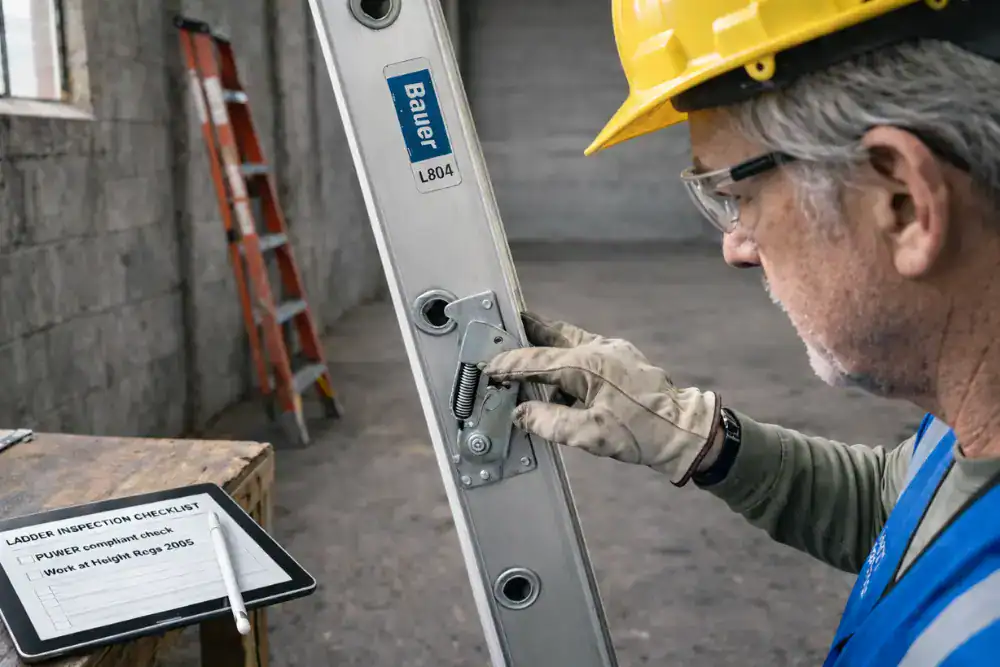
Inexperienced inspectors commonly pass locking mechanisms that engage under hand pressure but have accumulated wear: the lock indicator shows “locked” but the section moves under load. Manual play-testing – not visual inspection alone – is required to confirm function. This is the test most likely to be abbreviated when an inspector is under time pressure, and the most consequential one to miss.

Guide brackets

☐    Present and undamaged

☐    Securely attached: all fixings in place

☐    Operating correctly

☐    Free from dirt or corrosion that could restrict movement

Guide bracket defects are regularly underweighted because their failure is not immediately obvious in a static inspection: a bracket that appears adequate will allow sections to skew or bind under load. Corrosion or dirt that restricts movement tends to be recorded as a maintenance observation rather than a withdrawal criterion. If the bracket does not operate freely through its full range, the inspection is incomplete.

Accessories (stabilisers, tie straps, etc.)

☐    All accessories present and in working order

Missing accessories are frequently recorded as non-critical because the ladder appears functional without them. The failure is use-context dependent: a stabiliser that was issued for a specific deployment becomes critical the moment the ladder is used on an uneven surface. If accessories cannot be accounted for and confirmed serviceable, their absence should be treated as affecting fitness for use.

Functional check

☐    Ladder set up in 4:1 position: stable and solid

☐    Extension ladder extends and locks into position reliably (extension ladders only)

The functional check is the item most likely to be skipped under time pressure, because it takes longer than a visual pass, and there is no obvious failure consequence on paper if it is omitted. An inspection that does not include a functional check has not confirmed fitness for use – it has confirmed that the ladder appears intact at rest.

Stepladder Inspection Checklist

Stepladder faults tend to accumulate gradually – locking devices worn rather than broken, back legs slightly out of true, platforms that open but do not quite seat correctly. Each item individually may look serviceable; collectively, they can produce a ladder that is unstable under real working conditions. The inspection pattern that misses these faults is one that looks for obvious failures rather than assessing component function under load.

Overall condition

☐    Opens and closes smoothly: resistance or catching warrants investigation

☐    No obvious damage or unauthorised modifications

Resistance during opening is commonly attributed to storage or temperature and recorded as non-critical. The failure mode is that a stepladder that opens with difficulty under controlled conditions is likely to be forced open on-site, which risks damaging the hinge mechanism or misaligning the locking geometry. Any resistance should prompt closer inspection of hinges and locking devices before clearance.

Feet

☐    All feet present, secure, undamaged, and sufficiently clean to provide grip

Treads

☐    All treads in place, not bent or modified, and securely affixed

Platform

☐    No cracks, bends, dents, or creases

Back legs and rails

☐    Straight, in good condition, and securely affixed

☐    No corrosion: particular concern on equipment stored in damp environments

Surface corrosion on the back legs is consistently underweighted during inspection because it does not look dramatic. Pitting corrosion on a back rail that carries load when the ladder is in use is a structural concern, not a cosmetic one. The failure to withdraw on this criterion typically reflects both insufficient training and the absence of any organisational prompt that makes corrosion depth a decision point rather than an observation.

Braces and struts

☐    Present, undamaged, and not modified

☐    No bending or deformation: any change to brace geometry compromises loaded stability

Brace and strut deformation is the defect category most commonly passed as “minor”. The failure mode is not visible during static inspection: a brace with slight deformation will produce racking under dynamic load – when a person moves on the ladder rather than stands still. Inspectors trained to treat deformation as a withdrawal criterion regardless of degree will make a different decision here than those relying on visual impression.

Hinges and fixings

☐    All hinges and fixings in place, undamaged, not corroded or worn, and secure

Hinge wear is the failure that accumulates invisibly across many inspection cycles and is almost never the item that triggers withdrawal. A hinge that functions correctly at low load will allow play under real working conditions. The inspection requires each hinge to be tested through its full range of movement, with particular attention to any looseness at the pivot. Play that cannot be eliminated by tightening the fixing is a withdrawal criterion; the classification of acceptable vs unacceptable play requires an inspector who knows what the standard feels like.

Locking and restraint devices

☐    In place, undamaged, and engaging correctly

☐    No excessive wear: a restraint that is worn but technically functional may fail under dynamic load when someone moves rather than stands still

Worn locking and restraint devices are among the most common items passed at marginal condition. The failure mode is not static collapse – it is movement under load, which often only becomes apparent when the ladder is in use.

Functional check

☐    Ladder stable and solid when set up: any movement, racking, or instability under load is a failure

Telescopic Ladders: Additional Risks

Telescopic locking systems are the most inspection-sensitive component type across all ladder designs – and the failure mode is rarely visible to someone who does not know what to test for.

Overall condition

☐    No obvious damage, twisting, bending, or excessive wear

☐    No corrosion or unauthorised modifications

End caps and feet

☐    Present, intact, securely fixed, and sufficiently clean

Stiles and telescopic sections

☐   Each stile and section straight: not bowed, twisted, dented, cracked, or crushed

☐   Sliding surfaces clean: dirt or debris affects how sections move and whether they lock reliably

☐   No cracks, distortion, or damage at section joins

☐   No loose or missing fixings around joins

Rungs

☐    No rungs split, missing, bent, loose, or excessively worn

Locking mechanisms

☐    All locks in place, not bent or damaged, not excessively worn or corroded

☐    Fixings secure

☐    Lock and unlock as they should: any lock with visible play under manual testing is not functioning correctly

Release mechanisms

☐    Release buttons, levers, and catches undamaged and clean

☐    Operating smoothly: any mechanism requiring excessive force will be forced, which is a predictable route to premature section collapse

Guide brackets/slide guides

☐    Present, undamaged, securely attached

☐    Free from dirt or corrosion that could restrict movement

Accessories (stabilisers, stand-off bars, wall pads, carry straps, etc.)

☐    All accessories present and in working order

What to Do If a Ladder Fails Inspection

The inspection is only part of the system. What happens after a failure is equally important – and is where many organisations fall short. The immediate step is straightforward; the system failure is in what follows.

If a ladder is unfit for use, it must be taken out of service immediately. This means clearly marking it as unsafe, separating it from equipment in active use, and, where possible, securing it so it cannot be picked up and used by someone who was not present for the inspection.

The risk is predictable: colleagues who were not party to the inspection decision tend to act on what they see, not what they cannot see. In practice, an unmarked ladder removed from a rack and placed to one side can be indistinguishable from one that has been staged for use. Physical segregation is not bureaucratic caution; it is the control that makes the removal decision hold.

Where organisational mandate is not clearly established, inspectors can find the removal-from-use decision challenged or reversed when equipment is needed and work is in progress. This is a system design problem, not an individual one. The organisation needs to have established, in advance, that removal-from-use decisions are binding and not subject to informal reversal by site personnel.

Once out of service, the ladder needs a resolution – not just a status. Simple maintenance (lubricating moving parts, tightening fixings, cleaning, or replacing feet) can often be completed in-house, but only in line with manufacturer instructions.

More complex repairs – replacing structural components – should not be attempted without appropriate qualification, and in most cases, a repair will affect the standard to which the ladder was originally certified. The Ladder Association’s exchange scheme provides a practical disposal route where applicable (Ladder Association, 2021).

There must be a system for tracking corrective actions through to completion. A ladder removed from service, logged as requiring repair, and then lost in the system is not managed – it is parked. In practice, a ladder in that situation is likely to re-enter service, or someone may use it regardless. Neither outcome represents a functioning inspection programme.

Corrective action tracking is where the gap between documented intent and operational reality is most clearly visible. The reason this gap tends to go undetected is that the original inspection record shows a clean withdrawal decision – the equipment was identified and removed – which creates the appearance that the issue was managed, when in practice the resolution was never completed.

How Often Should Ladders Be Inspected?

The law does not prescribe fixed intervals. The Work at Height Regulations 2005 require inspections to be conducted at suitable intervals, determined by the employer based on manufacturer guidance, the type and volume of use, and the environment in which the ladder operates (HSE, 2005).

In practice, general-purpose working ladders are often inspected every three to six months, and ladders forming part of a scaffold system must be inspected every seven days as part of the scaffold inspection process. These should be treated as starting points, not defaults.

A ladder used daily in a harsh environment on a busy industrial site warrants a more frequent cycle than one used occasionally in a dry, controlled setting. Risk assessment and manufacturer guidance should determine the interval, and that determination should be documented.

What matters operationally is not only that an interval is set, but that it is reliably met. Inspection schedules that exist on paper but are routinely deferred under operational pressure do not function as controls. Where deferral is occurring, the cause is usually workload or scheduling rather than intent, and the remedy is a realistic inspection programme, not a reminder.

Why Ladder Inspections Fail Despite Completed Records

The organisational failure that makes ladder inspection a paper exercise rather than a risk control measure is rarely a lack of process. Most organisations have inspection forms, schedules, and records. The failure is that the process is disconnected from the conditions under which inspections are actually conducted.

Consider what a normal inspection round looks like in practice. An inspector covering twenty or thirty ladders across a site – or fitting rounds across multiple locations into a morning – is not an unusual scenario. In under-resourced programmes, paperwork is sometimes completed retrospectively, and inspections are fitted around operational schedules rather than the other way around. Under these conditions, marginal items are recorded as acceptable because a borderline call takes time and confidence, and the system routinely provides neither.

This is not a description of individual carelessness. It reflects how inspections can operate in organisations where programmes are under-resourced, and the system has to account for that load rather than assume quality is independent of it. Research on safety-critical inspection systems consistently finds that detection reliability is a function of training quality, workload, and the organisational conditions in which inspectors operate – not simply of individual diligence (Rasmussen, 1997).

The controls that hold in practice share a common characteristic: they are anchored in competence and authority, not paperwork alone.

  • Inspectors know what they are looking for and why, including the specific failure modes that commonly produce marginal calls.
  • Removal-from-use decisions are made from a position of organisational mandate, not deferred because someone else needs the equipment this afternoon.
  • Management response to a failed inspection supports the decision rather than eroding it.
  • Corrective actions are tracked to completion, not logged and forgotten.

A completed checklist that does not trigger corrective action when faults are present does not meet the intent of the law (HSE, 2005; HSE, 1998). An inspection record that exists but reflects no genuine technical assessment is, at best, a document trail. At worst, it creates false assurance that equipment has been verified when it has not.

Inspection frequency, form design, and documentation systems are all necessary. None of them replace the judgement of someone who actually knows what a failing locking mechanism looks, feels, and behaves like – and who has the authority to act on that judgement.

Ladder Inspection Training: How Human Focus Supports Compliant Programmes

Inspection reliability is a product of training quality, clear authority structures, and a management system that tracks corrective actions to closure. This is the argument the preceding sections have made: training is necessary but not sufficient. An inspector who completes a course and returns to a programme without organisational mandate, realistic workload, and management backing is likely to reproduce the same marginal-pass patterns within weeks. Human Focus addresses both conditions.

Ladder Inspection Training

Human Focus Ladder Inspection Training covers the legal requirements under the Work at Height Regulations 2005 and PUWER 1998, component-by-component inspection for leaning ladders, stepladders, and telescopic ladders, the specific fault types that inspectors most commonly miss, and the removal-from-use decision and corrective action process. The course includes an integrated e-Checklist, producing a structured inspection record that supports the organisation’s compliance obligations and closes the gap between documentation and genuine risk control.

Ladder Safety Training

Inspection cannot function in isolation. Human Focus also provides Ladder Safety Training for all employees who use ladders, covering safe setup and use, pre-use checks, and hazard awareness. The course e-Checklist enables corrective actions to be logged and supervisors to be notified, connecting user-level observations directly to the wider management system.

About the author(s)

Human Focus Editorial Staff comprises a dedicated collective of workplace safety specialists and content contributors. The team shares practical guidance on human factors, risk, and compliance to support safer, more effective workplaces.

Share with others
You might also like

Popular Courses

GDPR Awareness Training Course
GDPR Training
View Course Details
LOTOTO online training course
Safe Isolation – Lock Out, Tag Out, Try Out (LOTOTO) Training
View Course Details
IOSH Managing Safely
IOSH Approved Managing Safely e-Learning
View Course Details
spill kit training
Spill Kit Hazardous Substances Training
View Course Details
Legionella Risk Assessment Training
Legionella Risk Management Principles for Responsible Persons
View Course Details

Recent Articles

DSE risk assessment for managers
DSE Risk Assessment: What It Involves and Why It Creates Ongoing Management Work
harness inspection faults
What Are the Most Common Harness and Lanyard Defects Found During Inspection – and Why Are They Often Missed?
Noise Risk Assessment on Small Construction Projects
Noise Risk Assessment on Small Construction Projects: Why Controls Fail Under Change, Not on Paper
employer face fit testing duties
Face Fit Testing Responsibilities for Employers
Top-Rated Health and Safety Training Programs for SMEs

Current Offers

near miss reporting for effective learning
Managing Near Miss Reporting for Effective Learning

Original price was: £895.00.Current price is: £595.00. +VAT

Sustainability and Environmental Management Training
Sustainability & Environmental Management Training

Original price was: £895.00.Current price is: £595.00. +VAT

Icon-PNG
Home Working Bundle Pack (4 in 1)

Original price was: £100.00.Current price is: £49.00. +VAT

driving for work
Driver Training Pack (5 in 1)

Original price was: £100.00.Current price is: £60.00. +VAT

driving for work
Highway Code Updates Awareness Training

Original price was: £25.00.Current price is: £15.00. +VAT