This IIRSM-approved online Ladder Safety Training course ensures employees understand how to safely set up and use ladders at work.
The course provides essential training on setting up, placing and working safely from ladders. It includes practical guidance for managing hazards and preventing accidents during ladder use. A digital ladder safety checklist is also included to support users in applying their knowledge before starting work.
This course is approved by the International Institute of Risk & Safety Management (IIRSM).
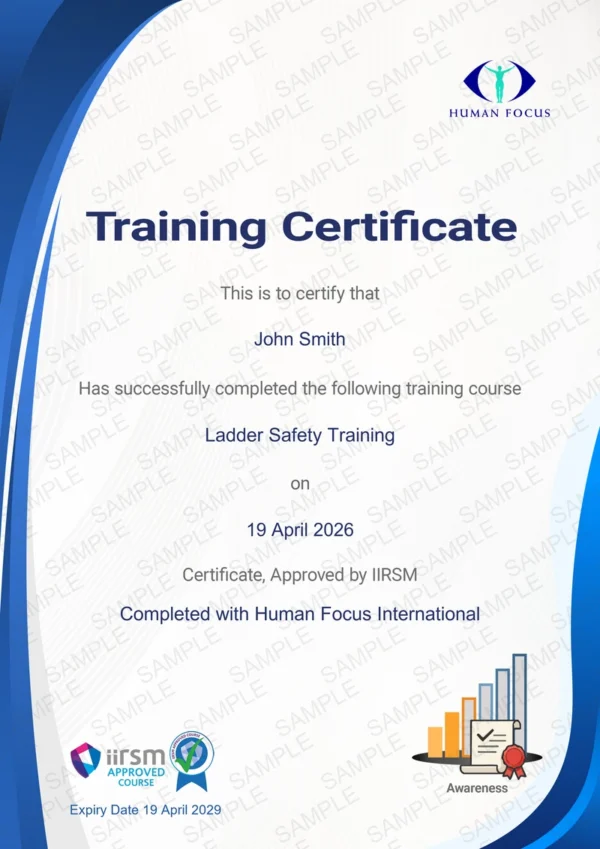
The course certificate includes:
User name
Company name
Course name
Completion date
Expiry date
Approval body
An IIRSM-approved certificate will be available for download and printing instantly upon course completion.
Users must complete an assessment before earning their certificate.
The end-of-course test is:
Fully online
Multiple choice
A score of 80% is required to pass.
Ladder Safety Course e-Checklist
This online training course includes a free ladder safety e-Checklist.
The e-Checklist helps users apply their knowledge and stay safe when working with ladders. It has two sections.
The first section reviews key safety principles. The second guides workers through the pre-inspection process. Required corrective actions can be logged directly on the e-Checklist, with notifications sent automatically to supervisors.
Completed checklists can be linked to QR codes for instant access to inspection records. Workers can confirm the ladder passed its last inspection and remains safe to use.
Note – This offer is for one Ladder Safety Training e-Checklist licence per trainee who completes this course. This e-Checklist licence is for their use and cannot be transferred or shared by other users.
Terms and conditions apply – access to this e-Checklist is for 12 months from purchase.
Customer Feedback
Why is a Ladder Safety Course Important?
Ladders are a common factor in workplace accidents. According to the Health and Safety Executive, around 8% of all reported non-fatal workplace injuries are the result of a fall from height, often a ladder.
Ladder accidents are often the result of human error. Typical mistakes include setting up ladders at the wrong angle, using the wrong type of ladder and neglecting pre-use inspections. Untrained workers also often overreach while working from a ladder or carry objects while climbing.
This ladder training course for workplaces equips individuals with the essential knowledge to select the right ladder for the task, check it for faults and position it correctly. The course covers how to use a ladder safely and avoid accidents and injuries caused by falls from heights.
Are You Aware of Your Responsibilities?
Employers have a legal duty to ensure workplace safety. The Health and Safety at Work etc. Act 1974 and the Management of Health and Safety at Work 1999 regulations require employers to identify and control workplace risks, including the risk of working at height. Under these regulations, they must also provide adequate safety training to employees.
Additionally, the Work at Height Regulations 2005 provides specific guidelines for setting up, using and handling ladders safely. The Provision and Use of Work Equipment Regulations (PUWER) 1998 also relates to ladder safety. PUWER requires employers to ensure all work equipment, including ladders, is suitable and in safe working order.
This online ladder awareness training course provides vital information that anyone working with ladders must know. It covers how to select, set up and work from ladders safely. This includes guidance on pre-use checks and ladder transport and storage to ensure equipment is maintained in good condition.
The course includes a free ladder safety e-Checklist. Users can follow the checklist to ensure ladders are safe and suitable for their work.
Frequently Asked Questions
This ladder safety awareness course explains how to safely use ladders for low-risk tasks. It covers ladder selection, placement and set-up. It also walks through pre-use inspections and looks at what workers need to know about a ladder risk assessment.
Ladder awareness training is essential for anyone who works with ladders, including construction workers, maintenance workers, warehouse workers, and tradespeople. This course provides essential awareness and outlines ladder safety tips users must follow to reduce the risk of workplace accidents.
Yes. Our Ladder Safety course covers a wide range of ladder types, including step ladders. Users learn about the safety considerations and best practices associated with using multiple ladder types in different work environments.
Our ladder safety course is priced at £25.00 +VAT for individual users. Discounts are available for bulk purchases.
This ladder training certificate is valid for three years. After this time, you must retake the training to renew your certification and refresh your knowledge.
All Human Focus courses are certified or approved by an independent health and safety body to guarantee quality and accuracy. This Ladder Safety eLearning course is approved by IIRSM (the International Institute of Risk & Safety Management).
It can help. A record of ladder awareness training can support the training evidence in an SSIP application where ladder use is relevant to your work. The assessment also considers wider health and safety arrangements, qualifications and experience. Completing this course alone does not secure SSIP approval. Check the chosen scheme’s evidence requirements.
UK ladder safety regulations sit across several laws and require employers to ensure ladder users are competent or, while being trained, supervised by a competent person. Training must suit the task, and course completion alone does not establish competence. The main regulations are listed below.
Use a ladder only when a ladder risk assessment shows it is suitable and equipment offering greater fall protection is not justified. Low-risk tasks of short duration may qualify, but duration alone is insufficient. The ladder must be level, stable and capable of being secured where reasonably practicable. Consider the task, location and working conditions.
Understanding how to use a ladder safely starts with selecting suitable equipment, carrying out a pre-use check and following the manufacturer’s instructions. Position the ladder on firm, level ground and secure it appropriately. Set a leaning ladder one unit out for every four units up. Maintain three points of contact when climbing and avoid overreaching.
The user should carry out pre-use ladder safety checks at the start of each working day and after changes that could affect safety, such as dropping the ladder. Employers should also arrange recorded detailed visual inspections by a competent person at regular intervals in line with the manufacturer’s instructions. Pre-use checks and detailed inspections serve different purposes. For more detail, see our guide on how often ladders should be inspected.
A ladder safety checklist should cover the stiles, feet, rungs and locking mechanisms. For stepladders, check the platform, steps and treads too. Look for damage, wear, loose parts and slippery contamination, and ensure locking devices engage properly. If you find a defect that affects safety, do not use the ladder and report it to the person in charge
Yes. This online ladder safety course and its multiple-choice assessment are fully online and accessible on a desktop, tablet or mobile device. The course duration is 55+ minutes. A score of 80% is required to pass, after which the digital certificate is available to download and print. Employers must still ensure users can apply their knowledge safely at work.
In Great Britain, the Work at Height Regulations 2005 govern planning, competence and equipment selection for safe ladder use. The Provision and Use of Work Equipment Regulations 1998 also apply to equipment suitability, maintenance and training. Northern Ireland has corresponding Work at Height Regulations (Northern Ireland) 2005 and Provision and Use of Work Equipment Regulations (Northern Ireland) 1999.
If ladder safety checks reveal a defect, stop and do not use the ladder. Report it to the person in charge and keep it out of use until it has been made safe or replaced. Follow the manufacturer’s instructions and your employer’s arrangements for dealing with defective equipment. Do not improvise repairs.