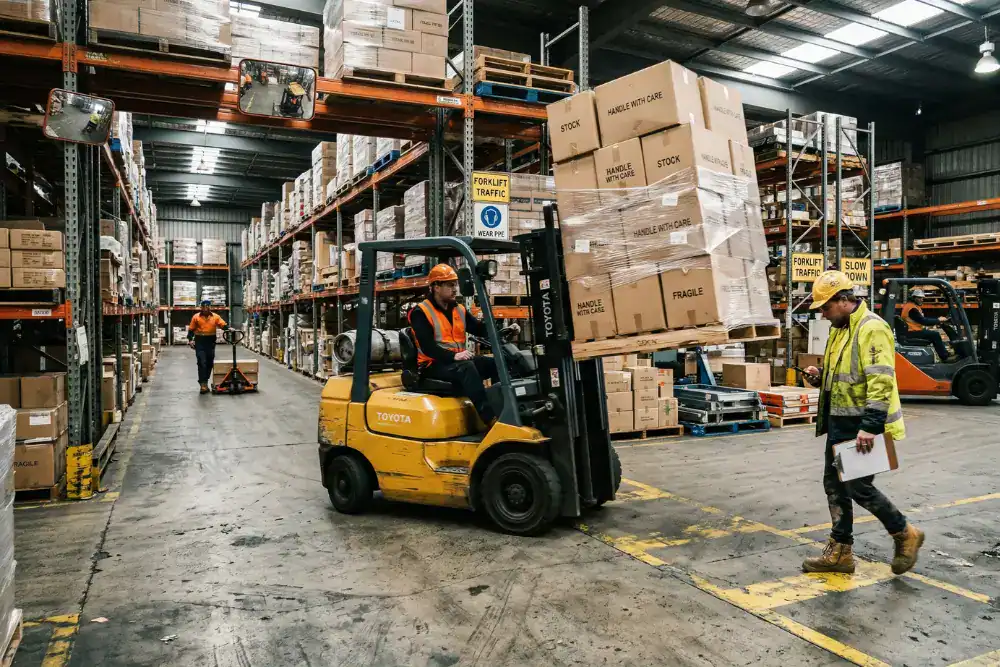
If your warehouse relies on painted lines, high-visibility clothing and driver awareness as the main controls for forklift–pedestrian interaction, your struck-by risk is being managed by attention, not by design. When production pressure rises — and it will — that control will degrade. The same applies to falling-load risk: if pallet quality, truck capacity and racking condition are not managed as a connected chain, a single weak link is enough to cause a failure.
Being struck by a moving vehicle remains one of the main kinds of work-related fatal accidents in Great Britain (HSE, 2025a). Forklift trucks are among the most common vehicles involved. HSE enforcement and investigation records consistently show that these incidents are not adequately explained by individual error alone. They are shaped by site layout, traffic route design, load-handling arrangements and the degree to which production pressure is allowed to override the controls in place.
This article explains why forklift struck-by incidents follow predictable patterns, what the regulatory and guidance framework requires, where the most common control failures occur, and what system-level controls reduce the likelihood of collisions and falling loads in warehouse operations.
When forklift struck-by incidents are investigated, the immediate cause is often recorded as a momentary lapse: a driver who did not see a pedestrian, a load that shifted during transit, or a rack that had been damaged but not reported. These immediate causes are rarely the full explanation. In most cases, the conditions that made the incident possible were present well before the event itself.
HSE has been explicit that workplace transport fatalities follow predictable patterns: reversing in shared space, poor visibility, missing or failed aids and weak traffic management basics (HSE, 2025b).
Three factors explain why these patterns persist in warehouse environments.
Warehouse operations are driven by throughput. Routes that were designed for one volume are used at another. Temporary arrangements become permanent. Crossing points shift as pick faces are reorganised. Under dispatch pressure, informal workarounds — cutting through vehicle zones, tolerating mixed movement in goods-in areas, skipping pre-use checks — become normalised because the work demands it and the consequences are not immediately visible.
If the primary control is a painted line, a rule about looking both ways, or a driver’s expectation that pedestrians will stay out of the aisle, that control is competing with noise, fatigue, time pressure and the cognitive demands of the task. Controls that require sustained perfect attention in a dynamic environment will be breached — not because people are careless, but because the control is mismatched to the conditions.
Recent HSE prosecutions demonstrate the consequences when system controls are inadequate:
- Pedestrian access inside vehicle operating areas. HSE reports that on 11 December 2023, an employee was run over and dragged by a forklift while unloading at a dockside (HSE, 2025c). The system issue is a common one: people working in the same space as moving plant, with no reliable separation in place.
- Visibility treated as a driver problem. HSE reports that on 24 November 2021, a worker was struck by a forklift because the driver’s view was obscured by the load. The investigation identified failures to manage forklift operations and pedestrian routes (HSE, 2026).
- Mixed movement in high-congestion areas. HSE prosecuted a textiles business after a worker using a pallet truck was hit by a telescopic handler in a goods-in area. The investigation concluded that vehicle movements were not properly managed (HSE, 2025d).
These cases are not exceptional. They represent what happens when the control strategy is to share the space and rely on experience to fill the gaps.
UK regulatory expectations are clear. Regulation 17 of the Workplace (Health, Safety and Welfare) Regulations 1992 requires traffic routes to be organised so that pedestrians and vehicles can circulate safely, with sufficient separation between them (UK Government, 1992).
HSE’s workplace transport guidance makes the same point in operational terms: separate roadways and footpaths wherever possible, protect people near vehicle routes and design pedestrian routes along the lines people will actually follow rather than where the site plan assumes they will walk (HSE, 2021a).
In warehouse environments, effective separation typically requires (HSE, 2021a):
- Defined pedestrian-only areas and vehicle-only areas
- Physical barriers, guard rails or kerbs between pedestrian and vehicle routes
- Controlled crossing points where routes must intersect
- Separate doors for pedestrian and vehicle access
- Access control to keep people out of vehicle work zones unless they have a specific operational reason to be there
Segregation controls fail in predictable ways. Understanding these failure modes is essential to maintaining effective separation over time:
- Barriers become obstacles when operations change. A barrier that made sense in the original layout becomes an impediment after re-slotting, peak volume increases or a new pick face configuration. People begin to cut through because the system has made the safe route inefficient.
- Painted lines are treated as separation. Floor markings are an administrative boundary that relies on constant compliance. They are not a physical control and will be breached when the work is time-critical.
- Crossings are designed for compliance rather than workflow. If the designated crossing point is significantly further from the natural work path, the work path will take precedence.
- Temporary arrangements become permanent. HSE’s INDG199 guide explicitly warns that temporary traffic routes must meet the same safety requirements as permanent routes. In practice, temporary reconfigurations frequently escape that discipline (HSE, 2013a).
A useful test for any segregation arrangement: if high-visibility clothing were removed tomorrow, would the layout alone still prevent routine pedestrian–vehicle interaction? If the answer is no, the design is not controlling exposure.
Across all workplace transport, reversing is consistently associated with fatal and serious outcomes. HSE’s reversing guidance states that nearly a quarter of workplace transport deaths occur during reversing, and that the first control is to remove the need to reverse altogether through one-way systems and drive-through arrangements (HSE, 2021b).
From a work design perspective, reversing is high-risk because it combines reduced visibility, high cognitive load, time pressure in tight bays and frequent informal pedestrian presence in the reversing zone.
- Route and bay design that eliminates reversing. One-way systems and drive-through loading and unloading positions remove the hazard at source. The failure mode is that one-way systems are temporarily suspended for convenience, or congestion leads supervisors to tolerate contra-flow movements because throughput is visible and risk is not.
- Planned reversing areas with pedestrian exclusion. Where reversing cannot be eliminated, it should take place in defined zones from which pedestrians are excluded. The failure mode is that the exclusion zone collapses when the reversing area is also the only practical route to pick faces, scanners, wrapping stations or administrative points.
- Signaller or banksman arrangements where appropriate. HSE notes that signallers may help keep pedestrians out and guide drivers, but also flags practical constraints in some industries (HSE, 2021b). The failure mode is that the banksman becomes a workaround for a poor layout, then disappears during peaks, breaks or staff shortages, leaving the same hazardous geometry without the compensating layer.
Reversing reduction is a high-value design decision. It should not be treated as a driver behaviour issue.
Once segregation and reversing reduction are in place, supporting controls add resilience. Used in isolation, without effective primary controls, they create an appearance of safety that does not withstand real operating conditions.
HSE’s INDG199 highlights that speed limits and other controls should match the site, the tasks and the risks, and notes that some physical measures such as road humps can introduce instability risks for certain vehicles if poorly selected (HSE, 2013a). Speed limits that exist on paper but are not supported by layout design or consistent enforcement will be overridden by operational pace.
HSE guidance is clear that signs and markings must be part of a managed system, not a set-and-forget installation (HSE, 2021a). Lift-truck guidance L117 also addresses the practical realities of lighting — avoiding glare, sudden changes in light levels and ensuring adequate illumination at interfaces (HSE, 2013b).
The common failure mode is that markings fade, mirrors become obscured, lighting degrades and ownership of the maintenance standard falls between facilities and operations teams.
HSE includes reversing alarms, flashing lights, CCTV and sensing systems as possible measures, explicitly noting that any single measure is unlikely to be sufficient on its own (HSE, 2021b).
Independent evidence for some technologies remains limited. A NIOSH pilot evaluation of retrofit warning lights reported improved perceived conspicuity based on feedback from nine employees in a single warehouse — useful directional evidence, but not collision-outcome data, and the study also identified concerns about glare and effectiveness fading over time (NIOSH, 2001; Bobick et al., 2020).
Technology should narrow residual risk after the primary controls are in place. Where it is deployed to compensate for poor segregation, nuisance alarms, false positives and habituation will drive disabling and workarounds.
Falling-load incidents rarely have a single cause. They are typically the result of a chain failure: a marginal pallet, a load with an unknown centre of gravity, a turn taken tighter than the available space allows, a floor defect, a rack beam with historic damage or an attachment used without proper derating. Effective control requires managing each link in the chain, on the basis that at least one will be weaker than assumed.
HSE’s pallet safety guidance makes the front end of the chain explicit: accidents are often driven by using pallets unsuitable for the load, handling method or storage system, using mixed or unknown-specification pallets and continuing to use damaged pallets (HSE, 2014a). It links pallet use to the Provision and Use of Work Equipment Regulations 1998 (PUWER) requirement that work equipment be suitable for its intended purpose.
The system control is procurement and pallet management that prevents unknown-specification pallets from circulating into safety-critical handling and racking interfaces. The common failure mode is that the business optimises for unit cost and availability rather than compatibility with racking, load types and handling equipment.
HSE lift-truck guidance L117 explicitly addresses stability factors including the speed and sharpness of turn, load security and integrity, rated capacity, rated load centres, centres of gravity, ground conditions and smoothness of operation (HSE, 2013). It is also clear that attachments change the truck’s characteristics, requiring manufacturer or supplier advice, derating where necessary and updated capacity information.
The common failure mode is that attachments are treated as interchangeable tools, capacity information is not updated, loads are not weighed or known with confidence and past experience is used as the decision rule.
Racking must be managed as a safety-critical structure, not as a passive asset. Industry good practice in the UK aligns racking management with work equipment duties under PUWER and structured inspection regimes. The Storage Equipment Manufacturers’ Association (SEMA) describes a three-tier approach referenced alongside HSE’s HSG76: weekly visual checks by a nominated Person Responsible for Racking Safety (PRRS), followed by expert inspections by a professionally qualified inspector at least once a year (SEMA, 2023; HSE, 2014b).
The common failure mode is that racking damage becomes normalised. Impacts are underreported because they are frequent, because of concern about blame, or because downtime is costly. Repairs are deferred to budget cycles and load notices drift from reality as product mixes change. The control is not assuming damage will not occur; it is detecting, classifying and acting on damage quickly enough that failures do not accumulate.
HSE’s L117 approach to operator training is structured deliberately: training in three stages — basic, job-specific and familiarisation — delivered away from production pressures, with written authorisation and controls to ensure only authorised operators use trucks (HSE, 2013b).
This framework treats competence as a maintained condition of the system, not a one-off qualification. However, competence controls degrade in predictable ways under real operating conditions:
- Authorisation becomes symbolic. Where agency labour and role swapping are routine, authorisation can drift into an assumption that any licence-holder is authorised for any truck on any route.
- Familiarisation is skipped. When the site is changing frequently — new pick faces, new routes, seasonal flows — familiarisation with the specific operating environment may not keep pace.
- Monitoring collapses under supervisory pressure. When supervisors are stretched, observation of the work at the points where risk is highest — interfaces, corners, crossings, loading bays — is the first activity to be displaced.
Competence is a control layer that assumes design controls are present. It degrades when those controls are missing.
The failures that recur across HSE enforcement cases and workplace transport incident investigations tend to fall into consistent categories. Most reflect weaknesses at the system level rather than individual lapses:
- No effective segregation between pedestrians and vehicles. Shared-space arrangements with painted lines, informal rules or high-visibility clothing treated as the primary control.
- Reversing in areas with pedestrian access. Reversing arrangements that have not been designed out where feasible, or where exclusion zones have collapsed under operational pressure.
- Goods-in and dispatch treated as exceptions. High-congestion areas where time pressure and contested space lead to the suspension of controls that apply elsewhere on site.
- Visibility treated as a driver responsibility. Sites that rely on drivers compensating for poor sightlines rather than designing routes so pedestrians are not positioned where loads routinely block forward visibility.
- Supporting controls used as substitutes for primary controls. Technology, signs and markings deployed to compensate for poor segregation rather than to add resilience to an already controlled interface.
- Pallet and load unit quality unmanaged. No procurement or management system to prevent unsuitable or damaged pallets from entering safety-critical handling and racking interfaces.
- Racking damage normalised and underreported. Inspection and reporting regimes that do not keep pace with the rate at which damage occurs in busy operations.
- Competence treated as a qualification rather than a maintained system condition. Authorisation, familiarisation and monitoring processes that have not been maintained as the operation has changed.
Most forklift struck-by and falling-load events do not start with a single bad decision. They start with a layout and flow that puts people and vehicles in the same space, then relies on attention to cover the gap. When pressure rises, that gap opens.
The controls that make the most difference are the ones that change the conditions of work: removing interactions through effective segregation, reducing reversing through route and bay design, and treating load stability as a managed chain rather than an operator skill.
A practical starting point is to walk the site for 30 minutes and map every point where a pedestrian and a forklift can meet. Identify the top three points where routes cross or reversing occurs. Then select one change that removes the interaction rather than manages it: add a barrier, move a doorway, change a route, relocate a scan point or establish a controlled crossing. If it reduces exposure, retain it. If it does not, change it again.
Effective forklift inspection is one of the key controls in reducing struck-by and falling-load risk. This IIRSM-approved Forklift Inspection course covers forklift hazards and control measures, risk assessment for forklift operations, LOLER requirements for the safe use and maintenance of forklifts, and the pre-use and recorded inspection process. The course equips operators and supervisors to conduct effective inspections, identify faults and document findings in line with the Lifting Operations and Lifting Equipment Regulations 1998.