Contractor safety usually fails after the documentation is complete. The method statement exists, the permit is signed, and supervision is nominally in place, yet the work has already moved away from the conditions those controls were written for. That failure persists because most assurance systems are built to confirm that documents exist, not to test whether controls still hold once the job is under way. This article examines where that gap opens and what dutyholders need to test on site if they want assurance to stay connected to the work.
Assuring Contractor Safety: Testing What Happens on Site
Key Takeaways
- Most contractor incidents are not failures of planning but failures of assurance at the point of work, where site conditions have moved on from what the documents assumed.
- Document review cannot detect the failure modes that matter most, because second-hand permit sign-off, overstretched supervision, and drift from procedure all sit outside the paperwork.
- Under CDM 2015, competence is routinely checked at the company level when the real duty is to the individual carrying out the task in the conditions that exist on the day.
- Near-miss reporting stops when anonymity, non-punitive treatment, and visible follow-through are absent, because in those conditions, silence is the rational response.
- Training creates capability at a point in time, but whether that capability is usable on site depends on the conditions under which the work is being done, not the record that it was delivered.
What Do HSWA and CDM 2015 Actually Require of Duty Holders?
Pre-qualification checks competence at company level. The obligation under CDM 2015 applies to the individual doing the work on the day. That gap – between the tier at which competence was assessed and the tier at which the work is carried out – is where most compliance breaks down, and the pre-qualification system cannot see it.
Both the HSWA duty and CDM 2015 establish why. The HSWA duty to protect health and safety so far as is reasonably practicable is continuous, not point-in-time. An organisation that evaluates contractor risk at pre-qualification and then treats the duty as discharged has misread the statute. The obligation persists through every phase of work and requires active monitoring of whether controls remain in place as conditions change (HSE, 2013).
CDM 2015 is commonly read as a documentation duty: appoint a principal contractor, produce a construction phase plan, notify HSE. The duty that generates the most enforcement action is different. Regulation 8 requires that anyone given responsibility under CDM has the skills, knowledge, experience and, where an organisation, the organisational capability to fulfil it. HSE is explicit that this cannot be satisfied by checking company accreditation. The obligation applies to the individual doing the work, on that task, with that equipment, under the site conditions that exist that day (CDM 2015, Reg. 8).
A principal contractor who pre-qualifies a subcontractor against accreditation, insurance, and past project references has completed a company-level competence check. That check does not extend to the worker on the scaffold on Tuesday morning. The competence gap is almost always one tier below the level at which it was assessed. It is invisible to the pre-qualification system designed to detect it.
HSG159 Managing Contractors: A Guide for Employers is clear that monitoring must include unannounced checks and direct observation of work in progress (HSE, 2011). It explicitly requires that controls in the method statement are verified against actual site practice throughout the job, not only at the start. A document trail – inductions logged, permits filed, method statements held on record – satisfies part of what the guidance asks for. The unannounced checks and direct observation it also requires are harder to evidence and easier to defer, which is where the gap between what organisations document and what HSG159 actually calls for tends to open.
Why Do Contractor Safety Controls Fail at the Point of Work?
Permits Signed Against Information, Not Conditions
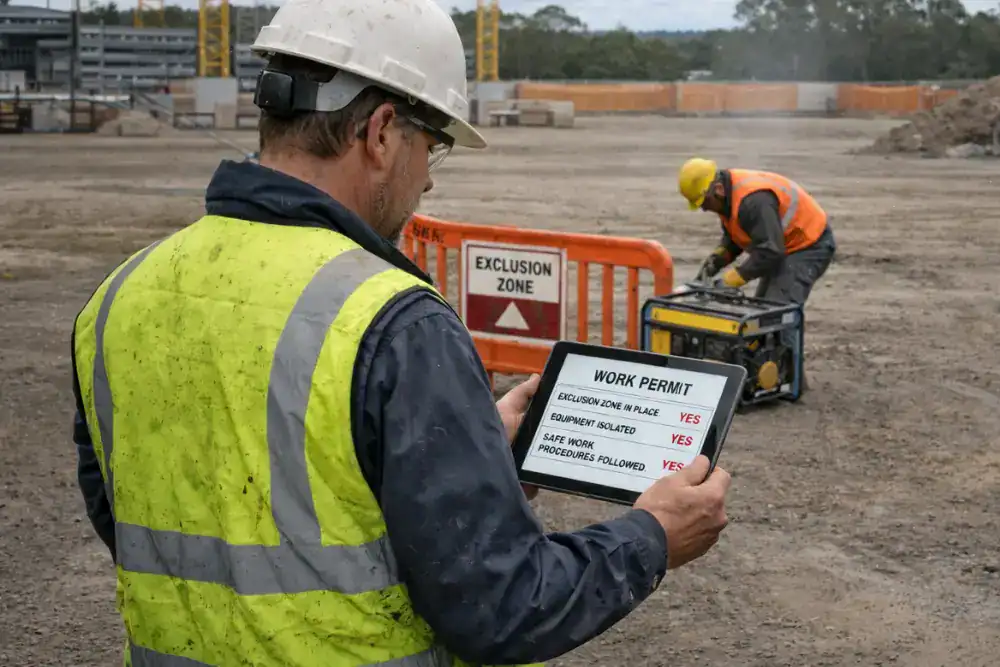
A permit to work functions as a control only when the signatory has independent knowledge of site conditions at the moment of signing. On complex sites with multiple contractors and concurrent activities, this is frequently not the case. The signatory works from what they have been told by the requesting party, often at a distance from the location, often under pressure to avoid delaying the job. The document records a verification that did not take place.
Reviewing whether permits were issued does not reveal this. The check that exposes it is physical: does the condition recorded on the permit exist at the location while the permit is live?
Supervision Present in Name, Not in Reach
Supervision is treated as a staffing question: is someone with the supervisor role on site? The question that determines whether supervision is actually functioning is different. Can the supervisor, given workload, span of control, site geography, and the number of concurrent high-risk tasks, actually observe and intervene at the point of work?
A supervisor carrying responsibility for six simultaneous high-risk activities across a large site cannot supervise any of them in any meaningful sense. The consequence is not merely inadequate oversight. It is a false assurance that no one is positioned to correct, because the record shows a responsible person was present and nothing flagged the gap. Defining supervision as a job title without specifying what the holder can realistically observe creates paper compliance and nothing else. HSG159 addresses supervisory ratios and the principle that supervision must be proportionate to the risk, not the headcount (HSE, 2011).
When Site Practice Drifts from the Written Procedure
The failure mode that document audit cannot detect by design is deviation that accumulates gradually. A shortcut is taken. No consequence follows. The task completes. The shortcut is repeated. Over time it becomes how the job is done. Not because workers are careless, but because the working conditions made it the rational choice and the system produced no corrective signal.
This pattern is not detectable by document review. The method statement records what the procedure was when it was written. It cannot show that the practice has moved on since. The audit finds no defect because it is checking the document, not the work. Only observation at the point of work detects the gap. Permit reviews, pre-use checks, and induction records cannot.
The pressure that drives deviance is programme pressure: the adjacent trade needs access, the delivery is early, the task needs to finish before shift end. Workarounds that resolve those pressures without immediate harm are repeated until they are normal. The assurance question is whether the monitoring system is positioned to see that, not whether workers intended to deviate.
Why Does Near-Miss Data Rarely Reach the Work It Should Change?
A near miss is a signal that something in the control system did not hold. The outcome was chance. The conditions that produced it were not. Organisations that treat near-miss reporting as a paperwork obligation – logging events to meet their RIDDOR duty and closing the record – satisfy the legal threshold while discarding the information that could prevent the next incident (RIDDOR 2013).
When Logging Replaces Learning
A prospective cohort study found that adequate response to near misses correlates directly with lower accident rates over the following year (Inagaki et al., 2024). Adequate response meant investigating root causes, taking corrective action, and verifying that physical conditions had changed. Organisations that only logged reports saw no such reduction. A near miss recorded but not acted on leaves the conditions that produced it unchanged. The next near miss occurs in the same conditions. At some point, the outcome is different.
In most contractor environments, the failure is not that near misses go unreported. It is that they are logged and closed without reaching the next shift, crew, or subcontractor working in the same conditions. The corrective action exists inside the management system. It does not reach the work.
Why Workers Stop Reporting
Under-reporting compounds this. Before raising a concern, workers on site make a calculation: what happens to me if I report this, against what happens if I stay quiet? Research on worker reporting behaviour consistently finds that when the answer to the first question is unclear or negative, reporting stops (Noort, Reader and Gillespie, 2019). Three site-level conditions consistently suppress it:
- Reporting is treated as an accusation rather than information, so raising a concern carries personal risk for the individual doing it.
- Past reports produced no visible response, leaving workers with no evidence that raising concerns made any difference.
- Reporting carries reputational or contractual risk for subcontractors whose continued engagement depends on the principal contractor’s goodwill.
The organisation loses its most reliable early warning signal and replaces it with silence, which the management information system may record as safety.
What Near-Miss Reporting Requires to Work
The HSE near-miss guidance and CIRAS confidential reporting model identify three conditions as prerequisites, not optional features (HSE, 2021; CIRAS, n.d.):
- Reporters can remain anonymous – without anonymity, the identity of the reporter cannot be separated from the content of the report, and the risk calculation changes immediately.
- Reports do not result in blame or sanction – once one report leads to a consequence for the reporter, others observe the outcome and adjust their behaviour accordingly.
- Reporters can see that something changed because of what they raised – without visible follow-through, reporting carries personal risk and produces no observable return, which means the calculation against reporting wins.
An organisation with a near-miss log but without those conditions is not recording an absence of incidents. It is recording an absence of reports.
What Determines Whether Training Produces Safe Behaviour on Site?
Training records document that a worker received instruction at a point in time. They do not show whether the trained behaviour is observable today, at the point of work, under current site conditions, with this crew and this equipment.
A worker trained for confined space entry six months ago, on a different site, with different equipment, carries that qualification into conditions where none of it applies. The gap is not in the training. It is in the assumption that training transfers reliably across contexts without task-specific briefing to bridge it.
Trained behaviour degrades under predictable conditions. Crew changeovers dilute site-specific knowledge. Equipment substitutions change the physical procedure without a corresponding briefing. Programme pressure makes the shortcut the faster and apparently cost-free choice. The working environment determines whether the trained method is the easiest available. If it is not, deviation follows regardless of what the training record shows.
A site induction that covers fire evacuation, PPE policy, and reporting procedures produces a documentation record. What determines behaviour on site is more specific: does the worker know the hazards of this task, in this location, under conditions that exist today? Can they name what should make them stop? Task-level briefing by someone with direct knowledge of the controls in place, at the start of the activity, is what answers those questions (HSE, 2013).
How Can Safety Managers Test Whether Controls Are Actually Holding?
A gap between the permit and the site is more than a site-level compliance finding. It is evidence that the permit-signing process is not connected to physical verification, which means the same failure will occur on every permit until the process changes. That is the distinction between a compliance check and a system diagnostic.
Permit-to-Work: Verify the Condition, Not the Document
Select one live high-risk task operating under a permit. Without notice, go to the location and compare what the permit specifies against what is physically present: isolation confirmed, exclusion zone in place, access controls as described.
If the condition the permit describes is not present on site, someone signed to confirm a state they did not verify. That is a process failure, not an execution failure. The same gap will appear on every permit until signing requires physical presence at the location.
RAMS to Site: Check What the Plan Assumed
Take the method statement for a current high-risk activity. Go to the location before the first five minutes of work are complete. Compare what the RAMS specifies against what is being used and how the work area is configured.
PPE on site that does not match the RAMS specification is not primarily a procurement failure. It indicates the method statement was written without reference to what was actually available for this task on this site – a generic document applied without task-specific review. It will produce the same gap on the next job.
Individual Competence: Two Questions the Training Record Cannot Answer
Go to the individual doing the task, not the supervisor or site manager. Ask two questions: What will make you stop this job? What has changed on site since the plan was written?
A worker who cannot name the stop criteria for this task has not internalised them, regardless of what the induction record shows. A worker who cannot describe what has changed on site since the plan was written has not received task-specific briefing reflecting current conditions. Neither gap is visible from a sign-off sheet, because sign-off sheets record attendance, not understanding.
Near-Miss Loop: Verify the Action, Not the Entry
Take three near-miss reports from the last month. For each one, identify the corrective action recorded. Go to the location and check whether it was implemented and whether it changed the physical set-up.
A logged action that was never carried out on site means the feedback loop closed on paper only. The conditions that produced the near miss remain in place. How many corrective actions from near-miss reports were actually implemented on site – not just marked complete in the system – tells you more about the real state of your safety programme than the total count of events logged. Most management dashboards do not show this figure.
What Makes Contractor Assurance Reliable on Site?
The failures described in this article are not failures of documentation. The documentation, in most cases, was in order.
What makes contractor controls hold in practice is not the volume of documentation or the existence of training records. It is whether someone verifies, in real conditions, that the permit matches the site, the task is being carried out as planned, competence applies to the individual doing the work that day, and corrective action has physically changed the job.
Human Focus’s Contractor Safety Management course is aimed at those overseeing contractor work and covers the same practical issues discussed here: checking whether permits reflect site conditions, testing competence at the task level, and verifying that corrective actions reach the work. As with any training, its value depends on whether those checks are reinforced through supervision, task briefing, and direct observation on site.