Stress is one of the most common causes of long-term absence and reduced productivity. It often builds gradually, and workers may not recognise the signs until the effects are already serious.
This CPD-certified Stress Management Training helps workers understand how workplace stress develops, recognise the early warning signs, and take practical steps to prevent it from affecting their health and performance. It gives staff a clear, structured approach to managing pressure before it becomes a problem.
This course is designed for workers in any role or sector where work-related pressure may affect health, wellbeing or performance, including:
Employees and operatives
Team leaders and supervisors
Line managers
HR and Operations managers
Occupational health advisers
Customer service staff
Course Content
This course is a single module containing the following sections:
Understand the difference between everyday pressure and stress. Learn how the body’s fight-or-flight response works, why it evolved and how prolonged activation leads to health problems.
Recognise the physical, psychological and behavioural effects of stress, including headaches, anxiety, sleep problems and reliance on unhealthy coping habits. Understand how these effects worsen when stress is ongoing.
See how different people respond to the same situation in different ways. Understand why the fight-or-flight response is not well suited to modern, long-term pressures and how this creates the conditions for stress-related illness.
Learn how to spot early signs of stress in yourself, including irritability, low mood and physical symptoms. Understand how to identify the work and personal factors that may be contributing and why stress typically results from a combination of pressures.
Recognise how unhelpful thinking patterns such as all-or-nothing thinking, overgeneralising and self-labelling can distort workers’ view of a situation. Learn how to test perceptions and develop more accurate, constructive responses.
Understand why raising concerns is essential and how to do it constructively. Learn how employers have a responsibility to manage work-related stress risks and how workers play a key role in identifying problems and supporting solutions.
Learn the practical steps that help manage stress day to day, including exercise, rest, healthy eating and reducing reliance on alcohol, caffeine and smoking. Understand when and how to seek help before problems escalate.
What Your Staff Will Learn
Workers who complete this course will understand:
How to recognise the difference between normal workplace pressure and harmful stress
How the body’s fight-or-flight response works and why prolonged activation causes health problems
The physical, psychological and behavioural effects of ongoing stress
How to identify the personal and workplace factors that contribute to stress building up
How unhelpful thinking patterns can distort their view of problems and make stress worse
The practical steps to take when pressure starts to become a problem
How to raise concerns at work and support early intervention
How exercise, rest, diet and seeking help protect against long-term harm
Available in 20+ Languages
Course subtitles are available in multiple languages, including:
This course is certified by the Continuing Professional Development (CPD) Certification Service.
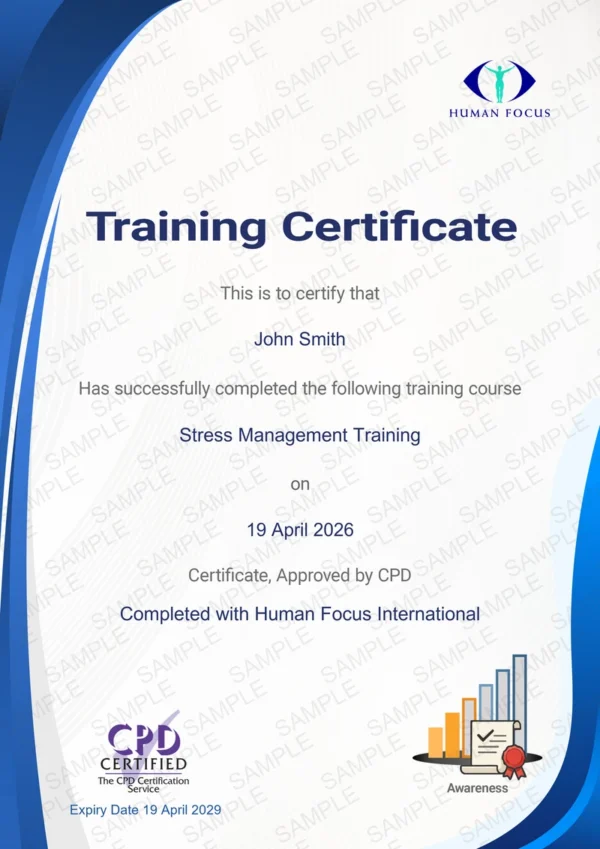
The course certificate includes:
User name
Company name
Course name
Completion date
Expiry date
Approval body
A CPD-certified Stress Management Training certificate will be available for download and printing instantly upon course completion.
Users must complete an assessment before earning their certificate.
The end-of-course test is:
Fully online
Multiple choice
A score of 80% is required to pass.
Course attempts
Each licence includes one attempt at the final knowledge assessment.
If a trainee does not pass and wishes to try again, an additional licence is required. For their second attempt, the trainee can retake the assessment without repeating the course content.
Customer Feedback
Why Stress Management Training Is Important
Stress is one of the leading causes of workplace absence and reduced productivity. It affects workers in every sector and at every level. Unmanaged stress leads to higher absence rates, lower performance, increased staff turnover and a greater risk of serious health problems.
The difficulty with stress is that it builds gradually. Workers may dismiss early symptoms such as poor sleep, irritability or difficulty concentrating as temporary or unimportant. Workers who cannot recognise the signs are unlikely to take action or raise concerns until the problem is already serious.
Employers have a legal duty to assess and manage work-related stress risks. This means identifying the factors that contribute to stress, taking reasonable steps to reduce them and ensuring workers know how to raise concerns. Training gives workers the knowledge to recognise pressure early and the confidence to act.
This CPD-certified course gives workers a structured, four-step approach: recognise the signs, assess the problem accurately, take action and support their own wellbeing. It helps shift the response from ignoring problems to addressing them early, which is where intervention is most effective.
How This Training Helps Your Organisation
This course helps organisations:
Improve workers’ ability to recognise stress early, before it leads to absence or health problems
Support compliance with employer duties to assess and manage work-related stress risks
Encourage workers to raise concerns and participate in identifying workplace stressors
Reduce reliance on unhealthy coping habits by teaching practical self-management strategies
Strengthen a workplace culture where stress is managed openly rather than ignored
Start Stress Management Training Today
Give your workers the knowledge they need to recognise when pressure is becoming harmful and take action before it affects their health, their work or your organisation. This training helps build a workplace where stress is understood, managed early and not left to escalate.
Frequently Asked Questions
This Stress Management Training costs £25 + VAT per learner. Discounts are available on bulk purchases.
This course takes 25 or more minutes to complete. It is self-paced, so learners can work through it at a time that suits them, on desktop, tablet or mobile.
The 5 C’s of stress management are Commitment, Control, Challenge, Connection and Care. Together, they describe the personal and environmental factors that help people remain resilient under pressure.
Commitment: finding meaning in work and daily life
Control: a person’s sense of agency over their situation
Challenge: framing demands as opportunities rather than threats
Connection: the protective role of relationships and support networks
Care: the physical foundations of resilience, including sleep, diet and exercise
This course addresses several of these directly. Workers learn to identify what is driving their stress, challenge unhelpful thinking patterns, raise concerns at work and build practical self-care habits that protect against long-term harm.
Yes. This course is CPD-certified. On successful completion, learners receive a printable certificate confirming they have completed the Stress Management Training. The certificate can be used to demonstrate training during audits, inspections or internal compliance reviews, and training records are stored online for easy retrieval.
The 5 R’s of stress management are Recognise, Respond, Relax, Reframe and Recover. Each targets a distinct stage in the stress cycle.
Recognise: spotting the physical, psychological and behavioural signs of stress before they escalate
Respond: taking deliberate action rather than ignoring the problem
Relax: rest, exercise and recovery habits that lower physiological arousal
Reframe: challenging the thinking patterns that distort how people perceive pressure and threat
Recover: returning to full functioning after a stressful period
This course covers comparable ground, giving workers a structured four-step approach that addresses awareness, accurate problem assessment, practical action and sustained self-support.