PUWER Compliance Management for Warehouse and Logistics Duty Holders
schedule
Course Duration: Approximately 4 hours
This IIRSM-approved PUWER Compliance Management for Warehouse and Logistics Duty Holders course provides clear, practical guidance on selecting, providing and overseeing warehouse work equipment.
It helps duty holders distinguish machinery supply requirements from ongoing responsibilities under the Provision and Use of Work Equipment Regulations 1998 (PUWER). A consistent approach supports equipment risk assessments, inspection arrangements and records that reflect actual warehouse tasks and operating conditions.
For duty holders responsible for selecting, providing or maintaining work equipment in warehouse and logistics operations:
Warehouse Managers
Logistics Managers
Operations Managers
Plant and Equipment Managers
Maintenance Managers
Health and Safety Managers
Course Content
The course contains the following modules:
Identify which PUWER duties apply to warehouse work equipment and who is responsible for meeting them. Distinguish manufacturer and supplier obligations from the employer’s ongoing responsibilities for selection, use and modifications.
What is PUWER?
Duties & Responsibilities
Legal Duties of Manufacturers & Suppliers
How Equipment Safety Works
Case Study
Identify the Essential Health and Safety Requirements (EHSRs), standards and conformity information relevant to warehouse machinery. Assess the implications of proposed modifications and recognise when specialist advice is needed.
Conformity to Community Requirements
Essential Health & Safety Requirements
Harmonised Technical Standards
Design Stage Risk Assessment
Technical File
Markings
Declaration of Conformity
Machinery Modifications
Apply machinery safety principles when selecting or approving warehouse equipment. Assess guarding, safety devices, energy isolation and safe systems of work (SSW) against foreseeable operation, cleaning and maintenance.
Eliminate & Reduce at the Manufacturing Stage
Eliminate & Reduce at the Procurement Stage
Engineering Controls: Safeguards
Engineering Controls: Types of Guards
Engineering Controls: Types of Safeguarding Devices
Engineering Controls: Other Safeguards
SSW: Energy Isolation
SSW: Information, Instruction & Training
Mitigation : Markings & Warnings
Determine the safety requirements equipment must meet before and during warehouse use. Assess controls for specified hazards, temperature, lighting, restricted use, control systems, stability and maintenance.
Specified Hazards
Temperature
Lighting
Specific Equipment Risks
Specific Risks & Restricting Use
Hardware Controls
Stability
Maintenance
Assess equipment against actual warehouse tasks and conditions. Identify hazards, establish who may be harmed and select proportionate controls, with recorded findings and review when circumstances change.
Facts About Work Equipment Accidents
Identify the Hazards
Decide Who Might Be Harmed & How
Evaluate the Risks & Decide on Precautions
Record Your Findings
Review Your Assessment
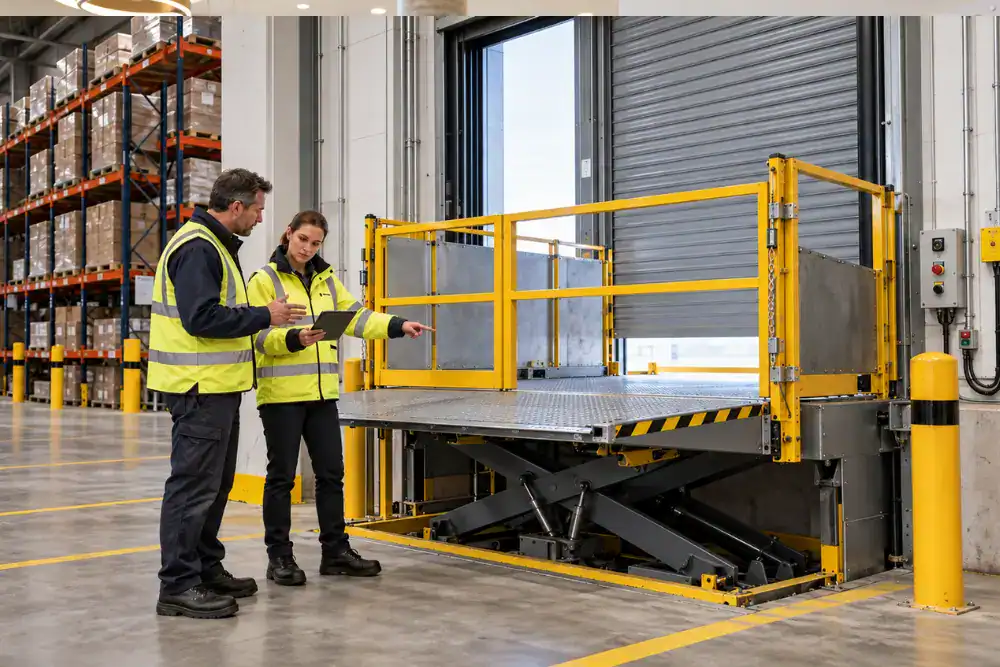
Assess goods unloading with a warehouse hydraulic scissor lift using the five-step risk assessment process. Address gaps in precautions, record findings and check whether the controls remain effective.
Identify the Hazards
Decide Who Might Be Harmed & How
Evaluate the Risks & Decide on Precautions
Record Your Findings
Review Your Assessment & Update
Establish PUWER inspection arrangements with defined responsibilities, competence requirements and records. Distinguish pre-use checks, formal inspections and specialist testing.
Inspection Requirements
Equipment Identification
Purpose & Modifications
General Condition & Maintenance
Environment & Context of Use
Safety Systems – Guards
Safety Systems – Sensors
Equipment Controls
Specified Hazards
Energy Isolation
Markings & Warnings
Restricted Use
Instructions & Training
Assess inspection findings for a warehouse scissor lift, including its condition, safeguards, controls and supporting records. Record defects, identify corrective actions and follow up equipment and training concerns.
Purpose & Modifications
General Condition & Maintenance
Environment & Context of Use
Safety Systems: Guards
Safety Systems: Sensors
Equipment Controls
Energy Isolation
Markings & Warnings
Instructions & Training
Disclaimer: This course provides in-depth knowledge and training in PUWER duty holder responsibilities for work equipment. Completing it does not by itself make a learner competent or qualified for any task or role — under UK law, competence combines training, knowledge, skills and experience, and confirming it is the employer’s responsibility. It does not appoint you to the role or confer the competence to fulfil it; appointing a competent person remains the dutyholder’s responsibility.
What You Will Learn
Identify PUWER’s purpose, scope and duty-holder responsibilities for warehouse work equipment.
Identify machinery EHSRs and how supply requirements relate to ongoing duties during equipment use.
Apply machinery safety principles when selecting or approving equipment for warehouse operations.
Determine the safety requirements work equipment must meet before and during use.
Carry out and evidence a suitable risk assessment for warehouse work equipment.
Identify assessment gaps and select precautions for warehouse scissor-lift unloading.
Establish and maintain PUWER inspection arrangements, including responsibilities, competence and records.
Apply inspection requirements to a warehouse scissor lift, recording findings, corrective actions and evidence of follow-up.
Available in 20+ Languages
Course subtitles are available in multiple languages, including:
This course is approved by IIRSM – the International Institute of Risk & Safety Management.
The course certificate includes:
User name
Company name
Course name
Completion date
Expiry date
Approval body
An IIRSM-approved course certificate will be available for download and printing instantly upon course completion.
Users must complete a final theory test before earning their certificate.
The end-of-course test is:
Fully online
Multiple choice
A score of 80% is required to pass.
Customer Feedback
Why Is PUWER Duty Holder Training Important?
Relying on supplier assurances can leave warehouse equipment risks unassessed once machinery enters use. Unsuitable equipment, ineffective guarding or failed isolation can cause serious injuries during operation, cleaning or maintenance.
PUWER and the Health and Safety at Work etc. Act 1974 require employers to manage work equipment risks. Equipment must be suitable, maintained and inspected where required, with adequate information, instruction and training. Machinery supply checks under the Supply of Machinery (Safety) Regulations 2008 do not replace these ongoing duties.
In practice, generic assessments and informal inspections can miss risks created by the warehouse’s layout, traffic and working methods. Unclear responsibilities or incomplete records can also leave defects and corrective actions unresolved.
This training helps ensure:
Duty holders distinguish supplier responsibilities from their own ongoing PUWER duties.
Equipment selection reflects intended tasks, users and operating conditions.
Risk assessments address foreseeable use, cleaning, fault clearance and maintenance.
Inspection arrangements have defined responsibilities, suitable competence and consistent records.
Inspection findings lead to recorded corrective actions and appropriate follow-up.
A consistent approach gives warehouse and logistics duty holders clearer priorities for equipment selection, assessment and inspection. Recorded findings and follow-up actions support oversight as equipment and working conditions change.
How This Training Helps Your Organisation
Clarify responsibility for work equipment after supply and installation.
Improve consistency in equipment selection and approval decisions.
Align risk assessments with actual warehouse tasks and operating conditions.
Strengthen inspection arrangements, record-keeping and corrective-action follow-up.
Support informed oversight of machinery requirements and ongoing PUWER duties.
Strengthen Equipment Decisions Across Your Warehouse and Logistics Operations
Give warehouse and logistics duty holders a consistent basis for equipment selection, risk assessment and inspection oversight. Strengthen understanding of ongoing PUWER duties, with clear expectations for assessment findings, inspection records and corrective actions.