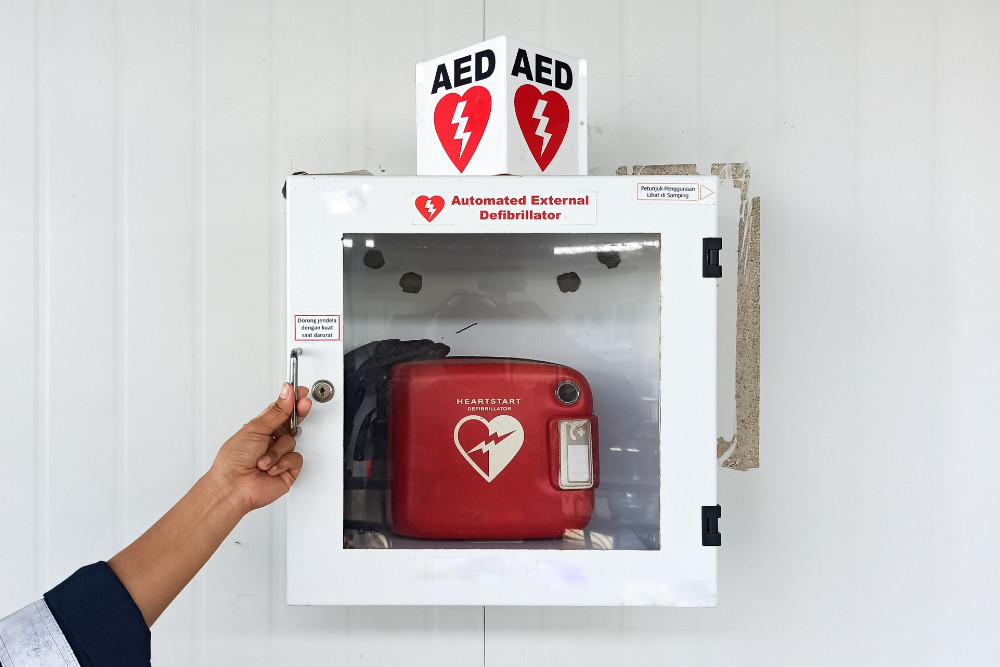
This RoSPA-assured AED Defibrillator Training course explains how to use an automated external defibrillator (AED) safely and effectively.
Users will gain awareness of how to use an AED safely and confidently in a cardiac emergency. The course covers when and how to use an automated external defibrillator, with guidance on each step of setting up and using the device. It also explains how to use an AED alongside CPR to give the casualty the best chance of survival.
This course is assured by the Royal Society for the Prevention of Accidents (RoSPA).
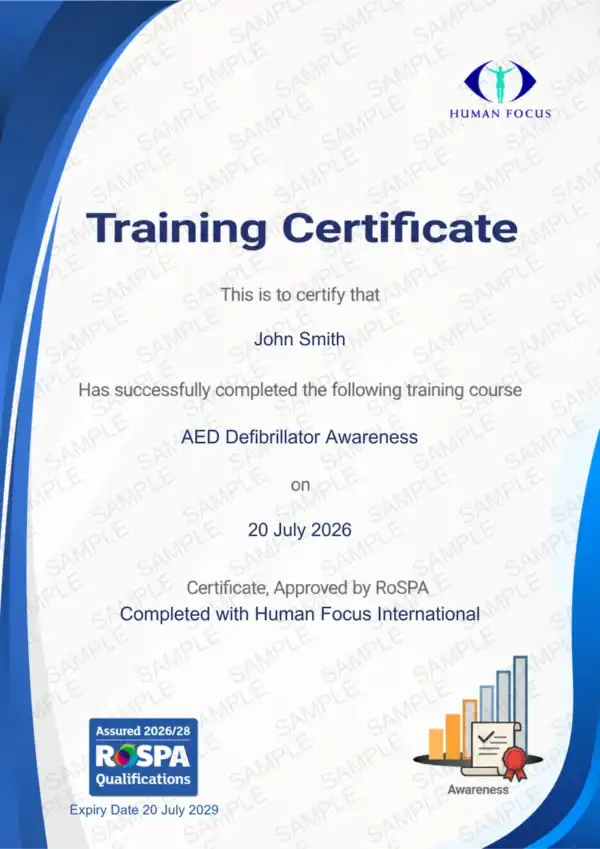
The course certificate includes:
User name
Company name
Course name
Completion date
Expiry date
Approval body
A certificate of completion will be available to download and print immediately upon completing the course.
Users must complete an assessment before earning their certification.
The end-of-course test is:
Fully online
Multiple choice
A score of 80% is required to pass.
Customer Feedback
Why is AED Training Important?
AED training provides evidence-based awareness that can help people act quickly and appropriately during a cardiac arrest.
This online AED course shows you how to spot the signs of cardiac arrest and use a defibrillator correctly in combination with CPR to help the casualty. Knowing how to set up and operate an AED prepares you to act decisively in the critical minutes following a cardiac emergency. And with state-funded schools in England now expected to have access to defibrillators following the Department for Education rollout, training on defibrillator awareness is especially useful for workers in education.
Key AED Statistics
When someone collapses in cardiac arrest, immediate CPR and early use of an AED give them the best chance of survival. The figures show how much depends on acting fast and having a defibrillator within reach.
Each year in the UK, ambulance services attempt resuscitation in around 43,000 out-of-hospital cardiac arrests, yet fewer than 1 in 10 people survive.
The latest Resuscitation Council UK data reports 30-day survival in England at 9.5%.
Every minute without CPR and defibrillation can reduce the chance of survival by up to 10%, while prompt CPR and defibrillation can more than double the chance of survival.
More than 100,000 defibrillators are registered on The Circuit, the national defibrillator network, but public-access AED use remains low — around 9% in England.
Are You Aware of Your Responsibilities?
Employers must take reasonably practicable steps to ensure a safe working environment for their employees and other visitors to their premises. As part of this responsibility, employers must assess the risks of their workplace and implement necessary control measures to prevent or mitigate harm. Specific control measures can include:
Prepare for medical emergencies such as sudden cardiac arrest
Train employees on the use of AEDs
Ensure AEDs are easily accessible within your premises
Make employees aware of defibrillator locations
Maintain AEDs in safe working order
This automated external defibrillator (AED) training supports these arrangements by helping staff recognise a cardiac arrest and understand how to use a defibrillator without delay.
About this Course
This online AED Training course equips users with an essential understanding of AEDs and how they can save lives in an emergency.
This awareness-level course will help prepare anyone to respond confidently in a cardiac emergency. Trainees learn the fundamentals of AEDs, including their purpose and operation, and how to use them effectively in emergencies.
How This Training Benefits Your Business
This course helps organisations:
Prepare employees to act quickly and confidently if someone suffers a cardiac arrest at work
Support the employer’s duty to plan for foreseeable medical emergencies
Raise staff awareness of where AEDs are located and how the devices are used
Improve the consistency of emergency response across teams, shifts and sites
Strengthen workplace safety provision for employees, visitors and members of the public
Learner Outcomes
By the end of this course, learners will be able to:
Recognise the signs of sudden cardiac arrest and respond without delay
Set up and operate an AED safely by following its voice and visual prompts
Use an AED alongside CPR to give a casualty the best possible chance of survival
Act confidently during the critical first minutes of a cardiac emergency
Understand the role AEDs play in the workplace and why early defibrillation matters
Frequently Asked Questions
AED stands for “automated external defibrillator.” It’s a portable device used in sudden cardiac arrest. It analyses the heart’s rhythm and, if needed, delivers an electric shock to help restore a normal rhythm.
This automated external defibrillator training course covers essential knowledge and awareness related to AEDs and their use in an emergency, including the following topics:
What is an AED
Emergency response
How to use an AED
This awareness-level defibrillator training course covers essential AED knowledge and can be completed in around 15 minutes.
Your training certificate will be valid for three years from the issue date. It’s recommended that any health and safety course is repeated periodically to ensure that knowledge stays relevant.
Your certificate from this course is valid for three years, so you should retake the course before it expires to keep it current.
Resuscitation skills and confidence fade over time, however, so refreshing sooner is good practice — the HSE recommends annual refresher training to help workplace responders maintain their competency. It is also worth retaking the training if resuscitation guidelines change or after an AED has been used in a real emergency.
CPR (cardiopulmonary resuscitation) involves manual chest compressions and rescue breaths to maintain blood flow and oxygenation when the heart stops beating. An AED analyses the heart’s rhythm and delivers a shock only if one is needed, helping restore a normal rhythm in certain types of cardiac arrest.
During a cardiac arrest, combining CPR with the use of an AED significantly increases the likelihood of survival.
No. Automated external defibrillators (AEDs) are designed to be used by people without specific training. They provide spoken and visual instructions that guide the user through each step, so lack of training should not stop someone using an AED in a suspected cardiac arrest.
However, training or a short awareness session can improve confidence, help people act quickly and ensure staff know where the device is kept and how it fits into CPR and emergency response procedures.
This course includes CPR awareness in the context of AED use. It explains how CPR and defibrillation work together during a cardiac arrest, but it does not provide hands-on CPR practice or assess practical CPR technique on a manikin.
If you need broader first-aid knowledge, Human Focus also offers a range of first aid courses covering CPR, AED use and other workplace emergencies.
Not specifically. There is no UK law requiring most workplaces to provide an AED or for staff to be certified to use one. However, employers do have a legal duty to assess their first-aid needs under the Health and Safety (First-Aid) Regulations 1981, and a wider duty to protect employees under the Health and Safety at Work etc. Act 1974.
Where an employer chooses to provide an AED, the Provision and Use of Work Equipment Regulations 1998 (PUWER) apply. This means the employer should ensure suitable information and written instructions are provided, such as the manufacturer’s instructions. Fuller AED training or familiarisation is strongly recommended because it can improve confidence and response times, but an untrained person should still use an AED in an emergency if one is available.
This course is priced at £25 +VAT for a single trainee. Discounted prices are available if you’re looking to make a volume purchase – speak to one of our sales team to learn more.
Yes. This course is assured by the Royal Society for the Prevention of Accidents (RoSPA).