Face Fit Testing Responsibilities for Employers

employer face fit testing duties

Face fit testing carries specific employer responsibilities where close-fitting respiratory protective equipment (RPE) is used as part of exposure control. Those responsibilities relate not just to completing a test, but to how face fit testing is understood and managed within the wider arrangements that determine whether RPE provides reliable protection in practice.

In many organisations, face fit testing is completed and recorded, but it is often treated as a standalone requirement. How the test result connects to RPE selection, issue, supervision, change management and retesting is less consistently defined. Where these links are weak, a face fit test can exist on record without providing confidence that a close-fitting seal is still being achieved at the point of exposure.

From a human factors perspective, face fit testing supports protection only when the characteristics of the wearer and the demands of the job are considered together. Fit is influenced not just by whether a respirator can seal on a person during a test, but by how that same person wears it while carrying out real work, under real conditions.

This article looks at employer responsibilities for face fit testing, and explains how face fit testing needs to sit within wider RPE and risk management arrangements if it is to support genuine respiratory protection rather than paper assurance.

What Face Fit Testing Is — and When It Applies

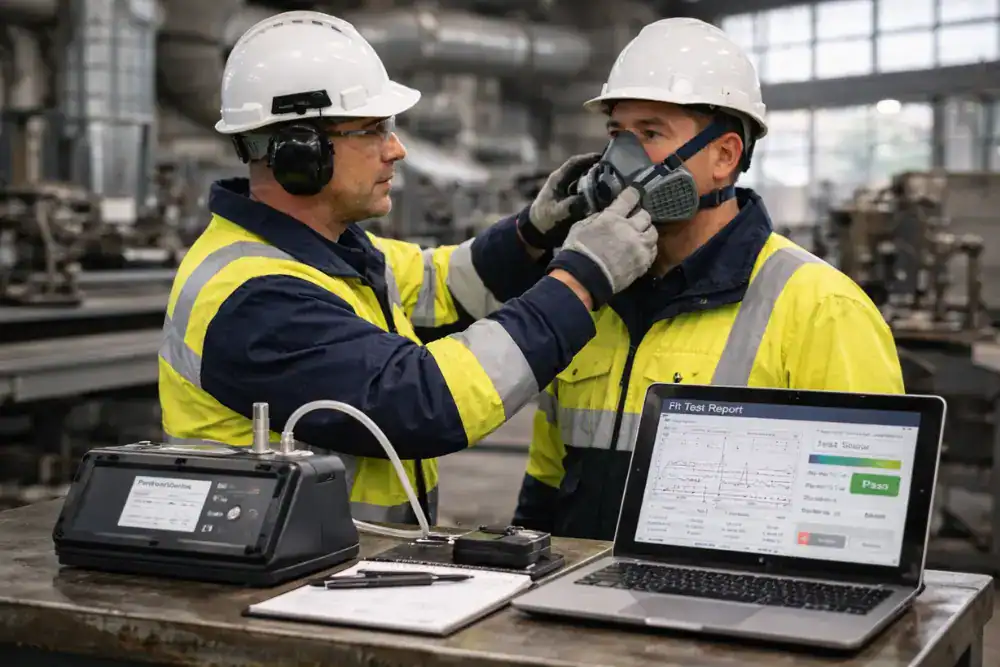
Face fit testing is the process used to confirm whether a specific close-fitting facepiece can achieve an effective seal on a specific individual when worn correctly. It does not approve a general category of respirator, nor does it guarantee protection beyond the tested configuration.

Face fit testing applies where exposure control relies on close-fitting RPE, including:

  • Disposable filtering facepiece respirators (FFP masks)
  • Half-mask respirators
  • Full-face respirators

It does not apply to loose-fitting hoods or helmets, because these do not rely on a facial seal. This does not remove employer responsibility. Employers must still ensure that any RPE provided is adequate for the hazard and suitable for the task, wearer and environment, as required under the Control of Substances Hazardous to Health (COSHH) Regulations 2002 and other regulations such as Control of Lead at Work Regulations 2002.

Employer Face Fit Testing Duties in Practice

Once an employer’s risk assessment determines that close-fitting RPE forms part of the exposure control strategy, face fit testing becomes one component of a wider system. The employer’s responsibility is not limited to whether a test has been completed, but includes whether the conditions that allow the tested seal to perform are maintained over time and under routine operating pressure.

1) Deciding When Face Fit Testing Is Required

Employers are responsible for identifying when close-fitting RPE is required and, therefore, when face fit testing must be carried out (HSE, 2013; HSE, 2025). This responsibility sits with the employer’s risk assessment and control decisions, not with the individual wearer.

Where problems arise is when RPE — and by extension face fit testing — is introduced without sufficient clarity on why higher-order controls do not adequately manage exposure. In those situations, face fit testing is asked to compensate for upstream decisions that already limit how reliable the overall control can be.

More robust practice includes:

  • Recording why substitution, enclosure, process change or local exhaust ventilation do not adequately control exposure
  • Defining the task-to-RPE specification, including contaminant, exposure profile and required protection factor
  • Designing work so time for issue, donning, seal checks and safe de-kitting is achievable without creating pressure to improvise

Face fit testing should be revisited as part of routine risk assessment review, rather than treated as a fixed compliance decision once RPE has been selected.

2) Selecting RPE That Is Adequate and Suitable

Under the Personal Protective Equipment at Work Regulations, employers must provide RPE that is adequate for the hazard and suitable for the wearer and the work (HSE, 1992; HSE, 2013).

Where close-fitting RPE is selected, suitability depends on whether a reliable seal can be achieved and sustained. Face fit testing informs this judgement, but does not remove the need to manage selection and availability over time.

In practice, risk is influenced by how selection decisions interact with procurement and substitution. When masks that appear similar are treated as interchangeable, the assumptions behind a fit test can be undermined without being noticed.

Controls that tend to reduce this risk include:

  • Maintaining a controlled range of approved makes and models that reflect different face shapes
  • Treating any change in make or model as a change to the control, rather than a like-for-like replacement
  • Using fit test outcomes to inform procurement decisions, rather than repeatedly testing designs that do not suit the workforce

RPE selection fails most often not because organisations ignore standards, but because they stop at the product and never connect it to the exposure level the risk assessment actually identified. A device carries a standard. That standard defines what the device is designed to do under test conditions. Neither of those facts confirms the device will deliver adequate protection in the job.

The operative question is whether the selected RPE meets the minimum Assigned Protection Factor (APF) required. The APF is the reduction in exposure expected when the device is correctly selected, fit-tested, and worn in real work.

Where the risk assessment identifies a required protection factor of 20, an FFP3 disposable under EN 149 or a half mask with a P3 filter under EN 140 is the minimum compliant selection. That conclusion holds only when the APF has been traced back to the risk assessment figure, not assumed from the product category.

The standards framework provides the baseline. EN 149 governs filtering half masks (FFP1 through FFP3); EN 140 covers half and quarter masks; EN 136 full-face masks; EN 137 self-contained open-circuit compressed air breathing apparatus.

Confirming conformity to the relevant standard is necessary. It is not sufficient. An FFP3 disposable on a worker with a poor facial seal or an untested fit will not deliver APF 20 in practice. For half masks with replaceable cartridges, incorrect filter selection for the contaminant present introduces an additional failure mode. In both cases, the risk assessment will have been satisfied on paper while exposure continues.

3) Ensuring Face Fit Testing Is Carried Out by a Competent Person

Employers must ensure that face fit testing is carried out by a competent person, whether testing is delivered in-house or outsourced (HSE, 2025). Outsourcing testing does not transfer legal responsibility away from the employer.

Competence includes appropriate training, experience and understanding of how fit testing interacts with selection, issue and real-world use (HSE, 2013). Industry schemes such as Fit2Fit provide a recognised benchmark, but competence also depends on how testing is applied in context.

A fit test confirms that a seal can be achieved under test conditions. Whether that seal is then reproduced during work depends on issue controls, donning practice and compatibility with other head-worn equipment.

Different Types of Fit Testing

Fit testing splits into two methods, and the distinction matters more than most organisations treat it. Choosing the wrong method for the facepiece type does not produce a marginal result. It produces an invalid test.

Qualitative Fit Testing

Qualitative fit testing is a pass/fail assessment. The wearer is exposed to a bitter or sweet-tasting aerosol and reports whether they detect it through the face seal. No measurement is produced. The result depends on the wearer’s sensory response, which is why the method is limited to disposable and reusable half masks, where the protection level is lower and a binary pass/fail outcome is an acceptable basis for selection. It cannot be used for full-face masks.

A qualified fit tester must administer the test regardless. The wearer’s involvement in detecting leakage does not remove that requirement, and treating it as a self-administered check is a compliance failure that surfaces quickly under audit.

Quantitative Fit Testing

Quantitative fit testing generates a numerical fit factor, a direct measurement of how well the facepiece seals against the wearer’s face. That measurable output is what makes the method suitable for full-face masks, where the protection requirements are higher and a subjective pass/fail is not an adequate basis for assurance.

It applies equally to disposable and reusable half masks. Common quantitative methods include ambient particle counting and controlled negative pressure. Both take approximately 25 minutes per test, as does qualitative testing, so scheduling and throughput planning should account for that across a workforce rather than treating fit testing as a quick administrative step.

4) Keeping Clear Records and Making Them Usable

Fit test records function as a control, not just as evidence. Their purpose is to prevent inappropriate issue and unmanaged variation.

Records should identify the wearer, the exact make, model and size tested, filter details, date/retest date, the test method used, tester competence and defined retesting triggers (HSE, 2025). If different models/makes are provided, each will need face fit testing. Where records are incomplete, inaccessible or detached from issue processes, historical passes are easily relied on even when conditions have changed.

More reliable systems make fit status checkable during supervision and issue, rather than treating records as back-office documentation.

5) Managing Facial Hair and Anything That Breaks the Seal

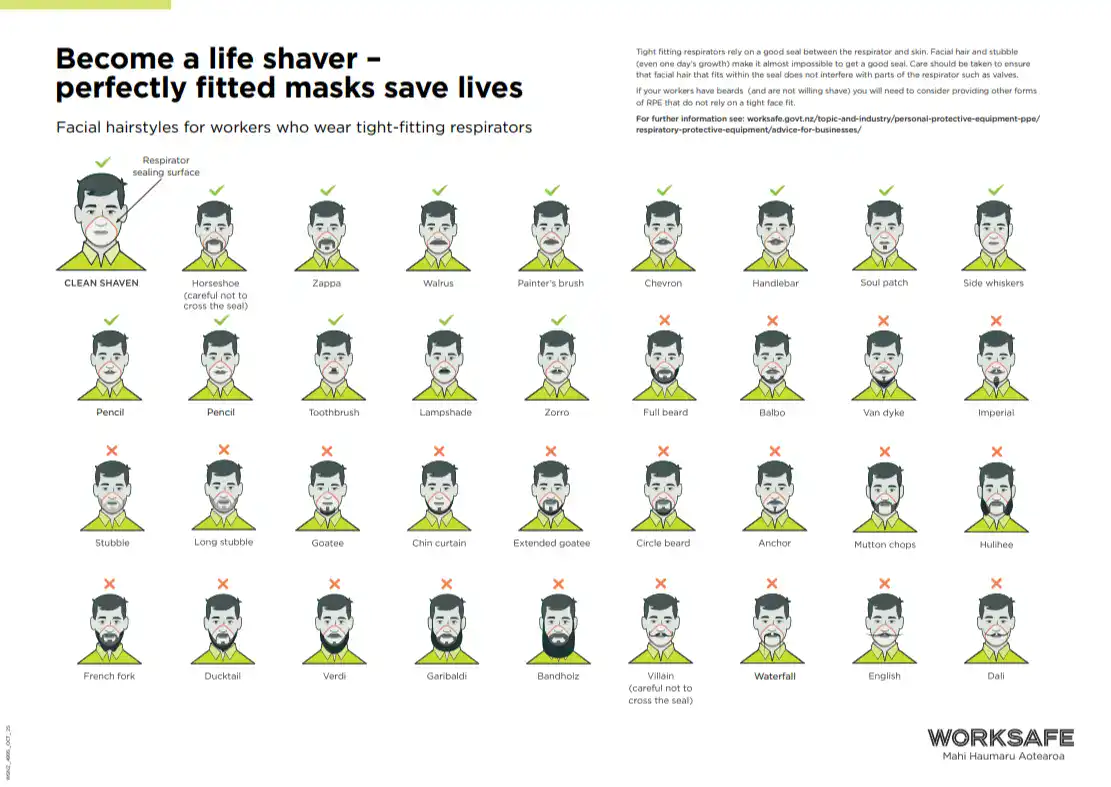
Close-fitting RPE relies on direct contact between the sealing surface and clean skin. Facial hair, stubble, dressings and some head-worn personal protective equipment can interfere with this contact and introduce leakage (HSE, 2013).

Where this constraint is not managed consistently, assurance weakens. The issue is not personal preference, but control integrity. If the seal cannot be achieved, the RPE is no longer suitable for that wearer in that configuration.

24-Hour Rule: Significant reductions in protection can occur within 24 hours of shaving, with research suggesting users should be clean-shaven within 8 hours of their shift.

In these cases, employers must consider whether an alternative form of RPE, such as a loose-fitting hood or helmet, can provide adequate protection for the hazard, and only where the risk assessment supports that conclusion.

become a life shaver

6) Repeating Face Fit Testing When Change Occurs

Employers must have arrangements in place to ensure face fit testing is repeated when changes occur that could affect fit, including changes to the RPE (make/model etc.), the wearer’s facial characteristics, or other head-worn equipment (HSE, 2025).

Retesting is the mechanism that keeps fit information current. Without defined retest triggers and follow-through, earlier results are easily treated as permanent, even when the conditions they relied on no longer apply.  Where a close-fitting respirator has failed a fit test for a wearer, it should not continue to be relied upon for exposure control while retesting or alternatives are considered.

Retesting is required when anything changes that affects how the facepiece seats against the face. Triggers include:

  • Significant weight loss or gain
  • Substantial dental work
  • Facial changes around the seal area, including scarring, moles, or the effects of ageing
  • Facial piercings
  • Introduction or change of other head-worn PPE worn alongside the respirator

Where none of those triggers apply, retesting is recommended at least every two years.[

7) Maintaining, Storing and Replacing RPE

Fit reliability is also influenced by the condition of the equipment. Seal degradation, strap fatigue and valve faults can undermine performance even where selection and testing were appropriate (HSE, 2013).

Employers are responsible for ensuring that RPE is stored, maintained and replaced in ways that preserve its function in real work. Training supports this, but it cannot compensate for inadequate storage, unclear replacement criteria or unrealistic expectations under operational pressure.

Reusable facepieces require a maintenance regime that holds in practice, not just on paper. Seals, valves and straps degrade with use and need replacing when worn, not when it becomes convenient.

Filters must be in date, matched to the specific hazard (particulate and gas or vapour filtration are not interchangeable) and changed according to the replacement schedule, not left in service until the user notices a problem.

Before each use, the wearer should complete a seal check. That check is the last verification point before exposure begins, and it only functions as a control if it is trained, expected and consistently performed.[

Keeping Face Fit Testing Reliable in Real Work

Face fit testing supports exposure control when it is treated as part of an ongoing system rather than a completed task. Risk is influenced not only by whether testing has occurred, but also by how consistently employers control selection, issue, competence, change and retesting once work is underway.

Training is necessary, but not alone sufficient. What sustains reliability is whether the fit-tested option remains available, wearable and appropriate as conditions change — and whether signals that fit may no longer hold lead to reassessment rather than workarounds.

Summary

Face fit testing is a specific employer responsibility where close-fitting respiratory protective equipment (RPE) is relied upon for exposure control. Its contribution to safety depends not only on whether testing has been completed, but on how the results are used, maintained and revisited as people, equipment and work conditions change.

A face fit test provides information about whether a particular respirator can fit a particular wearer. Whether that information continues to support protection in practice depends on how employers manage RPE selection, issue, supervision, compatibility with other equipment, and defined triggers for retesting. When these elements are weakly linked, a fit test can exist on record without providing reliable assurance at the point of exposure.

Treating face fit testing as part of wider RPE and risk management arrangements — rather than as a standalone compliance activity — is what allows it to support genuine respiratory protection rather than paper assurance.

Supporting Employer Duties

Human Focus provides IIRSM-approved Face Fit Testing training, including training for those responsible for RPE decisions and oversight. The training focuses on employer duties under COSHH and HSE guidance, and on managing face fit testing as part of a wider RPE and risk management system rather than as a one-off test.

About the author(s)

Human Focus Editorial Staff comprises a dedicated collective of workplace safety specialists and content contributors. The team shares practical guidance on human factors, risk, and compliance to support safer, more effective workplaces.

Share with others
You might also like

Popular Courses

GDPR Awareness Training Course
GDPR Training
View Course Details
LOTOTO online training course
Safe Isolation – Lock Out, Tag Out, Try Out (LOTOTO) Training
View Course Details
IOSH Managing Safely
IOSH Approved Managing Safely e-Learning
View Course Details
spill kit training
Spill Kit Hazardous Substances Training
View Course Details
Legionella Risk Assessment Training
Legionella Risk Management Principles for Responsible Persons
View Course Details

Recent Articles

Top-Rated Health and Safety Training Programs for SMEs
human factors in accident investigation
Human Factors in Accident Investigation: Why Tacit Expert Knowledge Is A Critical Missing Piece
Course Announcement Introduction to ISO 9001
Course Announcement: Introduction to ISO 9001
accident investigation interview techniques
Accident Investigation Interviews: How Existing Approaches Have Critical Blind Spots
Employment Law Training Solutions
Employment Law Training Solutions for Health and Safety Officers in the UK

Current Offers

near miss reporting for effective learning
Managing Near Miss Reporting for Effective Learning

Original price was: £895.00.Current price is: £595.00. +VAT

Sustainability and Environmental Management Training
Sustainability & Environmental Management Training

Original price was: £895.00.Current price is: £595.00. +VAT

Icon-PNG
Home Working Bundle Pack (4 in 1)

Original price was: £100.00.Current price is: £49.00. +VAT

driving for work
Driver Training Pack (5 in 1)

Original price was: £100.00.Current price is: £60.00. +VAT

driving for work
Highway Code Updates Awareness Training

Original price was: £25.00.Current price is: £15.00. +VAT